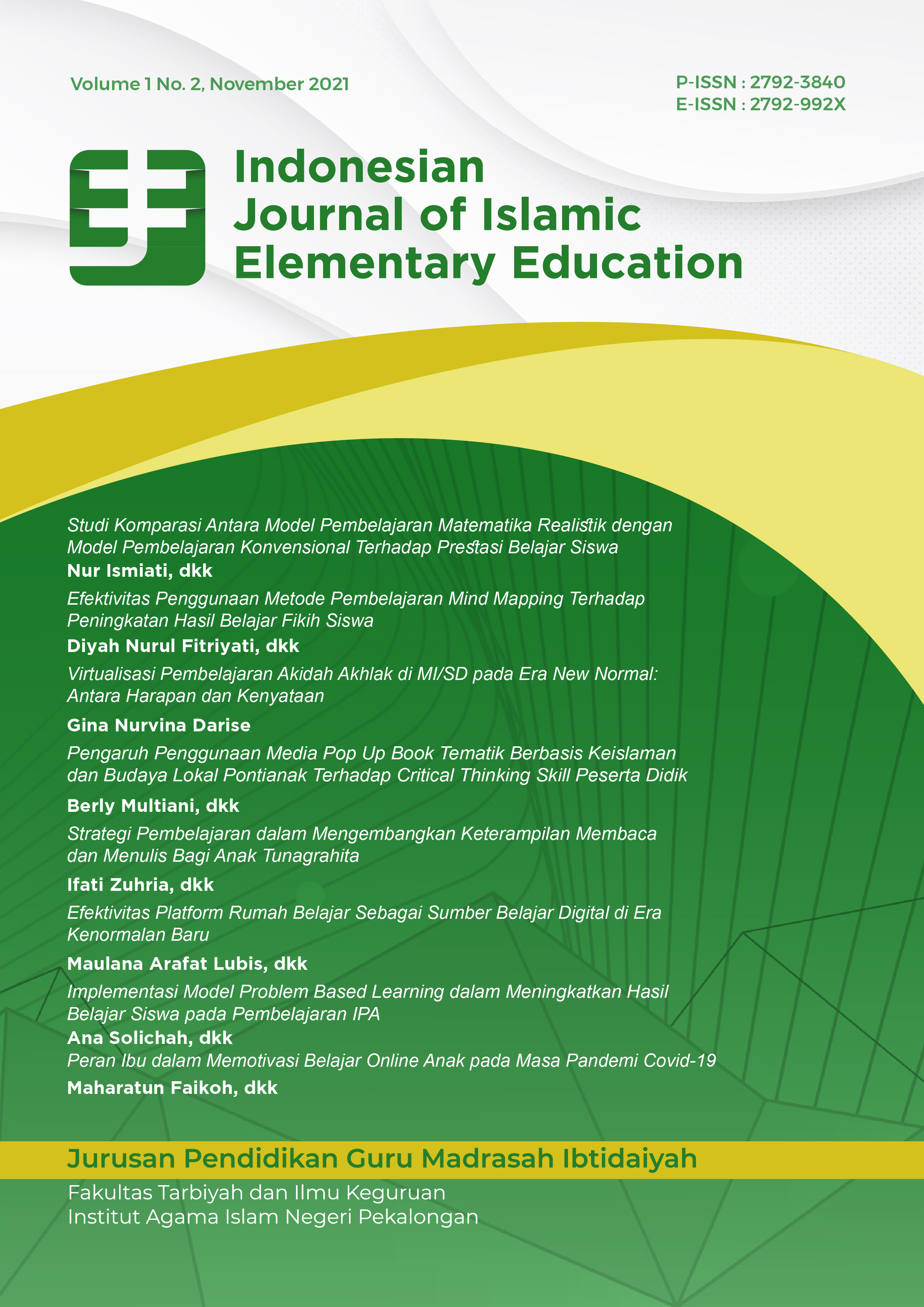
Studi Komparasi antara Model Pembelajaran Matematika Realistik dengan Model Pembelajaran Konvensional terhadap Prestasi Belajar Siswa MI Walisongo Kebonrowopucang Pekalongan
DOI:
https://doi.org/10.28918/ijiee.v1i2.4237Abstract
Mathematics is still considered a difficult subject. For this reason, in learning mathematics, it is necessary to apply a learning model that connects learning concepts so that students' lives are closer. The purpose of this study was to determine the difference in learning achievement between classes using conventional learning models and classes using PMR (Realistic Mathematics Learning) models in the mathematics learning process at MI Kebonrowopucang Pekalongan. This research is a quasi-experimental research type with a quantitative approach. Data collection techniques were carried out by test and documentation methods. The data obtained were then analyzed using the independent sample t-test analysis technique. The sampleof this research is all students of class IV A and IV B at MI Walisongo Kebonrowopucang Karangdadap. The results of this study indicate that tcount > ttable (tcount = 5,777, ttable = 2,000), then H0 is rejected and Ha is accepted. Thus, it can be concluded that there is a significant difference in students' mathematics learning achievement between those using realistic mathematics learning models and those using conventional learning models and the PMR (Realistic Mathematics Learning) learning model is better than conventional learning models.
Keywords:
References
Abdullah, Ridwan Sani. 2014. Pembeljaran Saintifik untuk Implementasi Kurikulum 2013. Jakarta: PT. Bumi Aksara.
Astuti. 2018. Penerapan Realistic Mathematic Education (Rme) Meningkatkan Hasil Belajar Matematika Siswa Kelas VI Sd, Jurnal pendidikan Matematika. Volume 1, No. 1.
Daryanto. 2014. Pendekatan Pembelajaran Saintifik Kurikulum 2013. Yogyakarta: Gava Media.
Hasratuddin. 2008. Permasalahan Pembelajaran Matematika Sekolah dan Alternatif Pemecahannya. Pythagoras, Vol. 4, No. 1.
Isrok’ atun et al. 2018. Model-Model Pembelajaran Matematika. Jakarta: PT Bumi Aksara.
Lefudin. 2017. Belajar dan Pembelajaran Dilemgkapi dengan Model Pembelajaran. Strategi Pembelajaran, Pendekatan Pembelajaran, dan Metode Pembelajaran. Yogyakarta: CV Budi Utama.
Permana, Andi Sutisna et al. 2016. Meningkatkan Pemahaman Matematis Melalui Pendekatan Tematik Dengan Rme. Jurnal Pena Ilmiah: Vol. 1, No. 1.
Rosyid, Zaiful, dkk,. 2019. prestasi belajar. Malang: CV Literasi Nusantara Abadi.
Shofiatun, Guru Kelas IV B MI Kebonrowopucang, 9 Mei 2019 pukul 09.00 WIB
Sugiono. 2015. metode penelitian pendidikan pendekatan Kuantitatif, Kualitatif, dan R&D. Bandung: Alfabeta.
Suhartati. 2016. Penerapan Pendekatan Saintifik Pada Materi Relasi Dan Fungsi Di Kelas X MAN 3 Banda Aceh. Jurnal Peluang. Volume 4, Nomor 2.
Syaodih, Nana Sukmadinata. 2006. metode penelitian pendidikan. Bandung: PT.Remaja Rosdakarya.
Downloads
Published
License
Copyright (c) 2021 Nur Ismiati, Zaenal Mustakim

This work is licensed under a Creative Commons Attribution 4.0 International License.
You are free to:
Share — copy and redistribute the material in any medium or format for any purpose, even commercially.
Adapt — remix, transform, and build upon the material for any purpose, even commercially.
The licensor cannot revoke these freedoms as long as you follow the license terms.
Under the following terms:
Attribution — You must give appropriate credit , provide a link to the license, and indicate if changes were made . You may do so in any reasonable manner, but not in any way that suggests the licensor endorses you or your use.
No additional restrictions — You may not apply legal terms or technological measures that legally restrict others from doing anything the license permits.
Notices:
You do not have to comply with the license for elements of the material in the public domain or where your use is permitted by an applicable exception or limitation .
No warranties are given. The license may not give you all of the permissions necessary for your intended use. For example, other rights such as publicity, privacy, or moral rights may limit how you use the material.