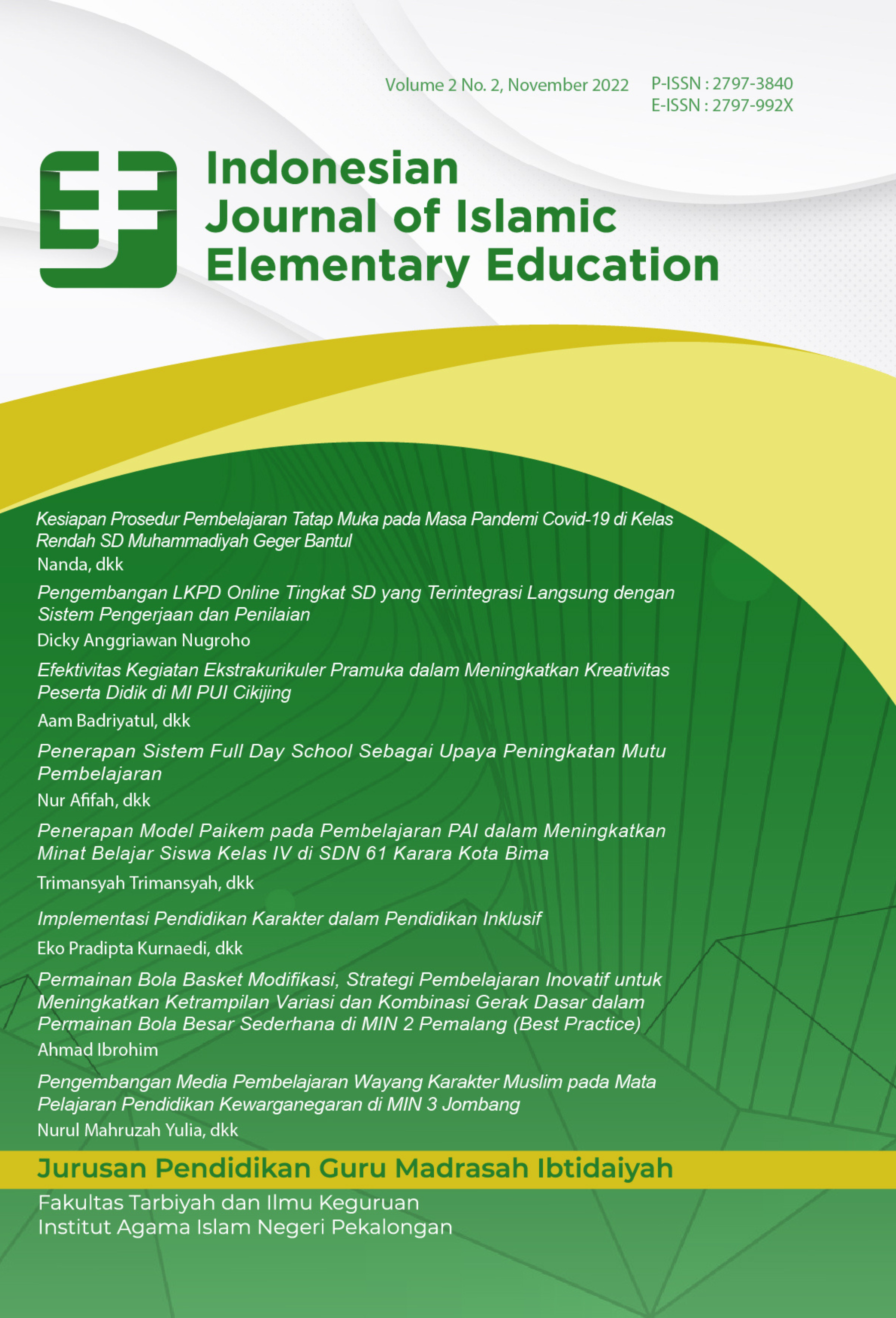
Pengembangan LKPD Online Tingkat SD yang Terintegrasi Langsung dengan Sistem Pengerjaan dan Penilaian
DOI:
https://doi.org/10.28918/ijiee.v2i2.6507Abstract
This research aims to develop onlinelearning media based on students’ worksheets which can be accessed onlineand directly integrated with the work system and assessment system. Research-based research and Development(R&D) with the 4D model Developmentmethod. The subjects of this study were experts at SDN 03 Gejlig consisting of learning media experts, material experts and 6th grade students. The research was started by collecting data based on the results of interviews and direct observation, surveys onmedia from learning media experts, surveys on material from learning material experts, and surveys on students' learning motivation using Google Forms to get results that are easy to analyze. For data analysis techniques using quantitative descriptive analysis and hypothesis testing using simple linear regression. And the results of the analysis show that the elementary school-Level OnlineStudent Worksheet-based learning media is very feasible to develop and apply because of its effectiveness in influencing student motivation and facilitating the assessment system and work on students’ worksheets.
Keywords:
References
Agustini, K., & Ngarti, J. G. (2020). Pengembangan Vvideo Pembelajaran Untuk Meningkatkan Motivasi Belajar Siswa Menggunakan Model R&D. Jurnal Imiah Pendidikan dan Pembelajaran, 62-78.
Amelia, R. (2021). Modul Smart ASN. Jakarta: Lembaga Administrasi Negara. Aristiadi, H., & Putra, R. R. (2018). Pengaruh Penggunaan Lembar Kerja Peserta
Didik (LKPD). Bioedusiana, 77-84.
Brandao, J., & Carvalho, V. (2014). "Game Quiz" - Implementin a Serious Game Platform Based in Quiz Games For The Teaching of Information and Technology. International Conference on Remote Engineering and Virtual Instumention, 47-50.
Kimura, N. (2020). Programming Workshops of Quiz Game for Children in three Municipalities in Hokkaido. IEEE TALE2020 - An International Conference on Engineering, Technology and Education, 942-944.
Markic, M. (2017). Evaluation of Quiz Using a Statistical Calculation in Learning Management System. International Conference on Software, Telecommunications and Computer Networks (SoftCOM).
Pratama, R. A., & Saregar, A. (2019). Pengembangan Lembar Kerja Peserta Didik (LKPD) Berbasis Scaffolding Untuk Melatih Pemahaman Konsep. Indonesian Journal of Science and Mathematics Education, 84-97.
Saeidi, A., Williams, A., Bushwell, N., Mumm, D., & Denaro, K. (2018). Can adding discussion-only active learning increase student learning in materials science class? IEEE Frontiers in Education Conference (FIE).
Sun, H., Zhang, H., & Zheng, Q. (2018). Data Model Building for Online Teachers' Professional Development. Seventh International Conference of Educational Innovation through Technology (EITT), 250-253.
Zain, N. N., Sayekti, I. C., & Eryani, R. (2021). Problematika Pembelajaran Daring pada Peserta Didik di Sekolah Dasar. Jurnal BASICEDU, 1840 - 1846.
Downloads
Published
License
Copyright (c) 2022 Dicky Anggriawan Nugroho

This work is licensed under a Creative Commons Attribution 4.0 International License.
You are free to:
Share — copy and redistribute the material in any medium or format for any purpose, even commercially.
Adapt — remix, transform, and build upon the material for any purpose, even commercially.
The licensor cannot revoke these freedoms as long as you follow the license terms.
Under the following terms:
Attribution — You must give appropriate credit , provide a link to the license, and indicate if changes were made . You may do so in any reasonable manner, but not in any way that suggests the licensor endorses you or your use.
No additional restrictions — You may not apply legal terms or technological measures that legally restrict others from doing anything the license permits.
Notices:
You do not have to comply with the license for elements of the material in the public domain or where your use is permitted by an applicable exception or limitation .
No warranties are given. The license may not give you all of the permissions necessary for your intended use. For example, other rights such as publicity, privacy, or moral rights may limit how you use the material.