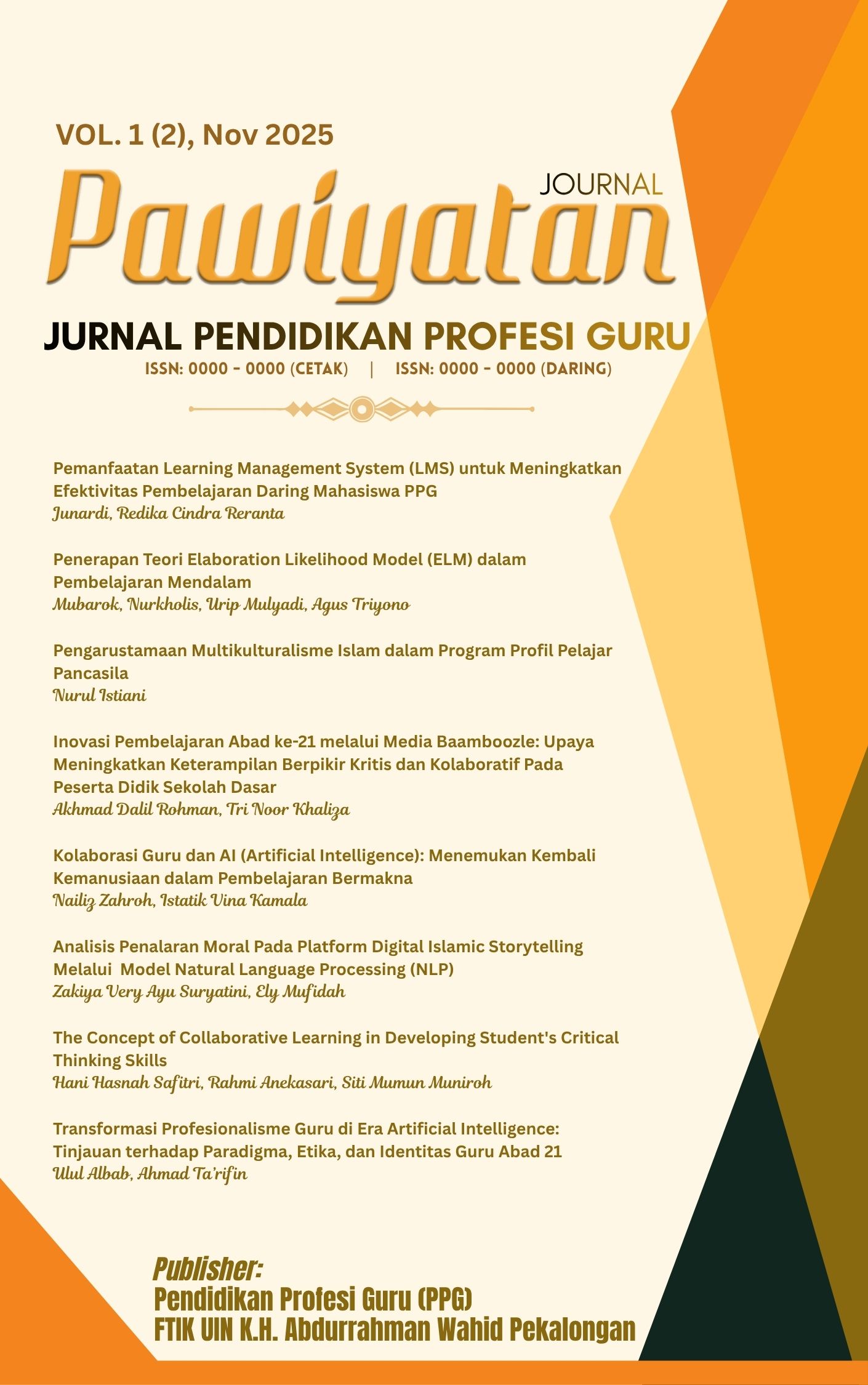
Transformasi Profesionalisme Guru di Era Artificial Intelligence: Tinjauan terhadap Paradigma, Etika, dan Identitas Guru Abad 21
DOI:
https://doi.org/10.28918/kzwkcw53Abstract
The integration of Artificial Intelligence (AI) into education has fundamentally transformed the epistemological, ethical, and professional dimensions of teaching. This study aims to critically examine the transformation of teacher professionalism in the AI era through a reflective and analytical qualitative approach based on library research, drawing upon scholarly journals and academic books. The findings reveal three key insights: first, teacher professionalism has shifted from a competence-oriented paradigm toward a reflective-ethical one that places moral responsibility at the core of professional identity; second, teachers’ professional identities have become increasingly reflective and transformative in responding to the algorithmic logic of digital education; and third, twenty-first-century professionalism demands the integration of three essential dimension digital competence, ethical-spiritual awareness, and social-collegial engagement. This study proposes a conceptual model of “Reflective-Ethical Teacher Professionalism in the AI Era,” emphasizing the urgent need to rehumanize education by positioning teachers as moral subjects who navigate technology with spiritual wisdom, critical reflection, and human awareness. The findings contribute to strengthening the global discourse on humanistic and ethical teacher professionalism in the age of automation.
Keywords:
References
U. Albab, A. Nurkhamidi, A. Tarifin, F. N. Hasanah, and A. Panaemalae, “Kemampuan professional kepemimpinan guru pendidikan Islam progresif,” Research Journal on Teacher Professional Development, vol. 1, no. 2, pp. 21–37, 2023.
U. Albab, A. Ta’rifin, D. Novianti, and H. H. Safitri, “Exploring the impact of augmented reality on meaningful learning in Islamic religious education: A quantitative analysis,” EDUKASI: Jurnal Penelitian Pendidikan Agama dan Keagamaan, vol. 23, no. 1, pp. 1–25, 2025.
M. Baloch, A. N. Kiazai, and M. Zakir, “An investigation on the impact of school leadership on teachers’ motivation: A case of secondary schools in Mastung, Balochistan,” Journal of Quranic and Social Studies, vol. 5, no. 3, pp. 26–47, Sep.–Dec. 2025.
G. Biesta, World-Centred Education: A View for the Present. London: Routledge, 2022. [Online]. Available: https://www.routledge.com/World-Centred-Education-A-View-for-the-Present/Biesta/p/book/9780367565527
S. Bulathwela, M. Pérez-Ortiz, C. Holloway, M. Cukurova, and J. Shawe-Taylor, “Artificial intelligence alone will not democratise education: On educational inequality, techno-solutionism and inclusive tools,” Sustainability, vol. 16, no. 2, p. 781, 2024. [Online]. Available: https://doi.org/10.3390/su16020781
F. Choirunnisa and M. Ibrahim, “Reconstructing teachers’ role and learning paradigm under the Merdeka curriculum,” Jurnal Penelitian Ilmiah Multidisipliner, vol. 2, no. 3, pp. 1666–1676, 2025.
A. Ciuffoletti, “Teaching networks to digital humanists,” IEEE Transactions on Education, vol. 64, no. 3, pp. 253–260, 2020.
T. Fawns, “Post-digital education in design and practice,” Postdigital Science and Education, vol. 1, pp. 132–145, 2019. [Online]. Available: https://doi.org/10.1007/s42438-018-0021-8
M. M. Hanif, R. Riyadi, A. Ta’rifin, H. H. Safitri, and U. Albab, “Management of the research madrasah program in developing student achievement at MAN Pekalongan,” Al-Tadzkiyyah: Jurnal Pendidikan Islam, vol. 16, no. 1, pp. 129–151, 2025.
A. Harry, “Role of AI in education,” Interdisciplinary Journal & Humanity (INJURITY), vol. 2, no. 3, 2023.
N. Herawati, M. Jafari, and K. Sanders, “Teachers’ perceptions of the efficacy of positive behavior support systems,” International Journal of Education and Cognitive Sciences, vol. 5, no. 2, pp. 8–15, 2024.
P. Kahn, M. Carrigan, P. Smith, L. Murtagh, R. Liu, and F. Song, “Teacher agency and generative artificial intelligence: Teaching in higher education as a responsive, cultural activity,” Learning, Media and Technology, pp. 1–12, 2025.
L. Markauskaite, L. Carvalho, and T. Fawns, “The role of teachers in a sustainable university: From digital competencies to postdigital capabilities,” Educational Technology Research and Development, vol. 71, pp. 181–198, 2023. [Online]. Available: https://doi.org/10.1007/s11423-023-10199-z
S. D. Masitoh and D. Purbowati, “Enhancing teacher professionalism in Indonesia: Challenges and strategies for digital technology utilization in the Society 5.0 era,” HEUTAGOGIA: Journal of Islamic Education, vol. 4, no. 2, pp. 219–236, 2024.
N. Noddings, Philosophy of Education. Boulder, CO: Westview Press, 2021. [Online]. Available: https://www.routledge.com/Philosophy-of-Education/Noddings/p/book/9780367277604
OECD, AI in Education: Policy Implications and Ethical Considerations. Paris: OECD Publishing, 2023. [Online]. Available: https://www.oecd.org/education/ai-in-education-policy.pdf
A. Rahman, “Revitalisasi peran guru sebagai tenaga pendidik di era Kurikulum Merdeka,” BELEJER: Journal of Islamic Education Management, vol. 1, no. 1, pp. 1–8, 2025.
A. Tan and J. van Aalst, “Comprehensive professional learning for teacher agency in addressing ethical challenges of AIED: Insights from educational design research,” Education and Information Technologies, vol. 30, pp. 3343–3387, 2024. [Online]. Available: https://doi.org/10.1007/s10639-024-12946-y
A. Ta’rifin, A. Zubaidah, N. Ana, M. Y. Abidin, U. Albab, and H. H. Safitri, “Design of augmented reality learning media for Islamic religious education: Encouraging religious moderation in junior high schools,” AL-ISHLAH: Jurnal Pendidikan, vol. 17, no. 2, pp. 2948–2960, 2025.
UNESCO, Ethical Guidelines for Artificial Intelligence in Education. Paris: UNESCO Publishing, 2024. [Online]. Available: https://unesdoc.unesco.org/ark:/48223/pf0000388259
Y. Wang and X. Han, “Empowering teacher agency in the era of artificial intelligence: Challenges,” in Blended Learning. Sustainable and Flexible Smart Learning: 18th International Conference on Blended Learning (ICBL 2025), Bangkok, Thailand, Jul. 22–25, 2025, vol. 15721, p. 3. Springer Nature, 2025.
B. Williamson, “The social life of AI in education,” International Journal of Artificial Intelligence in Education, vol. 34, pp. 97–104, 2024. [Online]. Available: https://doi.org/10.1007/s40593-023-00342-5
B. Williamson and J. Knox, “Algorithmic governance and the politics of AI in education,” Learning, Media and Technology, vol. 48, no. 2, pp. 115–131, 2023. [Online]. Available: https://doi.org/10.1080/17439884.2023.2200341
Downloads
Published
Article Statistics
Issue
Section
License
Copyright (c) 2025 Pawiyatan: Jurnal Pendidikan Profesi Guru

This work is licensed under a Creative Commons Attribution-ShareAlike 4.0 International License.