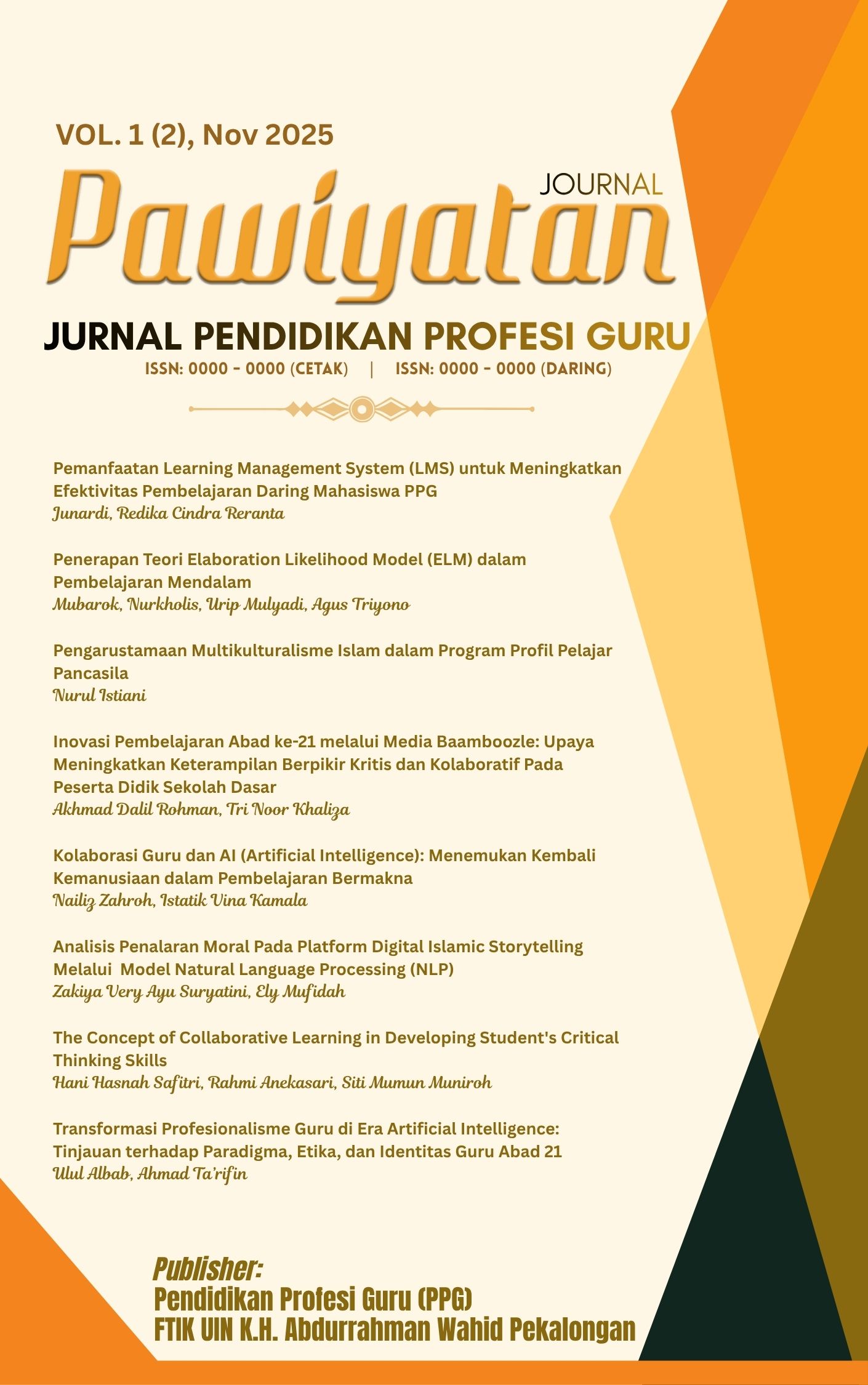
Kolaborasi Guru dan AI (<i>Artificial Intelligence</i>): Menemukan Kembali Kemanusiaan dalam Pembelajaran Bermakna
DOI:
https://doi.org/10.28918/njky9246Abstract
The advancement of Artificial Intelligence (AI) has profoundly transformed educational practices worldwide. Teachers are no longer solely knowledge transmitters but have become partners to intelligent learning systems capable of analysing data, assessing performance, and personalising learning experiences. This transformation requires a renewed understanding of teachers’ roles and responsibilities amid the increasingly complex integration of technology in education. This study aims to conceptually analyse the relationship between teachers and AI within the framework of human–machine collaboration to achieve meaningful learning. A qualitative approach with a library research method was employed. The analysis involved 30 peer-reviewed sources, analysed using inclusion–exclusion criteria, to synthesise four interconnected layers of collaboration: humanistic education as the normative foundation, reflective teachers as mediators of pedagogical decisions, meaningful learning as the intended learning outcome, and AI as an augmentative tool supporting instructional adaptation and analytic insight. These structural layers are further enriched by four theoretical dimensions—ethical, affective, cognitive, and reflective—which collectively illuminate how teacher agency and technological affordances interact. The resulting model demonstrates that AI can effectively enhance learning only when guided by reflective teacher judgment and anchored in humanistic values. The model is adaptable across primary to secondary education, with varying levels of complexity. This study offers theoretical insights into value-centred AI integration while acknowledging its limitations as a literature-based analysis. Future research is recommended to empirically validate the model across subjects and learning contexts.
Keywords:
References
Anderson, T., & Dron, J. (2022). Applications of artificial intelligence in education: A review and future directions. Educational Technology Research and Development, 70(5), 2145–2167. https://doi.org/10.1007/s11423-022-10123-4
Aoun, J. E. (2017). Robot-proof: Higher education in the age of artificial intelligence. MIT Press.
Bond, M., Marín, V. I., Dolch, C., Bedenlier, S., & Zawacki-Richter, O. (2021). Digital transformation in learning environments: A meta-analysis. Computers & Education, 168, 104–212. https://doi.org/10.1016/j.compedu.2021.104212
Ding, Y., Chen, L., & Zhao, H. (2025). AI-supported learning analytics for adaptive instruction: A systematic review. Computers & Education, 204, 105–129.
Fadel, C., Holmes, W., & Bialik, M. (2023). Artificial intelligence in education: Promise and implications. Center for Curriculum Redesign.
Hadi, A., Pramesti, W., & Nurhaliza, R. (2025). Kolaborasi manusia–mesin dalam pendidikan: Strategi guru beradaptasi dengan teknologi AI. Jurnal Teknologi Pendidikan Indonesia, 14(1), 22–35. https://doi.org/10.31004/riggs.v4i2.1583
Holmes, W., Bialik, M., & Fadel, C. (2023). Artificial intelligence in education: Promise and implications. Center for Curriculum Redesign.
Huda, M., & Kurniawan, I. (2022). Pembelajaran bermakna berbasis teknologi pendidikan di sekolah. Jurnal Teknologi Pendidikan Indonesia, 10(2), 115–130.
Huda, M., & Wibowo, A. (2023). Pendidikan karakter di era digital: Relevansi nilai humanis dalam pembelajaran berbasis teknologi. Jurnal Pendidikan dan Kebudayaan, 8(2), 145–158.
Marín, V. I., & Cabero-Almenara, J. (2021). Teacher competence in the digital era: A systematic review. Education and Information Technologies, 26(5), 5301–5323. https://doi.org/10.1007/s10639-021-10563-7
Mayer, R. E. (2021). Multimedia learning (3rd ed.). Cambridge University Press.
Muqorrobin, A., Rahmawati, S., & Irawan, M. (2024). Membangun karakter di era AI: Menggabungkan teknologi dan nilai kemanusiaan. At-Ta'dib: Jurnal Pendidikan Islam, 19(1), 55–70.
Muqorrobin, M., & Dewi, F. (2023). Kolaborasi guru dan kecerdasan buatan dalam peningkatan kualitas pembelajaran. Jurnal Inovasi Pendidikan, 14(1), 45–56.
Pratiwi, L. (2023). Reflektifitas guru dalam integrasi teknologi pembelajaran: Analisis praktik pengajaran abad 21. Jurnal Penelitian Pendidikan, 40(3), 211–223.
Pratama, R., & Firmansyah, A. (2022). Pemanfaatan artificial intelligence pada asesmen pembelajaran di Indonesia. Jurnal Penelitian dan Evaluasi Pendidikan, 26(2), 178–191.
Popenici, Ş. A. D., & Kerr, S. (2017). Exploring the impact of artificial intelligence on teaching and learning in higher education. Research and Practice in Technology Enhanced Learning, 12(22), 1–13. https://doi.org/10.1186/s41039-017-0062-8
Rachman, T., & Yuliana, E. (2023). Pendidikan humanis dalam konteks transformasi digital. Jurnal Pendidikan Karakter, 13(1), 1–14.
Rosidin, U., Setiawan, A., & Rahma, F. (2024). Teknologi pembelajaran adaptif dan pembelajaran bermakna: Studi integratif. Jurnal Inovasi Pembelajaran, 12(1), 1–14.
Ryan, R. M., & Deci, E. L. (2020). Self-determination theory: Basic psychological needs in motivation, development, and wellness. Guilford Press.
Siregar, R. (2024). Pemanfaatan artificial intelligence dalam perancangan instruksional: Implikasi bagi kinerja guru. Jurnal Teknologi Edukasi, 5(2), 67–80.
Susanto, H. (2021). Perspektif guru reflektif dalam pembelajaran abad 21. Jurnal Pendidikan dan Pembelajaran, 8(3), 233–242.
Selwyn, N. (2019). Should robots replace teachers? AI and the future of education. Polity Press.
Tan, M., Liu, S., & Wong, P. (2024). Adaptive AI tutoring and learning personalization: Evidence from recent applications. Educational Technology Research and Development, 72, 455–478.
Tobin, K. (2018). Learning to teach reflectively: A meta-synthesis. Teaching and Teacher Education, 75, 120–132. https://doi.org/10.1016/j.tate.2018.06.004
UNESCO. (2021). AI and education: Guidance for policymakers. UNESCO Publishing.
UNESCO. (2023). Futures of education: Learning to become. UNESCO.
Wardati, Q., Gunawan, M. Y., Haqqiqi, M. F., & Najwa, W. (2024). Pemanfaatan teknologi AI dalam upaya meningkatkan mutu pendidikan di Indonesia. Pengertian: Jurnal Pendidikan Indonesia, 2(2), 375–392. https://doi.org/10.61930/pjpi.v2i2.702
World Economic Forum. (2022). Education 4.0: Shaping the future of learning in the age of AI. WEF.
Zawacki-Richter, O., Marín, V. I., Bond, M., & Gouverneur, F. (2021). Systematic review of research on artificial intelligence in higher education: Promises and pitfalls. International Journal of Educational Technology in Higher Education, 18(3), 1–27. https://doi.org/10.1186/s41239-021-00292-4
Zhao, Y., & Watterson, J. (2022). The ethics of AI in education: Safeguarding human agency in learning. AI & Society, 37(1), 51–62. https://doi.org/10.1007/s00146-021-01194-9
Downloads
Published
Article Statistics
Issue
Section
License
Copyright (c) 2025 Pawiyatan: Jurnal Pendidikan Profesi Guru

This work is licensed under a Creative Commons Attribution-ShareAlike 4.0 International License.