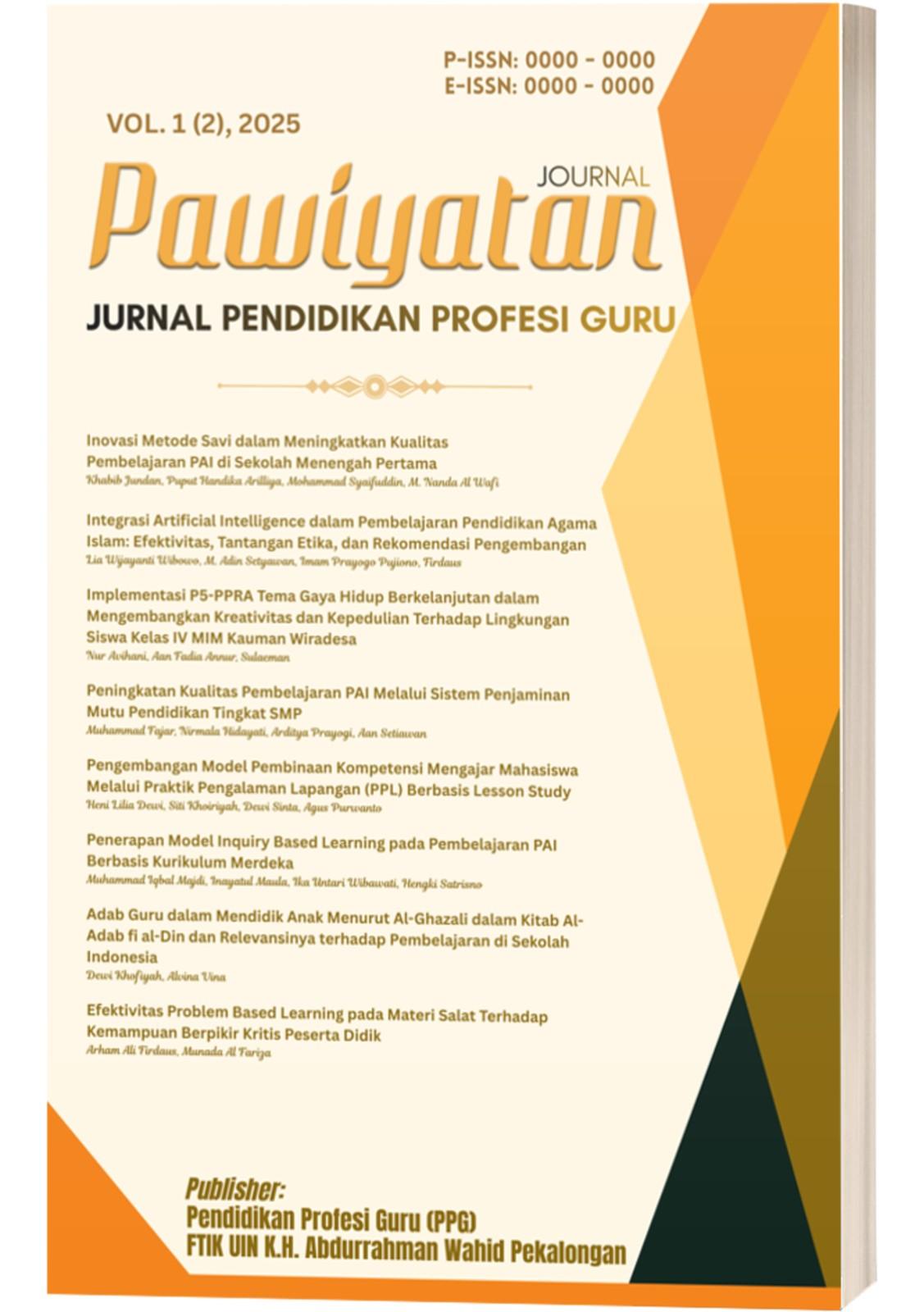
Efektivitas Problem Based Learning pada Materi Salat Terhadap Kemampuan Berpikir Kritis Peserta Didik
DOI:
https://doi.org/10.28918/czc3v480Abstract
This study is driven by the rapid changes in various aspects of human life, especially in science and technology, which demand 21st-century learning skills known as 4C: critical thinking, communication, collaboration, and creativity. However, learning activities at SMPN 1 Warungasem are still dominated by teacher-centered approaches that emphasize material comprehension through less optimal teaching models. As a result, students tend to be passive and show limited critical thinking skills. To address this issue, the research aims to examine the effectiveness of the Problem-Based Learning (PBL) model in teaching prayer (shalat) material to enhance students’ critical thinking abilities and to compare its impact with the Expository model. This research employed a true experimental design with seventh-grade students at SMPN 1 Warungasem as the population. Through simple random sampling, class VII G was assigned as the experimental group receiving PBL, while class VII D served as the control group taught with the Expository model. Data were analyzed using a one-sample t-test. The findings reveal that the significance value obtained (0.359 > 0.05) supports the acceptance of H₀, indicating that the proportion of students whose scores met the minimum mastery criteria (KKM) using PBL was ≥ 85%. Further analysis shows that 90% of students taught with PBL achieved classical mastery in critical thinking, compared to only 60% of those taught with the Expository model. Thus, the PBL approach enhanced students’ critical thinking skills by 30% more than the Expository method. This demonstrates that PBL is an effective instructional model to strengthen students’ higher order thinking in Islamic education learning contexts.
Keywords:
References
Agustin, M. (2022). Keterampilan berpikir dalam konteks pembelajaran abad ke-21: Kajian teoritis dan praktis menuju merdeka belajar. Refika Aditama.
Al-Tabany, T. I. B. (2014). Mendesain model pembelajaran inovatif, progresif, dan kontekstual: Konsep, landasan, dan implementasinya pada Kurikulum 2013. Prenadamedia Grup.
Hamruni. (2012). Strategi pembelajaran. Insan Madani.
Hardani. (2020). Model penelitian kualitatif dan kuantitatif. Pustaka Ilmu.
Hosnan. (2014). Pendekatan saintifik dan kontekstual dalam pembelajaran abad 21. Ghalia Indonesia.
Kodir, A. (2018). Manajemen pembelajaran saintifik Kurikulum 2013. Pustaka Setia.
Lismaya, L. (2019). Berpikir kritis dan PBL (Problem Based Learning). Media Sahabat Cendekia.
Mudlofir, A., & Rusydiyah, E. F. (2016). Desain pembelajaran inovatif: Dari teori ke praktik. PT Raja Grafindo Persada.
Ngalimun. (2016). Strategi dan model pembelajaran. Aswaja Pressindo.
Prayogi, A., dkk. (t.t.). Integrasi game online Mobile Legend pada pembelajaran Matematika berbasis STEAM di era Society 5.0. Prosiding Santika: Seminar Nasional Tadris Matematika. UIN K.H. Abdurrahman Wahid Pekalongan.
Rusman. (2018). Model-model pembelajaran: Mengembangkan profesionalisme pendidik. Rajawali Press.
Rusmono. (2012). Strategi pembelajaran dengan Problem Based Learning itu perlu. Ghalia Indonesia.
Sanjaya, W. (2009). Strategi pembelajaran berorientasi standar proses pendidikan. Kencana.
Sari, F. L., Fani, A., Ramdhani, M. A., Afandi, M. R., Sari, N. H. M., & Prayogi, A. (2022, September). Integrasi game online Mobile Legends pada pembelajaran Matematika berbasis STEAM di era Society 5.0. Santika: Seminar Nasional Tadris Matematika, 2, 156–167.
Sugiyono. (2013). Model penelitian pendidikan: Pendekatan kuantitatif. Alfabeta.
Suryani, N. (2012). Strategi belajar dan mengajar. Ombak.
Suprahatiningrum, J. (2013). Strategi pembelajaran: Teori dan aplikasi. Ar-Ruz Media.
Susetyo, B. (2014). Statistika untuk analisis data penelitian. Refika Aditama.
Suyono, & Hariyanto. (2016). Belajar dan pembelajaran. Remaja Rosdakarya.
Syaifuddin, M., & Taufiq, A. (2020). Strategi mindset system belajar kritis komprehensif. La-Tahzan: Jurnal Pendidikan Islam, 12(1), 94–110.
Zakia, L., & Lestari, I. (2019). Berpikir kritis dalam konteks pembelajaran. Erzatam.
Downloads
Published
Article Statistics
Issue
Section
License
Copyright (c) 2025 Pawiyatan: Jurnal Pendidikan Profesi Guru

This work is licensed under a Creative Commons Attribution-ShareAlike 4.0 International License.