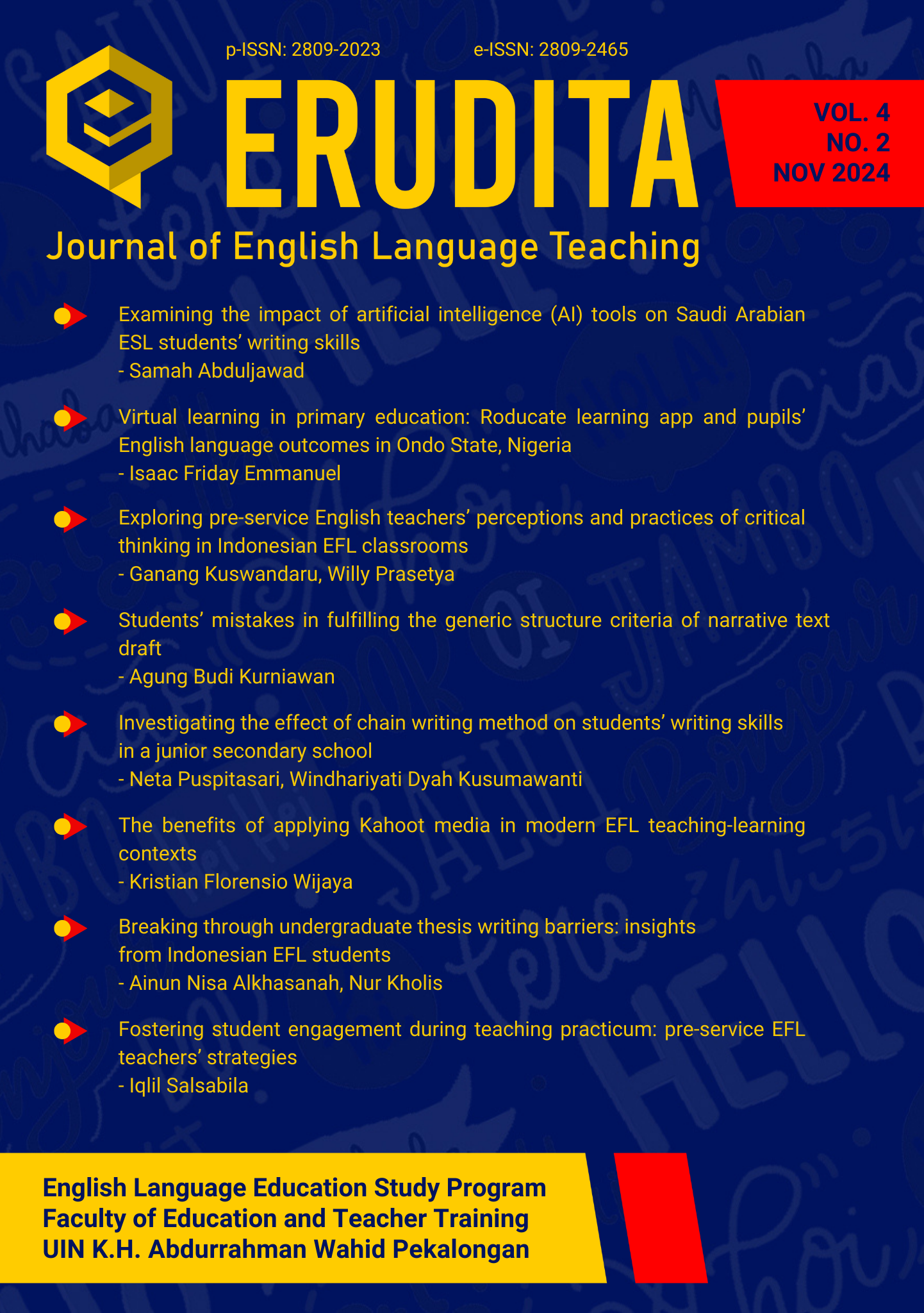
Fostering student engagement during teaching practicum: pre-service EFL teachers’ strategies
DOI:
https://doi.org/10.28918/erudita.v4i2.9311Abstract
The lack of student engagement greatly influences the implementation of the learning process. This is very important because it refers to the pre-service teacher’s ability to manage the class so that it runs effectively and involves all students. This study explores the strategies pre-service teachers use to increase student engagement. This research was designed with a case study approach. Four pre-service EFL teachers were selected as participants in the research. In collecting data, the researcher used semi-structured interview techniques and observations through video recordings of teaching carried out by each participant. The data were analyzed using thematic analysis. The findings revealed that there were six strategies used to increase student engagement during teaching practicum, including measuring student engagement, establishing good communication between pre-service teachers and students, balancing structure and student autonomy through cooperative learning methods, promoting digital media as an innovation in the learning process, providing evaluation questions, and increasing the engagement of students with exciting activities. This study concludes with pedagogical implications for how pre-service teachers can use strategies to increase student engagement in English learning during teaching practicum.
Keywords:
References
Appleton, J. J., Christenson, S. L., Kim, D., & Reschly, A. L. (2006). Measuring cognitive and psychological engagement: Validation of the student engagement instrument. Journal of School Psychology, 44(5), 427–445. https://doi.org/10.1016/j.jsp.2006.04.002
Appleton, I. (2008). Buildings for the performing arts. The Architectural Press Ltd.
Beeland, W. D. (2002, February 14). Student engagement, visual learning, and technology: A report on 10 years of ACOT research. http://education.smarttech.com/ste/en- US/News+and+research/Research/International/US/2002/Student+Engagement.htm.
Bell, K. (2006). Active learning handbook. Webster University.
Bond, M., & Bedenlier, S. (2019). Facilitating student engagement through educational technology: Towards a conceptual framework. Journal of Interactive Media in Education, 1(11), 1–14. https://doi.org/10.5334/jime.528
Braun, V., & Clarke, V. (2006). Using thematic analysis in psychology. Qualitative research in psychology, 3(2), 77–101. https://doi.org/10.1191/1478088706qp063oa
Cook, C. R., Fiat, A., Larson, M., Daikos, C., Slemrod, T., Holland, E. A., Thayer, A. J., & Renshaw, T. (2018). Positive greetings at the door: Evaluation of a low-cost, high-yield proactive classroom management strategy. Journal of Positive Behavior Interventions, 20(3), 149–159. https://doi.org/10.1177/1098300717753831
Creswell, J. W. (2012). Educational research. Pearson Education, Inc.
Dornyei, Z. (2007). Research methods in applied linguistics. Oxford University Press.
Dunleavy, J. & Milton, P. (2009). What did you do in school today? Exploring the concept of student engagement and its implications for teaching and learning in Canada. Canadian Education Association.
Eagle, J. W., Dowd-Eagle, S., Christenson, S., & Reschly, A. (Eds.). (2010). Handbook of school-family partnership. CEPS Journal, (2)1, 147–151 https://doi: 10.25656/01:11014
Gao, X., Guo, F., & Coates, H. (2022). Contributions to the field of student engagement and success. Higher Education Research & Development, 41(1), 62–74. https://doi.org/10.1080/07294360.2021.2008326
Gebhard, J. G. (2009). The practicum. In A. Burns and J. C. Richards (Eds.), The Cambridge guide to second language teacher education. Cambridge University Press.
Giang, T. T. T., Andre, J., & Lan, H. H. (2022). Student engagement: Validating a model to unify in-class and out-of-class contexts. Sage Open, 12(4), 1–20. https://doi.org/10.1177/21582440221140334
Greener, S. (2022). The tensions of student engagement with technology. Interactive Learning Environments, 30(3), 397–399. https://doi.org/10.1080/10494820.2022.2048550
Harari, O., & Covington, M. V. (1981). Reactions to achievement behavior from a teacher and student perspective: A developmental analysis. American Educational Research Journal, 18(1), 15–28. https://doi.org/10.2307/1162527
Hasdina, N., Sofyawati, E. D., Dewi, S., & Oktarina, H. (2024). Students’ engagement in English language course. English Education and Applied Linguistics Journal (EEAL Journal), 7(1), 23–33. https://doi.org/10.31980/eeal.v7i1.225
Hayes, N. (2000). Doing psychological research: Gathering and analysing data. Open University Press.
Isen, A. M., & Reeve, J. (2005). The influence of positive affect on intrinsic and extrinsic motivation: Facilitating enjoyment of play, responsible work behavior, and self-control. Motivation and emotion, 29, 295–323. https://doi.org/10.1007/s11031-006-9019-8
Jang, H., Reeve, J., & Deci, E. L. (2010). Engaging students in learning activities: It is not autonomy support or structure but autonomy support and structure. Journal of Educational Psychology, 102(3), 588–600. http://dx.doi.org/10.1037/a0019682
Kamlasi. (2017). The positive politeness in conversations performed by the students of English study program of Timor University. Metathesis: Journal of English Language, Literature, and Teaching, 1(2), 68–81. https://doi.org/10.31002/metathesis.v1i2.467
Klem, A. M., & Connell, J. P. (2004). Relationships matter: Linking teacher support to student engagement and achievement. Journal of School Health, 74, 262–273. https://doi.org/10.1111/j.1746-1561.2004.tb08283.x
Köksal, D. Genç, G. (2019). Learning while teaching: Student teachers’ reflections on their teaching practicum. Journal of Language and Linguistic Studies, 15(3), 895–913. https://doi.org/10.17263/jlls.631531
Miftachudin, & Zulfikar, M. (2024). The pathways of technology and class models of English language learning: Reflecting the new normal era. Erudita: Journal of English Language Teaching, 4(1), 88–101. https://doi.org/10.28918/erudita.v4i1.8528
Moser, A. & Korstjens, I. (2018). Practical guidance to qualitative research (Part 3): Sampling, data collection and analysis. European Journal of General Practice, 24(1), 9–18. http://dx.doi.org/10.1080/13814788.2017.1375091
Muir, S., Tirlea, L., Elphinstone, B., & Huynh, M. (2020). Promoting classroom engagement through the use of an online student response system: A mixed methods analysis. Journal of Statistics Education, 28(1), 25–31. https://doi.org/10.1080/10691898.2020.1730733
Nofiyanti, A., & Ali, F. (2022). Professional development during teaching practicum: Insights of Indonesian pre-service EFL teachers in designing lesson plans. Proceedings of International Conference on Islam and Education 2022 (pp. 23–36), 2(1). https://proceeding.uingusdur.ac.id/index.php/iconie/article/view/605
Nemtchinova, E. (2018). Teaching practicum in preparing NESTs and NNESTs. The TESOL Encyclopedia of English Language Teaching, 1–7. https://doi.org/10.1002/9781118784235.eelt0035
Oliveira, W., Hamari, J., Shi, L., Toda, A. M., Rodrigues, L., Palomino, P. T. and Isotani, S. (2023). Tailored gamification in education: A literature review and future agenda. Education and Information Technologies, 28(1), 373–406. https://doi.org/10.1007/s10639-022-11122-4
Prayudha, J., & Pradana, A. (2023). Unravelling EFL teachers’ mastery of TPACK to promote students’ participation. Erudita: Journal of English Language Teaching, 3(2), 132–143. https://doi.org/10.28918/erudita.v3i2.1153
Reeve, J. (2016). Autonomy-supportive teaching: What it is, how to do it. Springer Singapore.
Reschly, A. L., & Christenson, S. L. (2012). Jingle, jangle, and conceptual haziness: Evolution and future directions of the engagement construct. In S. Christenson, A. Reschly, C. Wylie (Eds.), Handbook of Research on Student Engagement (pp. 3–19). Springer. https://doi.org/10.1007/978-1-4614-2018-7_1
Skinner, E. A., & Belmont, M. J. (1993). Motivation in the classroom: Reciprocal effects of teacher behaviour and student engagement across the school year. Journal of Educational Psychology, 84(4), 571–581. http://dx.doi.org/10.1037/0022-0663.85.4.571
Smart, J.B., Marshall, J.C. (2013). Interactions between classroom discourse, teacher questioning, and student cognitive engagement in middle school science. Journal of Science Teacher Education, 24, 249–267. https://doi.org/10.1007/s10972-012-9297-9
Lin, D. T. A., Ganapathy, M., & Kaur, M. (2018). Kahoot! It: Gamification in higher education. Pertanika Journal of Social Sciences & Humanities, 26(1). 565–582. http://www.pertanika.upm.edu.my/pjssh/browse/regular-issue?article=JSSH-2477-2017
Thornberg, R., Forsberg, C., Hammar Chiriac, E., & Bjereld, Y. (2020). Teacher–student relationship quality and student engagement: A sequential explanatory mixed-methods study. Research Papers in Education, 37(6), 840–859. https://doi.org/10.1080/02671522.2020.1864772
Walsh, J. A., & Sattes, B. D. (2016). Quality questioning: Research-based practice to engage every learner. Corwin Press.
Wiggins, B. E. (2016). An overview and study on the use of games, simulations, and gamification in higher education. International Journal of Game-Based Learning (IJGBL), 6(1), 18–29. http://dx.doi.org/10.4018/IJGBL.2016010102
Willms, J. D., Friesen, S., & Milton, P. (2009,). What did you do in school today? Transforming classrooms through social, academic, and intellectual engagement (First National Report). https://galileo.org/publication/what-did-you-do-in-school-today-transforming-classrooms-through-social-academic-and-intellectual-engagement/
Yang, Y. F. (2011). Engaging students in an online situated language learning environment. Computer Assisted Language Learning, 24(2), 181–198. http://dx.doi.org/10.1080/09588221.2010.538700
Zhang, F., Schunn, C., Chen, S., Li, W., & Li, R. (2023). EFL student engagement with giving peer feedback in academic writing: A longitudinal study. Journal of English for Academic Purposes, 64, https://doi.org/10.1016/j.jeap.2023.101255
Downloads
Published
Article Statistics
Issue
Section
License
Copyright (c) 2024 Iqlil Salsabila

This work is licensed under a Creative Commons Attribution-ShareAlike 4.0 International License.
Erudita: Journal of English Language Teaching is licensed under a Creative Commons Attribution-ShareAlike 4.0 International License. An author who publishes in Erudita: Journal of English Language Teaching agrees to the following terms:
- Author retains the copyright and grants the journal the right of first publication of the work simultaneously licensed under the Creative Commons Attribution-ShareAlike 4.0 License that allows others to share the work with an acknowledgment of the work's authorship and initial publication in this journal
- Author is able to enter into separate, additional contractual arrangements for the non-exclusive distribution of the journal’s published version of the work (e.g., post it to an institutional repository or publish it in a book) with the acknowledgment of its initial publication in this journal.
- Author is permitted and encouraged to post his/her work online (e.g., in institutional repositories or on their website) prior to and during the submission process, as it can lead to productive exchanges, as well as earlier and greater citation of the published work (See The Effect of Open Access).