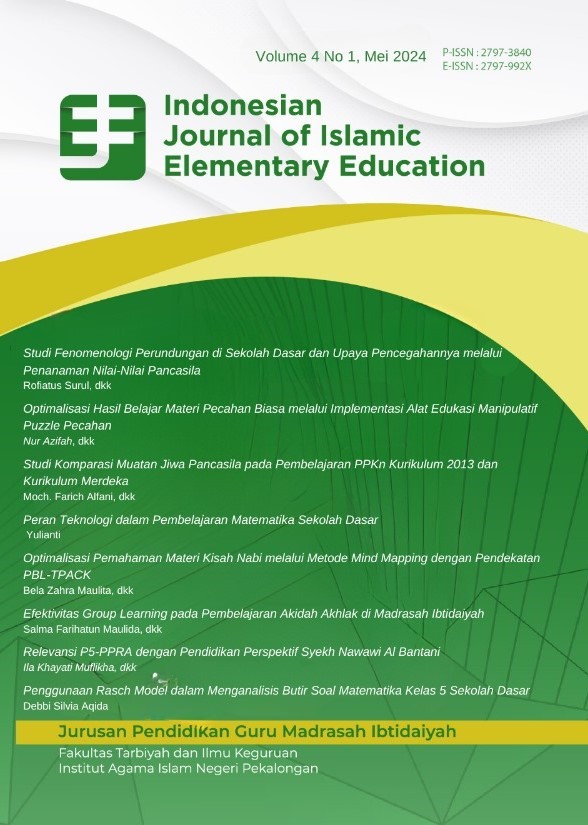
Optimalisasi Hasil Belajar Materi Pecahan Biasa melalui Implementasi Alat Edukasi Manipulatif Puzzle Pecahan
DOI:
https://doi.org/10.28918/ijiee.v4i1.2242Abstract
Problems identified at MI Islamiyah Syafiiyah include limited learning media, especially the use of simple theme books and accompanying books, which causes low cognitive learning outcomes. This research aims to evaluate the use of the Manipulative Fraction Puzzle (Mapupec) educational tool in increasing students' cognitive learning achievement. The research method applied is Classroom Action Research (PTK) by implementing the Kemmis and Mc model. Taggar in two rounds of the cycle. Each cycle involves four stages, namely planning, acting, observing, and reflecting. The research subjects consisted of 41 class IV students at MI Islamiyah Syafiiyah. Data was collected through test instruments, observation and documentation, with data analysis using a quantitative approach. The findings from the research indicate that the use of the Fraction Puzzle Manipulative educational tool (Mapupec) is able to improve the cognitive learning outcomes of class IV students at MI Islamiyah Syafiiyah. The evaluation value in cycle I showed an increase from 21.95% to 70.73%, while in cycle II, the results increased again to 85.37%. These findings conclude that the use of Fraction Puzzle Manipulative educational tools is not only a learning tool, but also an educational game that can stimulate the brain, hone the speed of thinking, and train coordination between the mind and hands.
Keywords:
References
Afandi, M. (2014). Pentingnya penelitian tindakan kelas bagi guru dalam pembelajaran di sekolah dasar. Jurnal ilmiah pendidikan dasar, 1(1), 1-19. http://dx.doi.org/10.30659/pendas.1.1.1-19
Afandi, M., & Irawan, D. (2013). Pembelajaran Kooperatif Tipe Student Teams Achivement Division di Sekolah Dasar. Semarang: Unissula Press. http://research.unissula.ac.id/file/publikasi/211313015/683ISI_STAD_EDIT_full.pdf
Afriyanto, R. (2011). Penerapan Pembelajaran Kooperatif Model Team Game Tournament (TGT) dengan Bantuan Media Animasi untuk Meningkatkan Aktivitas Belajar dan Kemampuan Kognitif Siswa pada Materi Bunyi Kelas IV F SMP Kasatriyan 1 Surakarta Tahun Pelajaran 2010/2011. (Skripsi Sarjana, Universitas Sebelas Maret). https://digilib.uns.ac.id/dokumen/download/19634/NDI3NTk=/Penerapan-pembelajaran-kooperatif-model-team-game-tournament-tgt-dengan-bantuan-media-animasi-untuk-meningkatkan-aktivitas-belajar-dan-kemampuan-kognitif-siswa-pada-materi-bunyi-kelas-viii-f-SMP-Kasatriyan-1-Surakarta-tahun-pelajaran-20102011-Binder15.pdf
Alisya, N. A. (2023). Analisis Berhitung Cepat Pecahan Desimal dan Pecahan Biasa. NIHAIYYAT: Journal of Islamic Interdisciplinary Studies, 2(3), 261. https://ejournal.tmial-amien.sch.id/index.php/nihaiyyat/article/view/64
Berlian, Titiek. (2021). Pengembangan Media Puzzle Pecahan pada Materi Pecahan Sederhana untuk Meningkatkan Hasil Belajar Kognitif Siswa Kelas IV Sekolah Dasar (Skripsi Sarjana, Universitas Muhammadiyah). https://repository.ummat.ac.id/3724/1/COVER-BAB%20III.pdf
Dewantari, N. F., Primasatya, N., & Zaman, W. I. (2023). Pengembangan Media Pembelajaran Berbasis Macromedia Flash 8 pada Materi Pecahan untuk Siswa Kelas IV di SDN Burengan 2 Kota Kediri [Other, Universitas Nusantara PGRI Kediri]. http://repository.unpkediri.ac.id/9018/
Farhana, S., Amaliyah, A., Safitri, A., & Anggraeni, R. (2022). Analisis persiapan guru dalam pembelajaran media manipulatif matematika di sekolah dasar. Educenter: Jurnal Ilmiah Pendidikan, 1(5), 507-511. https://doi.org/10.55904/educenter.v1i12.171
Firdaus, A. (2018). Pendekatan matematika realistik dengan bantuan puzzle pecahan untuk siswa Sekolah Dasar. Scholaria: Jurnal Pendidikan Dan Kebudayaan, 8(3), 243-252. https://doi.org/10.24246/j.js.2018.v8.i3.p243-252
Kudsiah, M., & Alwi, M. (2020). Pengembangan Media Puzzle Pecahan Matematika Materi Penjumlahan Pecahan untuk Siswa Kelas IV Sekolah Dasar. Jurnal Elementary: Kajian Teori dan Hasil Penelitian Pendidikan Sekolah Dasar, 3(2), 102–106. https://doi.org/10.31764/elementary.v3i2.2431
Nisem, N. (2020). Upaya Ppeningkatan Keterampilan Menghitung Pecahan Senilai Menggunakan Media Puzzle. Jurnal Ilmiah WUNY, 2(1), 88-100. https://doi.org/10.21831/jwuny.v2i1.30949
Purwanto. (2011). Evaluasi Hasil Belajar. Pustaka Pelajar.
Putra, S. H. J. (2021). Pendekatan Jelajah Alam Sekitar (JAS): Dampaknya terhadap Aktivitas dan Hasil Belajar Kognitif Siswa SMP. Journal of Natural Science and Integration, 4(2), 204-213. http://dx.doi.org/10.24014/jnsi.v4i2.10030
Rahmadani, E., & Al Hamdany, M. Z. . (2023). Implementasi Nilai-Nilai Penguatan Pendidikan Karakter (PPK) di Sekolah Dasar. Attadrib: Jurnal Pendidikan Guru Madrasah Ibtidaiyah, 6(1), 10–20. https://doi.org/10.54069/attadrib.v6i1.368
Rahmadhani, E., & Wahyuni, S. (2020). Integrasi Pembelajaran Matematika Berbasis ICARE dan Islam pada Materi Pecahan. JNPM (Jurnal Nasional Pendidikan Matematika), 4(1), 110–124. https://doi.org/10.33603/jnpm.v4i1.2874
Rahman, S. (2022, January). Pentingnya motivasi belajar dalam meningkatkan hasil belajar. In Prosiding Seminar Nasional Pendidikan Dasar. https://ejurnal.pps.ung.ac.id/index.php/PSNPD/article/view/1076
Sari, V. M. (2014). Efektifitas Penggunaan Media Puzzle dalam Meningkatkan Kemampuan Mengenal Konsep Bilangan Pecahan Sederhana Bagi Anak Kesulitan Belajar. Jurnal Penelitian Pendidikan Khusus, 3(1), 216-226. https://doi.org/10.24036/jupe30610.64
Sugriani, A. (2019). Upaya meningkatkan pemahaman konsep penjumlahan pecahan melalui pendekatan pendidikan matematika realistik Indonesia (PMR). Jurnal Didactical Mathematics, 1(2), 21-28. https://garuda.kemdikbud.go.id/documents/detail/1085358
Sulkifli, S., Kaharuddin, K., & Firdaus, F. (2019). Pemanfaatan Internet sebagai Media Pembelajaran Tambahan Siswa SMA Yaspib Bontolempangan. Equilibrium: Jurnal Pendidikan, 7(2), 242-248. https://doi.org/10.26618/equilibrium.v7i2.2682
Suryani, A., Anisah, A. S., & Muhamad, N. (2023). Meningkatkan Kemampuan Pemahaman Siswa pada Materi Pecahan melalui Model Problem Based Learning. Pendas: Jurnal Ilmiah Pendidikan Dasar, 8(3), 2745-2764. https://doi.org/10.23969/jp.v8i3.11160
Downloads
Published
License
Copyright (c) 2024 Nur Azifah, Sutoyo Sutoyo, Muhamad Jalil

This work is licensed under a Creative Commons Attribution 4.0 International License.
You are free to:
Share — copy and redistribute the material in any medium or format for any purpose, even commercially.
Adapt — remix, transform, and build upon the material for any purpose, even commercially.
The licensor cannot revoke these freedoms as long as you follow the license terms.
Under the following terms:
Attribution — You must give appropriate credit , provide a link to the license, and indicate if changes were made . You may do so in any reasonable manner, but not in any way that suggests the licensor endorses you or your use.
No additional restrictions — You may not apply legal terms or technological measures that legally restrict others from doing anything the license permits.
Notices:
You do not have to comply with the license for elements of the material in the public domain or where your use is permitted by an applicable exception or limitation .
No warranties are given. The license may not give you all of the permissions necessary for your intended use. For example, other rights such as publicity, privacy, or moral rights may limit how you use the material.