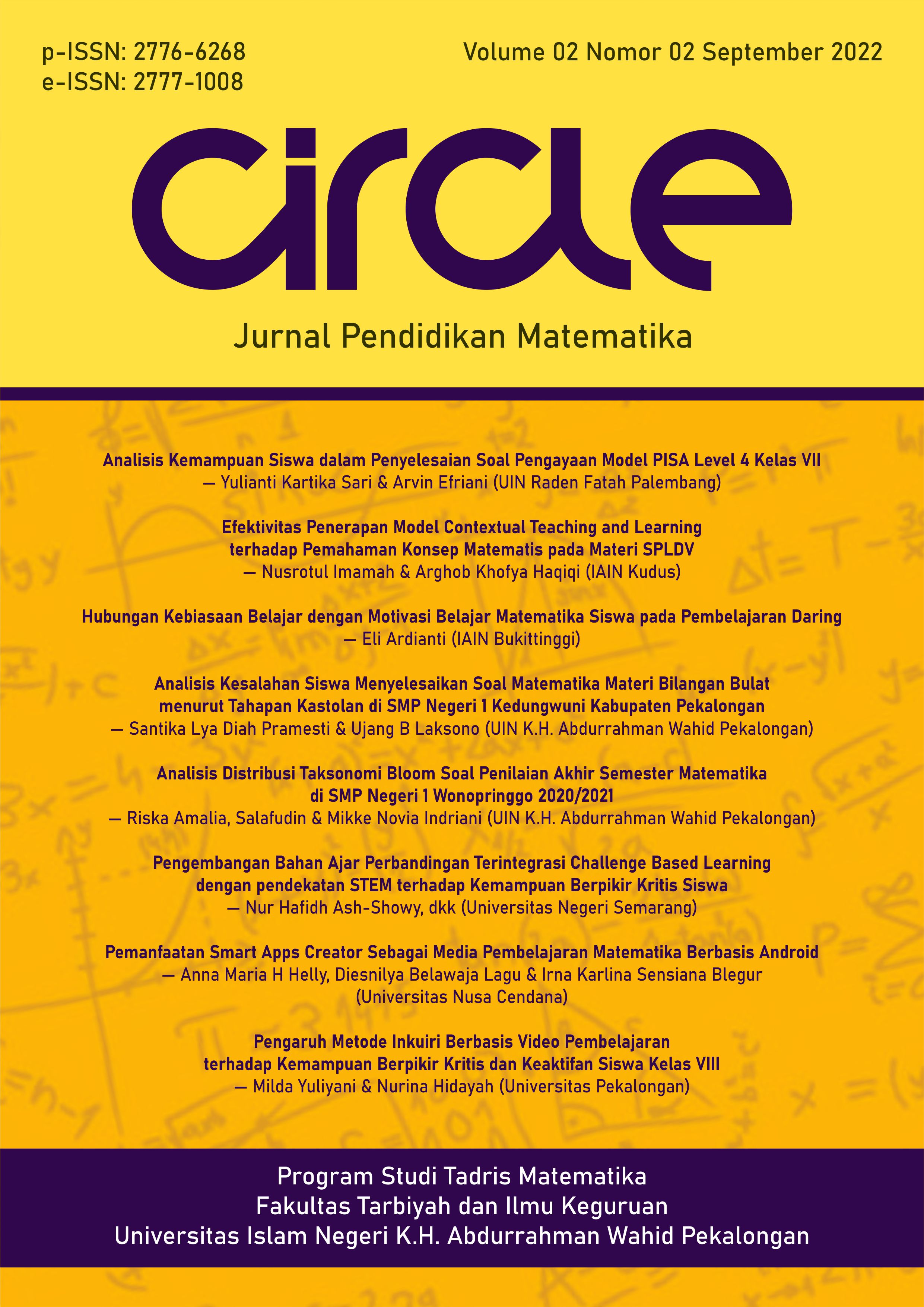
Analisis Distribusi Taksonomi Bloom Soal Penilaian Akhir Semester Mata Pelajaran Matematika di SMP Negeri 1 Wonopringgo 2020/2021
DOI:
https://doi.org/10.28918/circle.v2i02.6072Abstract
The purpose of this study is to determine the theoretical and empirical quality of the questions, as well as the distribution of cognitive domain levels of Bloom's revised taxonomy on PAS questions in mathematics. The type of research used is a combination research (Mixed Method) whit using the sequential model and its approach through exploratory strategy. Data collection techniques with observation and documentation. Data analysis techniques qualitative using content validity data analysis techniques according to Gregory, and matching cognitive domain levels, as well as quantitative data analysis using SPSS version 22.0 assisted programs. This was conducted at SMP Negri 1 Wonopringgo, A total of 72 samples from 256 populations per each grade level. The study's findings are as follows: From a theoretical standpoint, the question has a content validity of "very high," which means that the question has a content validity of "very high." suitable for use.The distribution of the cognitive domain level of class VII questions has been met; class VIII questions do not have a C5 level, and class IX questions do not yet have C4 and C6 levels. PAS questions are unusual Mathematics grades VII, VIII, and IX have good quality because the questions in the valid category are more valid a lot, the reliability of the high category is higher, the level of difficulty of the questions in the medium category is higher, and the power difference between good and very good is too great.
References
Downloads
Published
Article Statistics
Issue
Section
License
Copyright (c) 2022 Riska Amalia

This work is licensed under a Creative Commons Attribution-ShareAlike 4.0 International License.