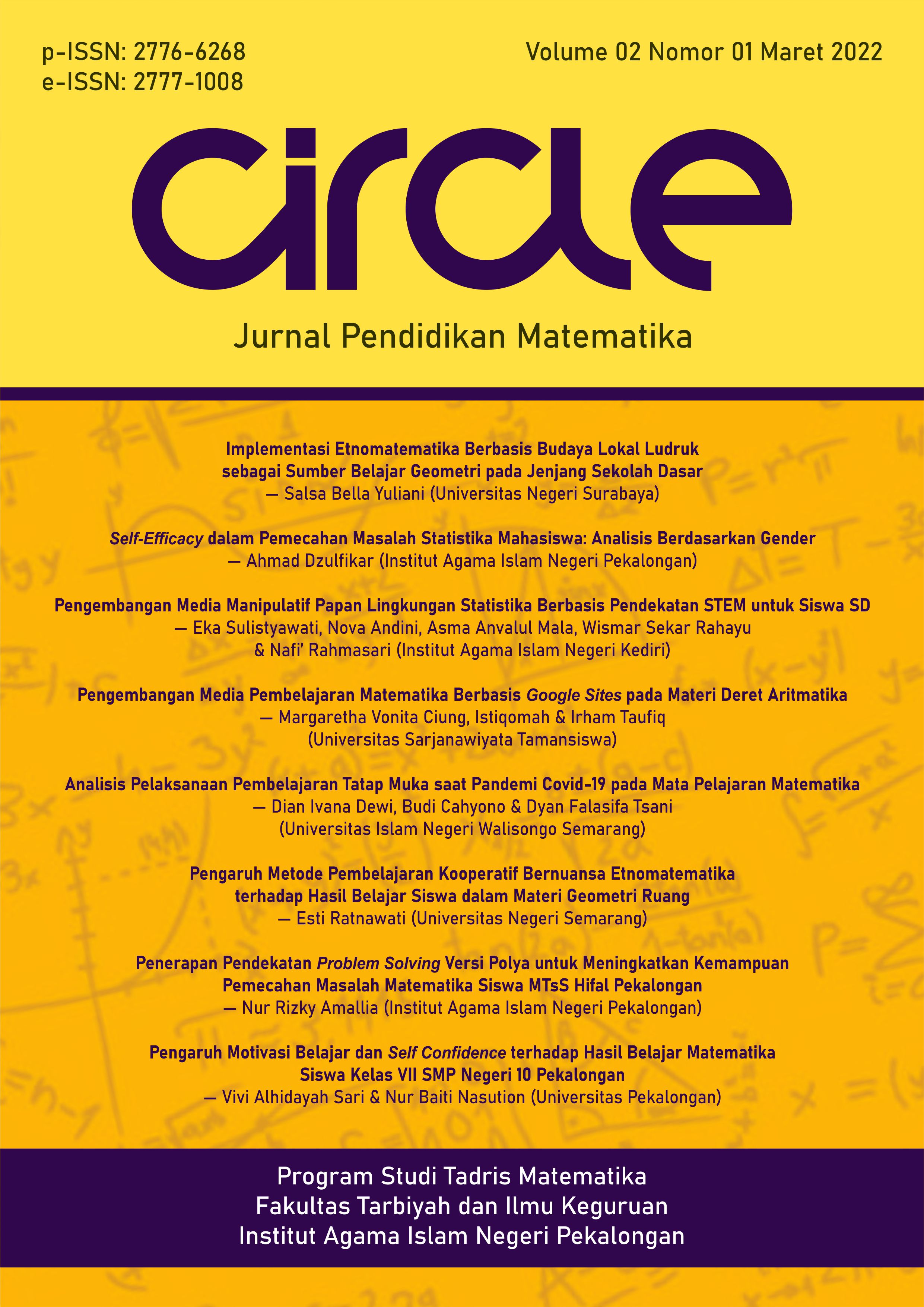
Implementasi Etnomatematika Berbasis Budaya Lokal Ludruk sebagai Sumber Belajar Geometri pada Jenjang Sekolah Dasar
DOI:
https://doi.org/10.28918/circle.v2i01.4216Abstract
This article aims to show how the implementation of ethnomatematics based on local culture, namely ludruk art, is used as a source of geometry learning at the elementary school level. This type of research is qualitative research using explorative methods. An explorative method of research aims to investigate a problem that has never been studied or has not even been thoroughly investigated before. The purpose of this exploration research is to explore the art of ludruk that can be implemented in supporting the process of geometry learning, especially in materials of building flats, building spaces, and angles. In addition, the interview method of the results of the activity is also carried out to know the opinions of students about the learning activities that have been conducted. The results of this study showed that ethnomatematic-based learning is new for students, so students look very enthusiastic when they are to be the subject of research. The results of the Student Worksheet (LKS) also show perfect scores, so that in general by implementing an ethnomatematic approach in mathematics learning can improve student’s learning outcomes and interests.
Keywords:
References
Downloads
Published
License
Copyright (c) 2022 Salsa Bella Yuliani

This work is licensed under a Creative Commons Attribution-ShareAlike 4.0 International License.