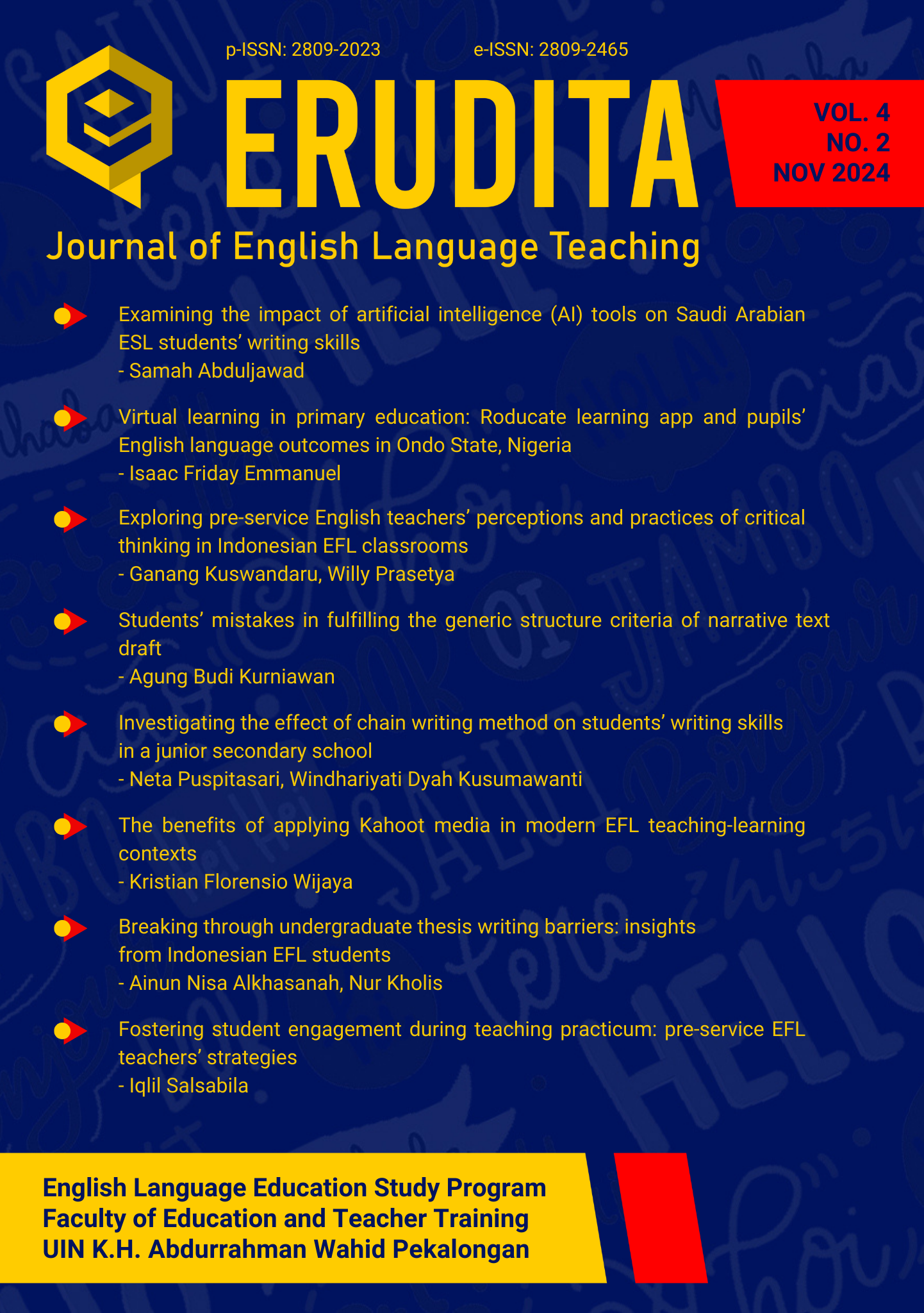
Exploring pre-service English teachers’ perceptions and practices of critical thinking in Indonesian EFL classrooms
DOI:
https://doi.org/10.28918/erudita.v4i2.8893Abstract
Critical thinking is essential for success in the 21st century, particularly in language learning. This study explores pre-service English language teachers’ (ELTs) perceptions and practices regarding critical thinking instruction in Indonesia. Through a qualitative case study approach, semi-structured interviews were conducted with two pre-service ELTs from a private university in Yogyakarta. Thematic analysis revealed a rich tapestry of insights into the participants’ understanding of critical thinking, their perceived importance in language learning, and their willingness to integrate critical thinking into their teaching practices. The findings highlight the significance of critical thinking in language acquisition, as it empowers students to analyze complex information, evaluate diverse perspectives, and form informed judgments. Participants emphasized the need for incorporating critical thinking strategies into language teaching to enhance students’ cognitive abilities and facilitate deeper understanding. Nevertheless, the study also identified potential challenges, including the uneven distribution of critical thinking practices across the education system and the need for specialized teacher training to implement critical thinking instruction effectively. The study contributes to understanding pre-service ELTs’ perceptions and practices of critical thinking in Indonesia. It also provides valuable insights for teacher training programs, curriculum development, and future research investigating critical thinking instruction in English language teaching.
Keywords:
References
Alnofaie, H. (2013). A framework for implementing critical thinking as a language pedagogy in EFL preparatory programmes. Thinking Skills and Creativity, 10(2), 154–158. https://doi.org/10.1016/j.tsc.2013.09.002
Buluc, R. (2018). Critical thinking in the fight against fake news. Archipelago XXI Press.
Çakici, D. (2018). Metacognitive awareness and critical thinking abilities of pre-service EFL teachers. Journal of Education and Learning, 7(5), 116–129. https://doi.org/10.5539/jel.v7n5p116
Cojocariu, V. M., & Butnaru, C. E. (2014). Asking questions–Critical thinking tools. Procedia-Social and Behavioral Sciences, 128, 22–28. https://doi.org/10.1016/j.sbspro.2014.03.112
Cotton, K. (1991). Close-Up#11: Teaching thinking skills. Northwest Regional Educational Laboratory’s School Improvement Research Series Website. http://www.nwrel.org/scpd/sirs/6/ cu11.html
Dwyer, C. P. (2017). Critical thinking: Conceptual perspectives and practical guidelines. Cambridge University Press. https://doi.org/10.1017/9781316537411
Ennis, R. H. (1989). Critical thinking and subject specificity: Clarification and needed research. Educational Researcher, 18(3), 4–10. https://doi.org/10.3102/0013189X018003004
Facione, N. C., & Facione, P. A. (2011). Critical thinking and clinical reasoning in the health sciences: An international multidisciplinary teaching anthology. The California Academic Press.
Facione, P. A. (2013). Critical thinking: What it is and why it counts. The California Academic Press.
Fengyu, Z. (2023). The impact of vocabulary assessment and personalized feedback on students’ vocabulary mastery. Education, Language and Sociology Research, 4(4), 65–77. https://doi.org/10.22158/elsr.v4n4p65
Fung, D. C. L., To, H., & Leung, K. (2016). The influence of collaborative group work on students’ development of critical thinking: The teacher’s role in facilitating group discussions. Pedagogies: An International Journal, 11(2), 146–166. https://doi.org/10.1080/1554480X.2016.1159965
Gashan, A. K. (2015). Exploring Saudi pre-service teachers’ knowledge of critical thinking skills and their teaching perceptions. International Journal of Education & Literacy Studies, 3(1), 26–33. https://journals.aiac.org.au/index.php/IJELS/article/view/1469
Ghaemi, H., & Taherian, R. (2011). The role of critical thinking in EFL teachers’ teaching success. Modern Journal of Applied Linguistics, 3(1), 8–22.
Gurbuz, I. (2021). Pre-service English language teachers’ critical thinking tendencies and their teaching-learning conceptions. Innovational Research in ELT, 2(2), 22–34. https://doi.org/10.29329/irelt.2021.416.2
Kadir, M. A. A. (2016). What teacher knowledge matters in effectively developing critical thinkers in the 21st century curriculum? Thinking Skills and Creativity, 23, 79–90. https://doi.org/10.1016/j.tsc.2016.10.011
Khusnia, A. N. (2015). Strategies to enhance peer feedback and self-assessment in extended speaking course. PEOPLE: International Journal of Social Sciences, 1334–1344. https://doi.org/10.20319/pijss.2015.s21.13341344
Ku, K. Y., Lee, V. S., & Ellis, J. W. (2017). Using artwork as problem context in generic critical thinking instruction: A strategy for thoughts. Thinking Skills and Creativity, 25, 53–59. https://doi.org/10.1016/j.tsc.2017.07.001
Li, L. (2016). Integrating thinking skills in foreign language learning: What can we learn from teachers’ perspectives? Thinking Skills and Creativity, 22, 273–288. https://doi.org/10.1016/j.tsc.2016.09.008
Ma, L., & Luo, H. (2021). Chinese pre-service teachers’ cognitions about cultivating critical thinking in teaching English as a foreign language. Asia Pacific Journal of Education, 41(3), 543–557. https://doi.org/10.1080/02188791.2020.1793733
Murawski, L. M. (2014). Critical thinking in the classroom...and beyond. Journal of Learning in Higher Education, 10(1), 25–30.
Petek, E., & Bedir, H. (2018). An adaptable teacher education framework for critical thinking in language teaching. Thinking Skills and Creativity, 28, 56–72. https://doi.org/10.1016/j.tsc.2018.02.008
Rezaei, S., Derakhshan, A., & Bagherkazemi, M. (2011). Critical thinking in language education. Journal of Language Teaching and Research, 2(4), 1798–4769. http://dx.doi.org/10.4304/jltr.2.4.769-777
Sadeghi, F., Adel, S. M. R., Zareian, G., & Davoudi, M. (2020). Iranian EFL teachers’ and learners’ perceptions of the principles of critical thinking: A constructivist grounded theory study. Iranian Journal of Language Teaching Research, 8(2), 63–81. https://doi.org/10.30466/ijltr.2020.120889
Wang, S. (2022). Critical thinking development through project-based learning. Journal of Language Teaching and Research, 13(5), 1007–1013. https://doi.org/10.17507/jltr.1305.13
Zhang, H., Yuan, R., & He, X. (2020). Investigating university EFL teachers’ perceptions of critical thinking and its teaching: Voices from China. The Asia-Pacific Education Researcher, 29, 483–493. https://doi.org/10.1007/s40299-020-00500-6
Downloads
Published
Article Statistics
Issue
Section
License
Copyright (c) 2024 Ganang Kuswandaru, Willy Prasetya

This work is licensed under a Creative Commons Attribution-ShareAlike 4.0 International License.
Erudita: Journal of English Language Teaching is licensed under a Creative Commons Attribution-ShareAlike 4.0 International License. An author who publishes in Erudita: Journal of English Language Teaching agrees to the following terms:
- Author retains the copyright and grants the journal the right of first publication of the work simultaneously licensed under the Creative Commons Attribution-ShareAlike 4.0 License that allows others to share the work with an acknowledgment of the work's authorship and initial publication in this journal
- Author is able to enter into separate, additional contractual arrangements for the non-exclusive distribution of the journal’s published version of the work (e.g., post it to an institutional repository or publish it in a book) with the acknowledgment of its initial publication in this journal.
- Author is permitted and encouraged to post his/her work online (e.g., in institutional repositories or on their website) prior to and during the submission process, as it can lead to productive exchanges, as well as earlier and greater citation of the published work (See The Effect of Open Access).