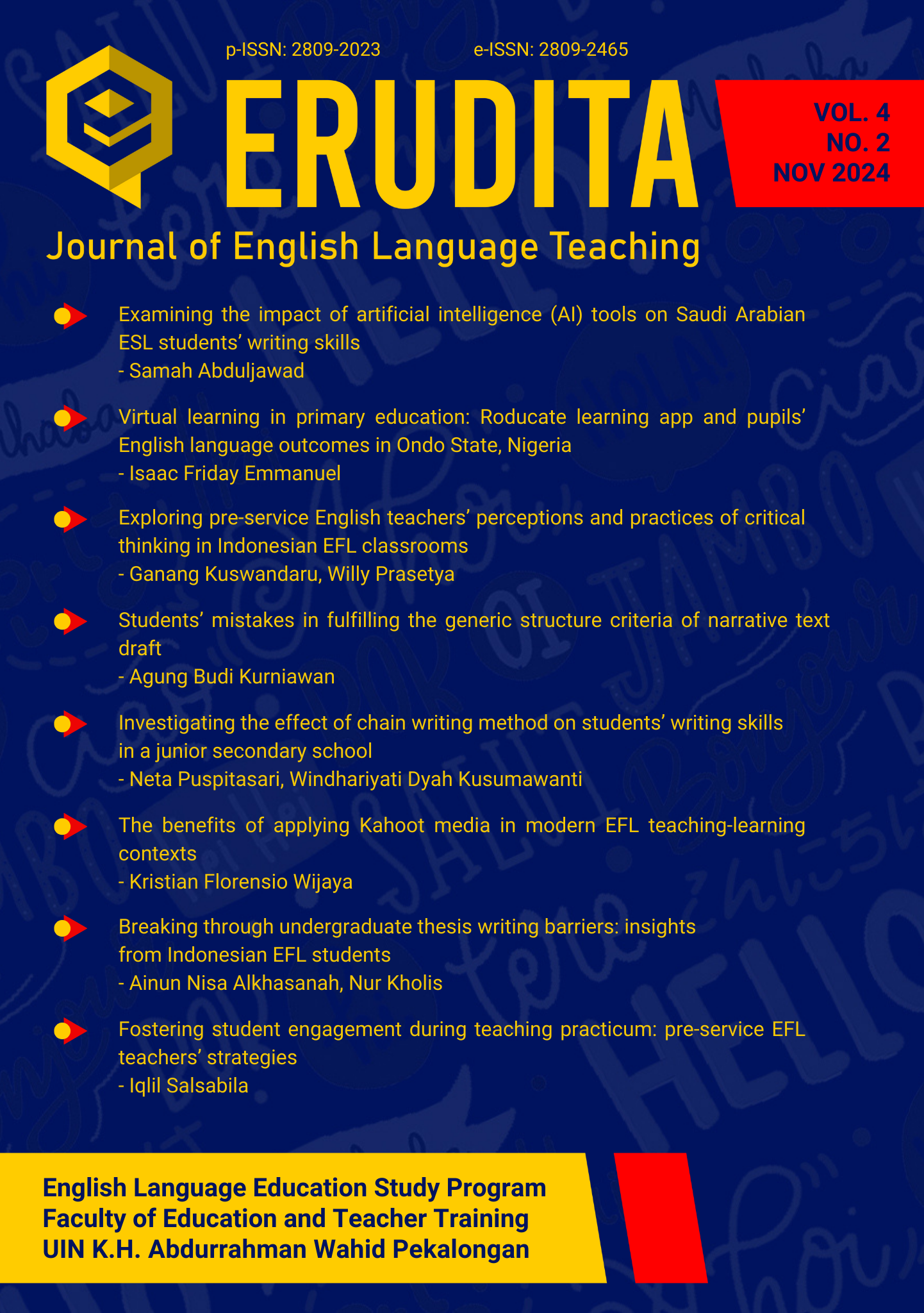
Virtual learning in primary education: Roducate learning app and pupils’ English language outcomes in Ondo State, Nigeria
DOI:
https://doi.org/10.28918/erudita.v4i2.8875Abstract
In today’s rapidly evolving digital world, technologies remain essential to modern challenges. However, in Nigeria, these technologies have not gained the prominence they deserve, especially at the primary school level. This study examined the effectiveness of Roducate in Primary School Pupils’ English Language Outcomes in Ondo State, Nigeria. Three research questions were answered and two hypotheses were tested. A quasi-experimental and descriptive survey research design were adopted for the study. The population consisted of all primary school pupils and their teachers. Through purposive sampling, 45 pupils and 30 primary school teachers were selected. Pupils with access to mobile devices were placed in the experimental group and those without access on the control group. The research instruments were the Teachers’ Roducate Knowledge Questionnaire (TRKQ), r = 0.76, Level of Digital Competence Questionnaire (LDCQ), r = 0.79, and the Primary School Common Entrance Past Questions. Findings revealed that Roducate has a significant effect on pupils’ achievement in English language. Similarly, primary school teachers do not know about Roducate learning app. On the basis of these findings, the study recommends that there should be comprehensive teacher training programs focusing on building digital competence for primary school teachers.
Keywords:
References
Abraham, A., Victor, O., Endurance, I., & Naomi, A. (2023). Factors that affect the adoption of digital learning in secondary schools in Ankpa Local Government Area of Kogi State, Nigeria. International Journal of Research Publication and Reviews, 4(5), 5486–5493. https://ijrpr.com/uploads/V4ISSUE5/IJRPR13527.pdf
Ajani S., Ojeyomi O., & Akeke R. (2022). Challenges militating against teachers’ adoption of internet-based method in Business Education Programme in tertiary institutions in South West Nigeria. Al-Hikmah Journal of Business Education, 2(1), 43–50. https://alhikmahuniversity.edu.ng/centralJournal/my_portal/user/event/bookUrl369.pdf
Ajayi S., Ogunnode N., & Ayoko V. (2023). Challenges facing e-learning in basic education in Nigeria and the way forward. Analytical Journal of Education and Development, 3(5), 17–28. https://sciencebox.uz/index.php/ajed/article/view/6886/6340
Alneyadi S., Wardat Y., Alshannag Q., & Abu-Al-Aish A. (2023). Effect of using smart e-learning app on the academic achievement of eighth-grade students. EURASIA Journal of Mathematics, Science and Technology Education, 19(4), 1–11. https://doi.org/10.29333/ejmste/13067
Althubyani, A. R. (2024). Digital competence of teachers and the factors affecting their competence level: A nationwide mixed-methods study. Sustainability, 16(7), 2796. https://doi.org/10.3390/su16072796
Camilleri, M. A., & Camilleri, A. C. (2020). The use of mobile learning technologies in primary education. In R. Z. Zheng (Ed.), Cognitive and affective perspectives on immersive technology in education (pp. 250–266). Information Science Reference/IGI Global. https://doi.org/10.4018/978-1-7998-3250-8.ch013
European Commission. (2018). Digital competence framework 2.0: DigComp 2.0. https://ec.europa.eu/jrc/en/digcomp/digitalcompetence-framework
Federal Republic of Nigeria. (2013). National policy on education (6th ed.). NERDC Press.
Ibhafidon, H. E., & Ofeimu J. (2024). Assessment of primary school teachers’ computer literacy in south-south region of Nigeria. AAU Journal of Business Educators, 4(1), 340–345. https://aaujbe.com.ng/index/index.php/aaujbe/article/view/58/88
Imhanyehor, G. (2020). Digital literacy and primary educational system in Nigeria. Journal of Public Administration, Finance and La, 20, 206–221. https://doi.org/10.47743/jopafl-2021-20-13
Karaferye, F. (2022). Digital teaching and learning: Exploring primary school teachers’ approaches, sources of concern & expectations. Journal of Educational Technology and Online Learning, 5(4), 808–824. https://doi.org/10.31681/jetol.1156717
Korkmaz, M., & Akçay, A. O. (2024). Determining digital literacy levels of primary school teachers. Journal of Learning and Teaching in Digital Age, 9(1), 1–16. https://doi.org/10.53850/joltida.1175453
Mustapha K. (2022). Influence of English language performance at primary education on the attainment of educational standard in an ESL situation. International Journal of Advances in Engineering and Management (IJAEM), 4(7), 330–335. https://doi.org/10.35629/5252-0407330335
Noskova, A. V., Goloukhova, D. V., & Kuzmina, E. I. (2021). Digital competence of university teachers: Self-perception of skills in online-environment. Perishable and eternal: Mythologies and social technologies of digital civilization. https://www.europeanproceedings.com/article/10.15405/epsbs.2021.12.03.113
Nwafor P., Ejoh O., Chukwurah M., & Okeke U. (2023). Assessment of teachers’ competence in utilization of digital instructional tools in upper basic schools in cross river state, Nigeria. Global Journal of Educational Research, 22, 165–175. https://doi.org/10.4314/gjedr.v22i2.7
Ogunbodede, K. F., Ewata, T. O., Kumar, A., & Okediji, O. G. (2023). Digital competencies and the 21st century skills of university teachers in Nigeria. European Journal of Interactive Multimedia and Education, 4(2), e02305. https://doi.org/10.30935/ejimed/13966
Ogunyemi, K. O., & Emmanuel, I. F. (2020). Teachers’ awareness and utilization of L2 research findings: Implications for L2 teaching in Ondo State. European Scientific Journal (ESJ), 16(10), 124–134. https://doi.org/10.19044/esj.2020.v16n10p124
Roducate Learning App (2024). About Roducate learning app. https://www.roducate.com/site-for-students
Tom-Lawyer O., Thomas M., & Kalane M. S. (2021). Examining the status of English as a medium of instruction in sub-Saharan Africa: A comparative study of Botswana and Nigeria. European Scientific Journal (ESJ), 17(36), 51–70. https://doi.org/10.19044/esj.2021.v17n36p51
UNICEF. (2022). Language in education: Phase II report. https://www.unicef.org/nigeria/media/7861/file/Language%20in%20Education%20Report.pdf
Yeşilbağ S., & Korkmaz Q., (2020) The effect of Voki application on students’ academic achievements and attitudes towards English course. Education and Information Technologies, 26, 465–487. https://doi.org/10.1007/s10639-020-10264-7
Downloads
Published
License
Copyright (c) 2024 Isaac Friday Emmanuel

This work is licensed under a Creative Commons Attribution-ShareAlike 4.0 International License.
Erudita: Journal of English Language Teaching is licensed under a Creative Commons Attribution-ShareAlike 4.0 International License. An author who publishes in Erudita: Journal of English Language Teaching agrees to the following terms:
- Author retains the copyright and grants the journal the right of first publication of the work simultaneously licensed under the Creative Commons Attribution-ShareAlike 4.0 License that allows others to share the work with an acknowledgment of the work's authorship and initial publication in this journal
- Author is able to enter into separate, additional contractual arrangements for the non-exclusive distribution of the journal’s published version of the work (e.g., post it to an institutional repository or publish it in a book) with the acknowledgment of its initial publication in this journal.
- Author is permitted and encouraged to post his/her work online (e.g., in institutional repositories or on their website) prior to and during the submission process, as it can lead to productive exchanges, as well as earlier and greater citation of the published work (See The Effect of Open Access).