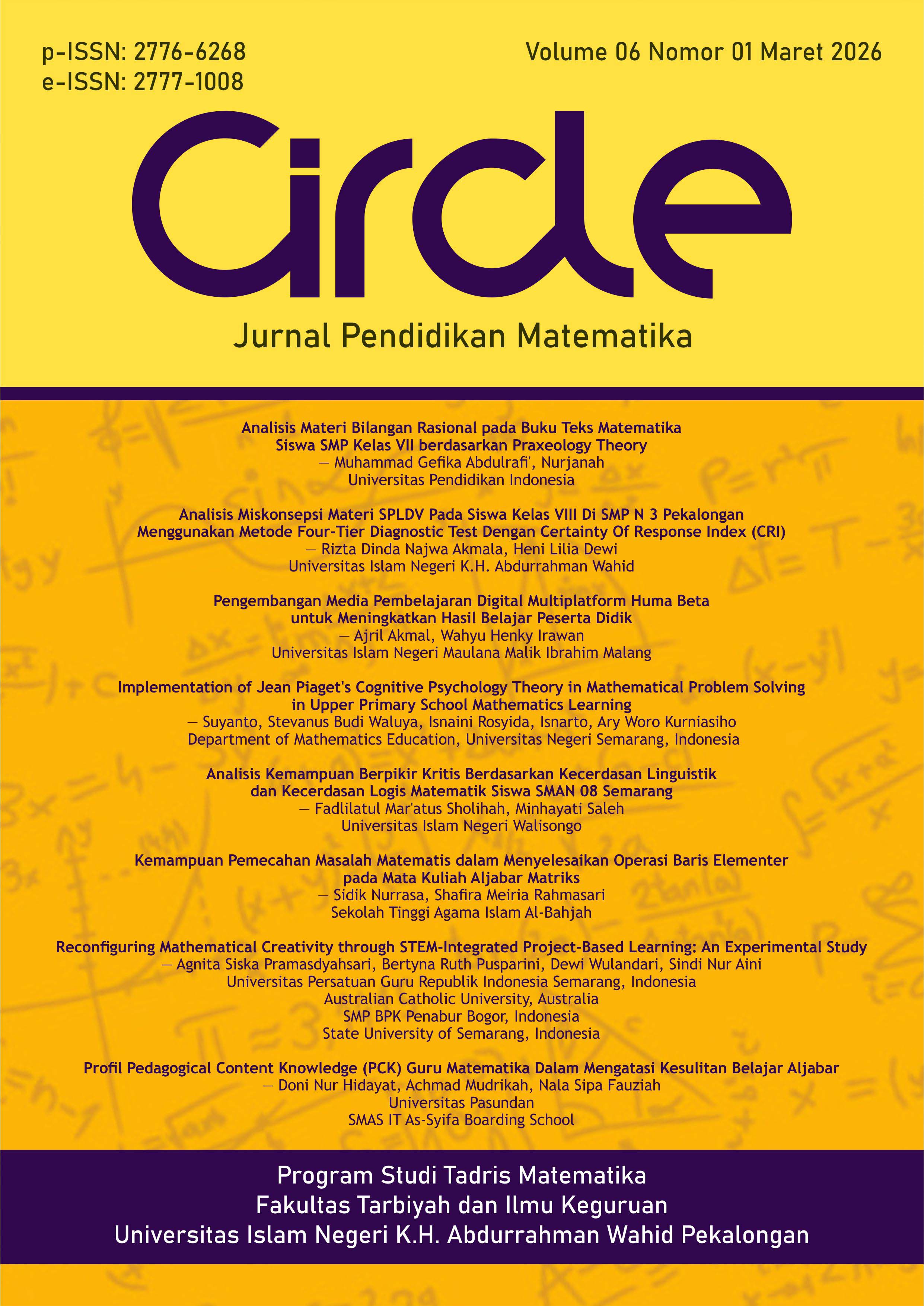
Profil Pedagogical Content Knowledge Guru Matematika dalam Mengatasi Kesulitan Belajar Aljabar
DOI:
https://doi.org/10.28918/circle.v6i1.2603Abstract
This research aims to identify the algebra learning difficulties experienced by seventh-grade students and to describe the Pedagogical Content Knowledge (PCK) profile of mathematics teachers in addressing these difficulties. A descriptive qualitative approach was employed, involving three mathematics teachers and 21 seventh-grade students across three educational units. Data were collected through a triangulation of instruments, including diagnostic tests to map learning difficulties, vignette instruments to reveal teachers' pedagogical reasoning and responses, and interviews to deepen data interpretation. Data were analyzed using an interactive analysis technique comprising data reduction, data display, and conclusion drawing. The findings indicate that students predominantly face difficulties in conceptual aspects, such as identifying algebraic elements, and principle aspects, particularly in applying algebraic operations and modeling contextual problems. The teachers' PCK profiles showed varied levels of competence: two teachers were at a limited level characterized by repetitive instructional strategies, while one teacher demonstrated a more proficient PCK profile through accurate diagnosis of student difficulties and the application of varied, contextual teaching strategies. This study contributes to the development of a more operational PCK mapping methodology by integrating assessment instruments that capture authentic teacher responses to learning obstacles. Theoretically, these findings enrich the literature on PCK frameworks within the context of misconception diagnosis, while practically, they highlight the necessity of strengthening teachers' diagnostic competencies through professional development programs and reflective teaching practices to enhance the effectiveness of algebra instruction.
Keywords:
References
Anathiya, L., & Andriani, S. (2021). Pemahaman Konsep Matematis Dilihat Dari Minat Belajar Dengan Strategi Pembelajaran Genius Learning Berbantu Lagu Edukasi. CIRCLE: Jurnal Pendidikan Matematika, 1(1), 1-13. https://doi.org/10.28918/circle.v1i1.3500
Burcu, T. (2024). Collegial Practicum Journey of EFL Teacher Trainees through Vignette-based Reflections İngilizce Öğretmen Adaylarının Vinyet Tabanlı Yansıtmalar Aracılığı ile Meslektaş Dayanışmalı Staj Yolculuğu. Journal of Theoretical Educational Science, 17(January), 80–99.
Dazrullisa. (2017). Pedagogical Content Knowledge (PCK) Calon Guru. Jurnal MAJU, 4(1), 51–58.
Dursun, F., & Aykan, A. (2025). Exploring Teachers’ Narratives: Challenges and Strategies for Enhancing the Teaching Process. Sage Open, 15(1), 1-21. https://doi.org/10.1177/21582440251332557
Elma, Z., Lestari, N. D. S., Oktavianingtyas, E., Trapsilasiwi, D., & Safrida, L. N. (2025). The identification of misconceptions in visual learners based on the certainty of response index (CRI) in solving numeracy problems in algebra. AXIOM: Jurnal Pendidikan dan Matematika, 14(1), 70-86.
Fardian, D., Suryadi, D., & Prabawanto, S. (2025). A praxeological analysis of linear equations in Indonesian mathematics textbooks: Focusing on systemic and epistemic aspect. Journal on Mathematics Education, 16(1), 225-254.
Grigaliūnienė, M., Lehtinen, E., Verschaffel, L., & Depaepe, F. (2025). Systematic review of research on pedagogical content knowledge in mathematics: Insights from a topic-specific approach. ZDM–Mathematics Education, 57(4), 777-794. https://doi.org/10.1007/s11858-025-01684-1
Habiyaremye, H. T., Ntivuguruzwa, C., & Ntawiha, P. (2023, November). Rwandan teacher training college’s mathematics teachers’ pedagogical content knowledge for teaching: assessment toward competency-based curriculum. In Frontiers in Education (Vol. 8, p. 1214396). Frontiers Media SA. https://doi.org/10.3389/feduc.2023.1214396
Haki, U., Prahastiwi, E. D., & Selatan, U. T. (2024). Strategi pengumpulan dan analisis data dalam penelitian kualitatif pendidikan. Jurnal Inovasi Dan Teknologi Pendidikan, 3(1), 1-19.
Kabadaş, H., & Mumcu, H. Y. (2024). Examining the process of middle school math teachers diagnosing and eliminating student misconceptions in algebra. Journal of Theoretical Educational Sciences, 17(3), 563-591. https://doi.org/10.30831/akukeg.1323295
Lay, Y. O., Wulandari, I., & Andayani, S. (2025). A Systematic Literature Review: The Role of Digital Technology in Improving Conceptual Understanding and Problem-Solving Skills. MATHEMA JOURNAL, 7(2), 591–616.
Love, T. S., & Hughes, A. J. (2022). Engineering pedagogical content knowledge : examining correlations with formal and informal preparation experiences. International Journal of STEM Education. https://doi.org/10.1186/s40594-022-00345-z
Lufita, D., Kuswanto, H., Rosana, D., Pratiwi, F. A. I., & Triananda, L. (2025). Identification of Misconception Using Diagnostic Tests: Systematic Literature Review. Jurnal Penelitian Pendidikan IPA, 11(5), 10-15. https://doi.org/10.29303/jppipa.v11i5.9986
Mapulanga, T., & Bwalya, A. (2024). Teachers ’ and students ’ perceptions of teaching- learning activities used in secondary school biology classrooms : a comparative study. Cogent Education, 11(1). https://doi.org/10.1080/2331186X.2024.2372144
Mariya, K., Shakeel, A., Shazli, T., & Raja, H. (2022). Analysing the role of gender and place of residence in acceptability and satisfaction towards e ‑ learning among university students ’ during COVID ‑ 19 pandemic in India. SN Social Sciences, 2(10), 1–28. https://doi.org/10.1007/s43545-022-00544-z
Muhtarom, M., Juniati, D., & Siswono, T. Y. E. (2019). Examining prospective teacher beliefs and pedagogical content knowledge towards teaching practice in mathematics class: A case study. Journal on Mathematics Education, 10(2). 185–202.
Mutammam, M. B., & Wulandari, E. N. (2023). Profile of junior high school students’ symbol sense thinking. JTAM (Jurnal Teori Dan Aplikasi Matematika), 7(2), 509-521.
Noverli, M. F., Asih, E. C. M., & Juandi, D. (2024). Analisis kemampuan berpikir kritis matematis peserta didik kelas viii penghafal al-qur’an pada materi peluang. Jurnal Inovasi Pembelajaran Matematika: PowerMathEdu, 3(2), 285–294. https://doi.org/10.31980/pme.v3i2.1783
Oktaviane, M. E. B. B., Wijaya, A., & Retnawati, H. (2020). Hubungan pedagogical content knowledge guru matematika dan prestasi belajar siswa sekolah menengah pertama. PYTHAGORAS: Jurnal Matematika dan Pendidikan Matematika, 15(2), 178-189.
Padilla, M. O., Velasco, N., & Ortiz, S. A. (2025). Analysis of pedagogical content knowledge for teaching mathematics in early childhood education. Journal of Infrastructure, Policy and Development, 9(1), 1–15.
Pamintuan, C. F. (2024). Investigating the Classroom Implementation of Mandarin Teachers' Pedagogical Content Knowledge (PCK): Exploring Effective Strategies and Practices for Teaching Chinese as a Foreign Language in the Philippines. International Journal of Language Education, 8(1), 112-126.
Purwoko, R. Y., Nugraheni, P., & Instanti, D. (2019). Implementation Of Pedagogical Content Knowledge Model In Mathematics Learning For Implementation Of Pedagogical Content Knowledge Model In Mathematics Learning For High School. Journal of Physics: Conference Series, 1254(1). 1-6. https://doi.org/10.1088/1742-6596/1254/1/012079
Rupasinghe, D. D. (2023). Investigating the Mathematics Teachers ’ Pedagogical Content Knowledge in Teaching Algebraic Symbols. International Journal of Research and Scientific Innovation (IJRSI), 10(11). 126-138. https://doi.org/10.51244/IJRSI
Sæleset, J., & Friedrichsen, P. (2021). Pre-service science teachers’ pedagogical content knowledge integration of students’ understanding in science and instructional strategies. Eurasia Journal of Mathematics, Science and Technology Education, 17(5), em1965.
Sæleset, J., & Friedrichsen, P. (2021). Pre-service Science Teachers’ Pedagogical Content Knowledge Integration of Students’ Understanding in Science and Instructional Strategies. Eurasia Journal of Mathematics, Science and Technology Education, 17(5), em1965. https://doi.org/10.29333/ejmste/10859
Scholten, N., & Doll, J. (2024). Environmental Education The relevance of preservice teachers ’ declarative content knowledge and professional role identity for a lesson planning task close to professional demands. International Research in Geographical and Environmental Education, 33(4), 319–336. https://doi.org/10.1080/10382046.2024.2336707
Soeharto, S., & Csapó, B. (2021). Evaluating item difficulty patterns for assessing student misconceptions in science across physics, chemistry, and biology concepts. Heliyon, 7(11). 1-10. https://doi.org/10.1016/j.heliyon.2021.e08352
Solihat, A. N., & Nurdianti, R. R. S. (2020). Analisis Pengaruh Pedagogical Content Knowledge Terhadap Teaching Efficacy Calon Guru. Jurnal Ekonomi Pendidikan Dan Kewirausahaan, 8(2), 121–128. https://doi.org/10.26740/jepk.v8n2.p121-128
Somasundram, P. (2021). The Role of Cognitive Factors in Year Five Pupils' Algebraic Thinking: A Structural Equation Modelling Analysis. Eurasia journal of mathematics, science and technology education, 17(1). 1–12. https://doi.org/10.29333/ejmste/9612
Sukabumi, S. P. (2022). Teknik pengambilan sampel umum dalam metodologi penelitian: Literature review. Jurnal Ilmiah Pendidikan Holistik (JIPH), 1(2), 85-114.
Tantri, R. A., & Soro, S. (2022). Kemampuan Berpikir Kritis Matematis Ditinjau Dari Kemampuan Menghafal Al-Qur’an. AKSIOMA: Jurnal Program Studi Pendidikan Matematika, 11(1), 589. https://doi.org/10.24127/ajpm.v11i1.4636
Wang, L., & Zhan, F. (2023). Elaborating teachers’ pedagogical content knowledge from static and dynamic perspectives. Creative Education, 14(11), 2301-2312. https://doi.org/10.4236/ce.2023.1411145
Waugh, A. H., Green, K. E., & Andrews, T. C. (2025). How do early-career biology faculty develop pedagogical content knowledge? Exploring variation and longitudinal development. CBE—Life Sciences Education, 24(1), 1-13. https://doi.org/10.1187/cbe.24-08-0211
Yatri, A. E. (2025). Kajian Literatur: Faktor Penyebab Kesulitan dalam Pemahaman Konsep Matematis pada Siswa. Lattice Journal: Journal of Mathematics Education and Applied, 5(2), 146-159.
Yip, S. Y. (2025). Transition into teaching : examining the pedagogical content knowledge ( PCK ) development of pre-service STEM career-change teachers. Journal of Education for Teaching, 51(3), 525–540. https://doi.org/10.1080/02607476.2025.2471901
Ziatdinov, R., & Valles, J. R., Jr. (2022). Synthesis of Modeling, Visualization, and Programming in GeoGebra as an Effective Approach for Teaching and Learning STEM Topics. Mathematics, 10(3), 1-16. https://doi.org/10.3390/math10030398
Downloads
Published
License
Copyright (c) 2026 Doni Nur Hidayat, Achmad Mudrikah, Nala Sipa Fauziah

This work is licensed under a Creative Commons Attribution-ShareAlike 4.0 International License.