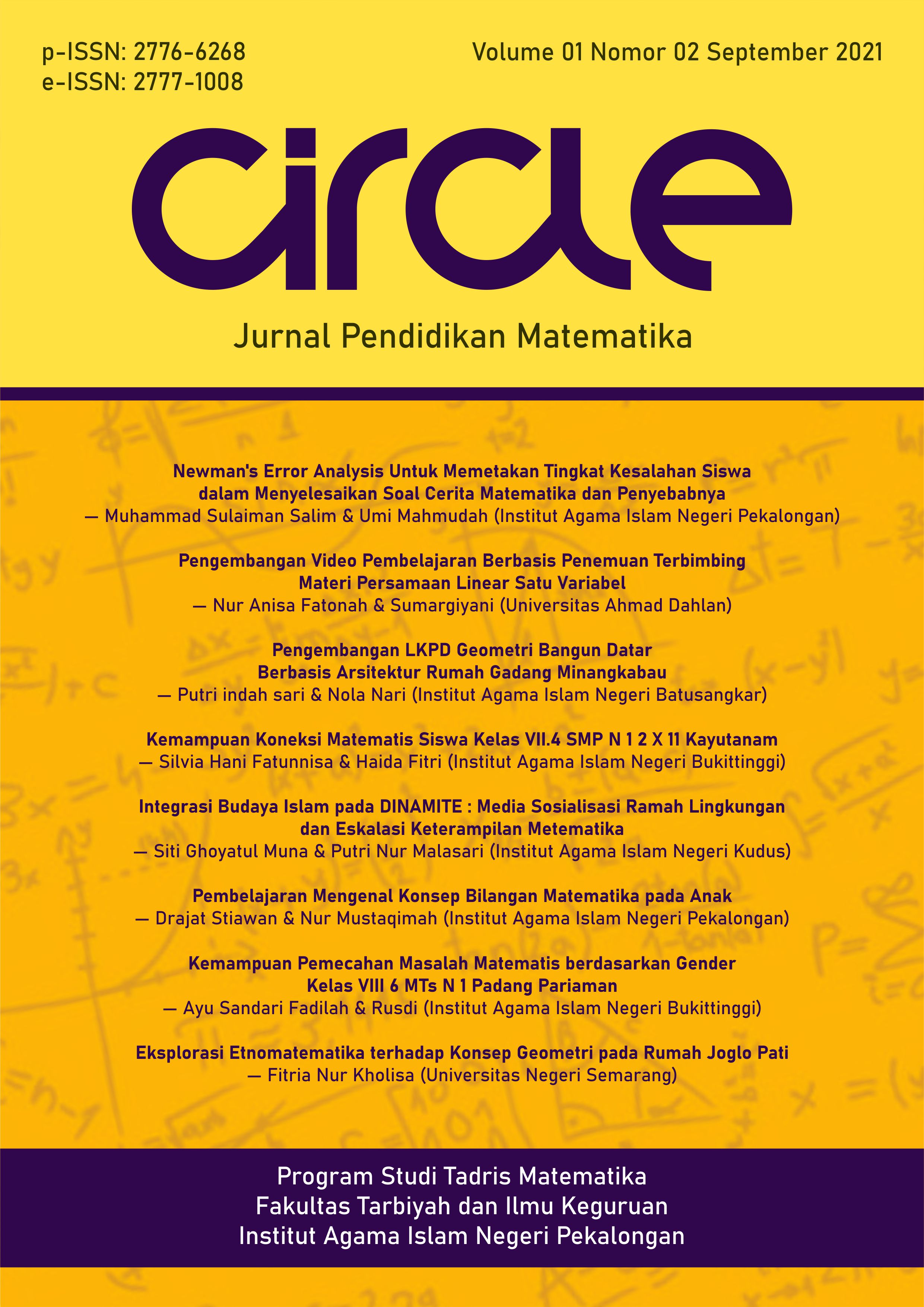
Integrasi Budaya Islam pada DINAMITE: Media Sosialisasi Ramah Lingkungan dan Eskalasi Keterampilan Matematika
DOI:
https://doi.org/10.28918/circle.v1i02.4215Abstract
The purpose of this research is to produce LKPD Geometry flat shapes based on the Minangkabau Gadang architecture that is valid and practical. This is research and development (Research and development). By using the 4-D development model. The procedure for applying the development model that the researcher did was only in three stages, namely the define, design, and develop stages. The research instrument consisted of a validity sheet and a practicality sheet. The data analysis technique used is validity analysis and practicality analysis. Based on the results of the study, it was shown that the Geometry LKPD based on the Minangkabau gadang architecture that was designed was valid and practical. The results of the validity test are 83.63% with a very valid category, and the results of the practicality test of 95.11% are categorized as very practical.
Keywords:
References
Cooke, B. D., & Buchholz, D. (2005). Mathematical Communication in The Classroom: A Teacher Makes a Difference. Early Childhood Education Journal, 32(6), 365-369.
Demidova, L. (2016). Augmented Reality and ARToolkit for Android: the First Steps. In SHS Web of Conferences (Vol. 29, p. 02010). EDP Sciences.
Fatah, A., Suryadi, D., & Sabandar, J. (2016). Open-Ended Approach: An Effort in Cultivating Students' Mathematical Creative Thinking Ability and Self-Esteem in Mathematics. Journal on Mathematics Education, 7(1), 11-20.
Fauzan, A. (2002). Applying Realistic Mathematics Education (RME) in teaching geometry in Indonesian primary schools (p. 346). University Of Twente.
Hudojo, H. 2005. Pengembangan Kurikulum dan Pembelajaran Matematika. Malang. JICA
Jacob, S. M. (2012). Mathematical achievement and critical thinking skills in asynchronous discussion forums. Procedia-Social and Behavioral Sciences, 31, 800-804.
Jacko, J. A., & Sears, A. (2003). Handbook of Research on Ubiquitous Computing Technology for Real Time Enterprises. CRC Press.
Krismanto, A. (2008). Pembelajaran Sudut dan Jarak Dalam Ruang Dimensi Tiga. Yogyakarta: Departemen Pendidikan Nasional.
Litbang Kemendikbud. 2013. Kurikulum 2013: Pergeseran Paradigma Belajar Abad-21, http://litbangkemendikbud.go.id/index.php/index-berita-kurikulum/243-kurikulum-2013pergeseran-paradigma-belajar-abad-21.
Murtiyasa, B. 2016. Isu-isu Kunci dan Tren Penelitian Pendidikan Matematika. Makalah Konferensi Nasional Penelitian Matematika dan Pembelajarannya (KNPMP) 6 Universitas Muhammadiyah Surakarta.
Nahdi, D. S. (2019). Keterampilan Matematika Di Abad 21. Jurnal Cakrawala Pendas, 5(2), 133-140.
Nazir, M. 2015. Metode Penelitian. Jakarta. Ghalia Indonesia.
Sternberg, R. J. (2003). Creative thinking in the classroom. Scandinavian Journal of Educational Research, 47(3), 325-338.
Sunardi, S., Kurniati, D., Sugiarti, T., Yudianto, E., & Nurmaharani, R. (2017). Pengembangan Indikator 4c's yang Selaras dengan Kurikulum 2013 pada Mata Pelajaran Matematika SMA/MA Kelas X Semester 1.
Downloads
Published
License
Copyright (c) 2021 Siti Ghoyatul Muna, Putri Nur Malasari

This work is licensed under a Creative Commons Attribution-ShareAlike 4.0 International License.