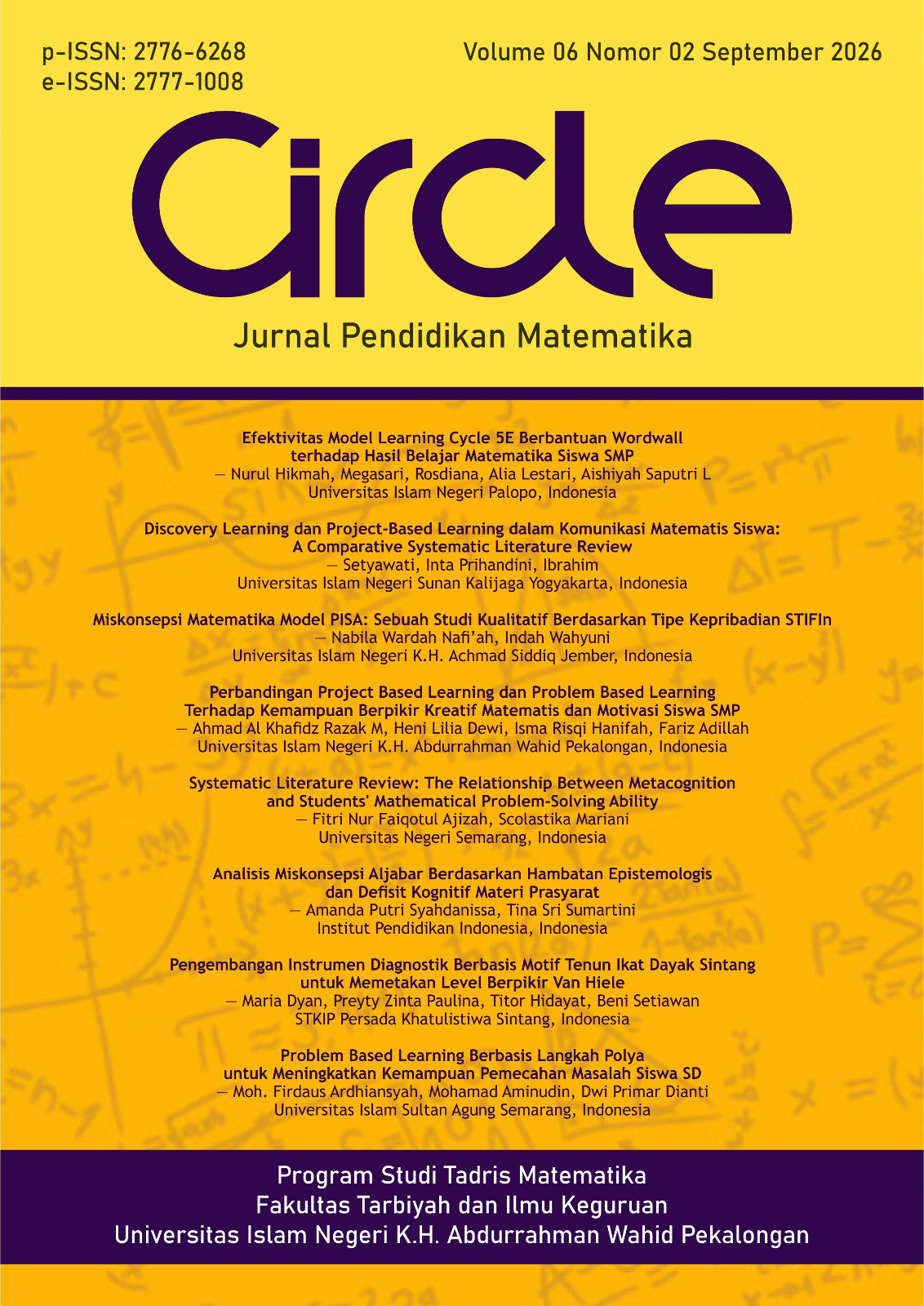
Problem-Based Learning Terintegrasi Langkah Polya untuk Meningkatkan Pemecahan Masalah Matematika Siswa
DOI:
https://doi.org/10.28918/circle.v6i2.2614Abstract
Mathematics learning in elementary school needs to encourage students to apply concepts, reason, and solve problems in meaningful contexts. However, preliminary observation and pretest results showed that fifth-grade students at SDN Kalisari 03 Sayung Demak experienced difficulties in identifying important information, planning solutions, explaining answers, and checking results. This study aimed to improve students’ mathematical problem-solving abilities on data presentation material through Problem-Based Learning (PBL) integrated with Polya’s problem-solving steps. The study employed classroom action research based on the Kemmis and McTaggart model, conducted in two cycles, with two meetings in each cycle. The participants were 32 fifth-grade students. Data were collected through tests, observations, documentation, and field notes. Mathematical problem-solving ability was assessed using five essay questions based on four Polya indicators: understanding the problem, devising a plan, carrying out the plan, and checking the result. Each indicator for each item was scored from 0 to 5, resulting in a maximum score of 100 for each student. Data were analyzed descriptively using mean scores, individual completeness, classical completeness, and the percentage of achievement on each Polya indicator. The success criteria were set at a minimum KKTP of 70 and a minimum classical completeness of 80%. The results showed that the mean score increased from 55.44 in the pre-cycle to 68.38 in Cycle I and 79.34 in Cycle II. Classical completeness increased from 28.13% to 50.00% and 87.50%, with 28 of 32 students achieving the KKTP in Cycle II. Thus, within the sequence of classroom action research, the implementation of PBL integrated with Polya’s steps was accompanied by improvements in students’ mathematical problem-solving abilities on data presentation material, and the success criteria were achieved at the end of Cycle II.
Keywords:
References
Aini, N., & Suryowati, E. (2024). The Development of Student s ’ Worksheets Based on Combinatoric Reasons in Elementary School. JTAM (Jurnal Teori Dan Aplikasi Matematika), 8(2), 390–399. https://doi.org/10.31764/jtam.v8i2.20214
Alman, A., Tatang, H., Prabawanto, S., & Kurino, Y. D. (2023). Literasi Statistik Dalam Pembelajaran Matematika SD Melalui Kurikulum 2013. 6(3), 1454–1466. https://doi.org/10.31949/jee.v6i3.6351
Aminudin, M., & Wijayanti, D. (2022). Identifikasi Pertanyaan Yang Diajukan Mahasiswa dalam Memecahkan Masalah Matematika. JNPM (Jurnal Nasional Pendidikan Matematika), 6(4), 594. https://doi.org/10.33603/jnpm.v6i4.7132
Aulia, A., Jesi, alim, A., & Puta, zetra, H. (2025). Pengaruh Pendekatan Pendidikan Matematika Realistik Indonesia (Pmri) Terhadap Hasil Belajar Siswa Pada Materi Penyajian Data Kelas V Sekolah Dasar. TUNJUK AJAR: JURNAL PENELITIAN ILMU PENDIDIKAN, 8, 80–96. https://doi.org//10.31258/jta.v8i1.80-96
Damayati, Y. I., & Sutarni, S. (2023). Penerapan Langkah Polya Dengan Pbl Untuk Peningkatan Kemampuan Menyelesaikan Soal Matematika Hots. Histogram : Jurnal Pendidikan Matematika, 7(1), 501–516. https://doi.org/10.31100/histogram.v7i1.2680
Handriyani Putri, Ade, F., Sulistyowati, Dwi, R., Mustika, Fittari, & Julianto. (2024). Analisis Metakognisi Peserta Didik Kelas V Sekolah Dasar dalam Memecahkan Masalah Matematika Bangun Ruang dalam Perspektif Teori Perkembangan Kognitif Jean Piaget. Sekolah Dasar: Kajian Teori Dan Praktik Pendidikan, 33(01), 26–39. https://doi.org/10.17977/um009v33i12024p26-39
Hayati, R., Fachrurazi, Karim, A., & Marzuki. (2022). Peningkatan Kemampuan Pemecahan Masalah Menggunakan Model Problem Based Learning Berbantuan Video. Jurnal Absis: Jurnal Pendidikan Matematika Dan Matematika, 5(1), 621–629. https://doi.org/10.30606/absis.v5i1.1558
Jannah, D. R. N., Gunarhadi, & Riyadi. (2024). Polya ’ s Approach to Analyze Students ’ Errors in HOTS Mathematics ’ Story Problems : Case Study in Elementary Schools. Jurnal Ilmiah Sekolah Dasar, 8(4), 673–685. https://doi.org/10.23887/jisd.v8i4.84327
Kemmis, S., & McTaggart, R. (1988). The Action Research Planner. Victoria: Deakin University Press.
Kodariyati, L., & Astuti, B. (2016). Pengaruh Model Pbl Terhadap Kemampuan Komunikasi Dan Pemecahan Masalah Matematika Siswa Kelas V SD. Jurnal Prima Edukasia, 4, 93–106. https://doi.org/10.21831/jpe.v4i1.7713
Mubharokh, A. S., Ilma, R., Putri, I., & Susanti, E. (2022). Kemampuan Penalaran Matematis Peserta Didik Pada Materi Penyajian Data Menggunakan Pendidikan Matematika Realistik Indonesia (PMRI). JPMI Jurnal Pembelajaran Matematika Inovatif, 5(2), 345–354. https://doi.org/10.22460/jpmi.v5i2.345-354
Nasrulloh, I., Ibrahim, N., & Solihatin, E. (2024). Improving Mathematical Problem-Solving Skills through the Development of Interactive Digital Modules. Mosharafa: Jurnal Pendidikan Matematika, 13(1), 17–28. https://doi.org/10.31980/mosharafa.v13i1.1972
OECD. (2025). PISA 2025 Results (Volume I): I (Number Volume I).
Pratiwi, D. T., & Alyani, F. (2022). Kemampuan Pemecahan Masalah Matematika Siswa Kelas V SD Pada Materi Pecahan. Journal for Lesson and Learning Studies, 5(1), 136–142. https://doi.org/10.23887/jlls.v5i1.49100
Purwanto, P. P., Baedowi, S., & Wakhyudin, H. (2025). Efektivitas Model Problem Based Learning dengan Metode Polya pada Materi Pecahan dalam Mengembangkan Literasi dan Numerasi Siswa Kelas V Sekolah Dasar. Ainara Journal (Jurnal Penelitian Dan PKM Bidang Ilmu Pendidikan), 6(1), 10–16. https://doi.org/10.54371/ainj.v6i1.700
Puspitasari, R. P. P., Sutarno2, & I Wayan Dasna. (2020). Pengaruh Model Problem Based Learning terhadap Kemampuan Pengaruh Model Problem Based Learning terhadap Kemampuan Berpikir Tingkat Tinggi dan Hasil Belajar Siswa Kelas V SD. Jurnal Pendidikan: Teori, Penelitian, Dan Pengembangan, 5(4), 503–511. https://doi.org/10.17977/jptpp.v5i4.13371
Safitri, D., & Nurafni. (2021). The Effectiveness of PBL Models Based on Google Meet on the Ability of Mathematical Problem Solving. Jurnal Ilmiah Sekolah Dasar, 5(2), 315–325. https://doi.org/10.23887/jisd.v5i2.36608
Suparman, S., Tamur, M., Yunita, Y., Wijaya, T. T., & Syaharuddin, S. (2021). Using Problem-Based Learning to Enhance Mathematical Abilities of Primary School Students: A Systematic Review and Meta-Analysis. JTAM (Jurnal Teori Dan Aplikasi Matematika), 5(1), 144. https://doi.org/10.31764/jtam.v5i1.3806
Wahyuni, N., Dodik, M., & Dona, Ningrum, M. (2024). Kemampuan pemecahan masalah matematika siswa melalui model problem based learning berbantuan media pembelajaran scratch. Jurnal Penelitian Pembelajaran Matematika Sekolah (JP2MS), 8(2), 153–166. https://doi.org/10.33369/jp2ms.8.2.153-166
Wiastrini Ni, Wayan, E., Suranata, K., & Trisna, G. A. P. S. (2024). Implementation of Problem Based Learning Model in Improving Elementary School Students ’ Mathematics Learning Outcomes. 29(2), 324–332. https://doi.org/10.23887/mi.v29i2.78928
Downloads
Published
License
Copyright (c) 2026 Moh. Firdaus Ardhiansyah, Mohamad Aminudin, Dwi Primar Dianti

This work is licensed under a Creative Commons Attribution-ShareAlike 4.0 International License.