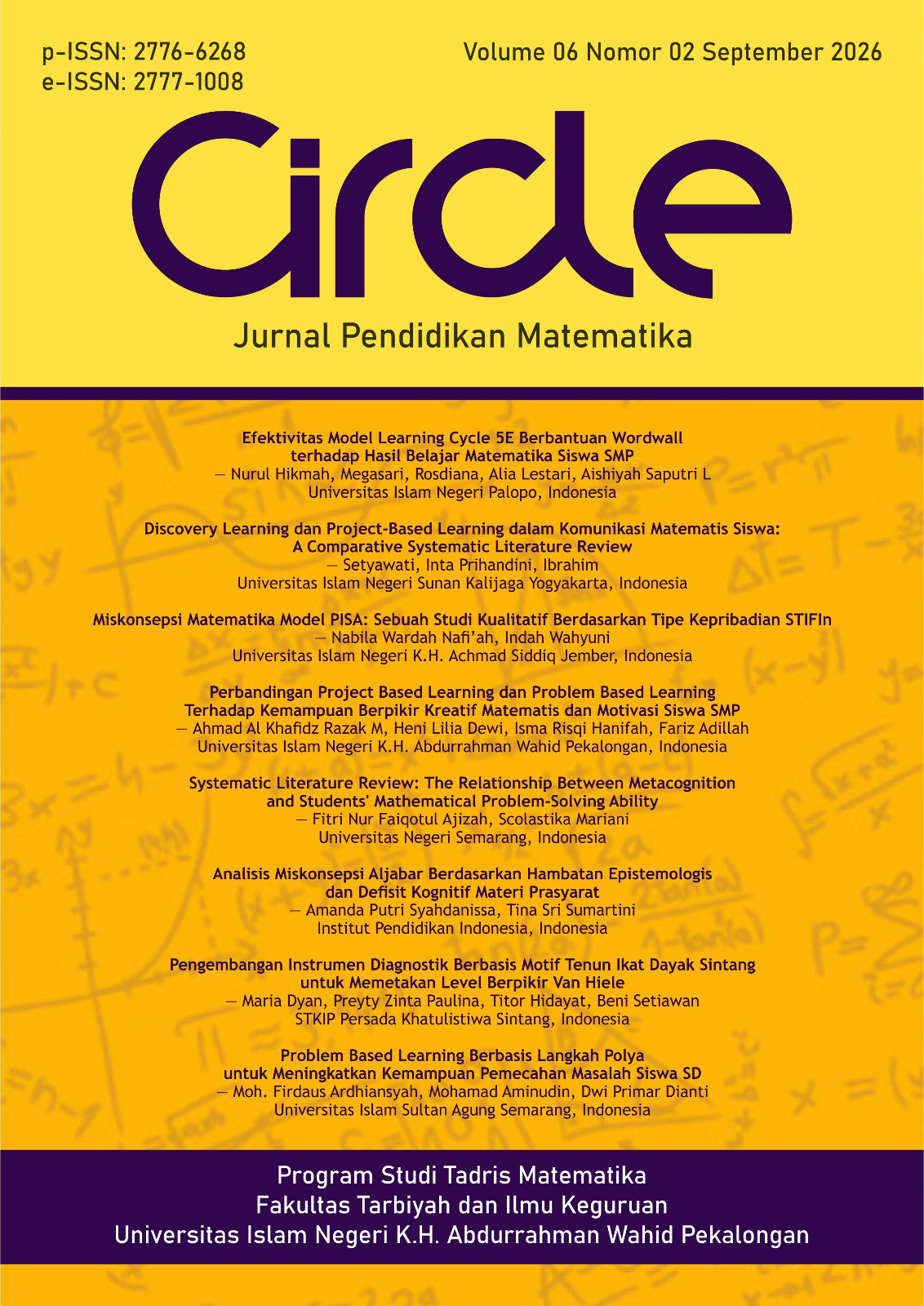
Systematic Literature Review: The Relationship Between Metacognition and Students' Mathematical Problem-Solving Ability
DOI:
https://doi.org/10.28918/circle.v6i2.2609Abstract
Although numerous empirical studies have examined the relationship between metacognition and students’ mathematical problem-solving ability, the available evidence remains fragmented. Previous review studies primarily synthesized literature published before 2020, generally treated metacognition as a single construct, and provided limited discussion of differences across educational levels as well as methodological and conceptual heterogeneity. To address these limitations, this study systematically synthesizes empirical evidence published between 2020 and 2026 using a Systematic Literature Review (SLR) following the PRISMA 2020 protocol. Twenty empirical studies retrieved from Scopus, Web of Science, Google Scholar, and Sinta-indexed journals met the inclusion criteria and were critically appraised using the Mixed Methods Appraisal Tool (MMAT) 2018. A narrative synthesis was conducted because of substantial heterogeneity among the included studies. Unlike previous reviews, this study synthesizes findings by considering differences in metacognitive dimensions, educational levels, methodological characteristics, and study quality. The findings indicate a consistent qualitative pattern of positive association between metacognition and mathematical problem-solving ability across the reviewed studies, rather than a statistically established relationship. Metacognitive regulation, particularly planning, monitoring, and evaluation, emerged as the dimensions most consistently associated with mathematical problem-solving ability, although the evaluation stage remained the most challenging across studies. The available evidence is predominantly derived from junior and senior secondary education, highlighting the need for further high-quality primary research at the elementary school level. These findings provide a more comprehensive understanding of the role of metacognition and support its explicit integration into mathematics instruction.
Keywords:
References
Amalia, N. R., & Salafudin, S. (2022). Penerapan Pendekatan Problem Solving Versi Polya untuk Meningkatkan Kemampuan Pemecahan Masalah Matematika Siswa MTsS Hifal Pekalongan. CIRCLE : Jurnal Pendidikan Matematika, 2(01), 70–77. https://doi.org/10.28918/circle.v2i01.5094
Bandura, A. (1997). Self-Efficacy: The Exercise of Control (1st ed.). W.H Freeman and Company. https://www.academia.edu/28274869/Albert_Bandura_Self_Efficacy_The_Exercise_of_Control_W_H_Freeman_and_Co_1997_pdf
Brown, A. L. (1987). Metacognition, Executive Control, Self-Regulation, and Other More Mysterious Mechanisms. In F. E. Weinert & R. H. Kluwe (Eds.), Metacognition, Motivation, and Understanding (pp. 65–116). Lawrence Erlbaum Associates.
Cahyani, N. P. D., Redana, M., & Witraguna, K. Y. (2024). Pengaruh Model Pembelajaran Think Talk Write (TTW) berbantuan LKPD dengan Teori Polya terhadap Kemampuan Pemecahan Masalah Matematika Siswa Kelas V SD Negeri 2 Batubulan Gianyar. Circle: Jurnal Pendidikan Matematika, 4(2), 101–110. https://doi.org/10.28918/circle.v4i2.8653
Defi, S. A., Haryono, Y., & Jufri, L. H. (2022). Metacognitive Analysis of Students in Solving Mathematics Problem. Al Khawarizmi: Jurnal Pendidikan Dan Pembelajaran Matematika, 6(2), 150. https://doi.org/10.22373/jppm.v6i2.15420
Fadillah, R., Budiyono, & Nurhasanah, F. (2021). The Analysis of Students’ Metacognition in Solving Math Problems Based on Self-Efficacy. Journal of Physics: Conference Series, 1808(1), 012062. https://doi.org/10.1088/1742-6596/1808/1/012062
Flavell, J. H. (1979). Metacognition and Cognitive Monitoring: A New Area of Cognitive–Developmental Inquiry. American Psychologist, 34(10), 906–911. https://doi.org/10.1037/0003-066X.34.10.906
Hidayat, R., Mohd Saad, M. R., & Wewe, M. (2025). A Meta-Analysis of the Effect of Metacognitive Instruction on Mathematics Achievement. Cogent Education, 12(1). https://doi.org/10.1080/2331186X.2025.2517510
Hidayati, D. W., Junaedi, I., & Mulyono. (2025). Studi Perbandingan Kurikulum Finlandia dan Indonesia: Upaya Peningkatan Kemampuan Pemecahan Masalah Matematika Siswa SMA. CIRCLE : Jurnal Pendidikan Matematika, 5(1), 1–21. https://doi.org/https://doi.org/10.28918/circle.v5i1.9812
Hong, Q. N., Fàbregues, S., Bartlett, G., Boardman, F., Cargo, M., Dagenais, P., Gagnon, M.-P., Griffiths, F., Nicolau, B., O’Cathain, A., Rousseau, M.-C., Vedel, I., & Pluye, P. (2018). The Mixed Methods Appraisal Tool (MMAT) version 2018 for Information Professionals and Researchers. Education for Information, 34(4), 285–291. https://doi.org/10.3233/EFI-180221
Khasanah, N. (2021). Analisis Kemampuan Pemecahan Masalah Matematis Siswa Quitters Ditinjau dari Kemampuan Metakognitif. PYTHAGORAS Jurnal Pendidikan Matematika, 16(1), 44–58. https://doi.org/10.21831/pg.v16i1.34509
Khunaeni, S., Mariani, S., & Hendikawati, P. (2024). Kemampuan Pemecahan Masalah Ditinjau dari Metakognisi pada Model Problem Based Learning Berbantuan Google Classroom. Symmetry Journal, 9(2), 238–345. https://doi.org/https://doi.org/10.23969/symmetry.v9i2.16897
Kumar, L., Goud, J., & Ramulu, P. (2025). Mathematics and its Applications. International Journal For Multidisciplinary Research, 7(5). https://doi.org/10.36948/ijfmr.SVGASCA-2025.1101
Kurniawan, P., & Wijayanti, P. (2022). Profil Metakognisi Siswa SMA dalam Memecahkan Masalah Matematika Materi Fungsi Komposisi dan Fungsi Invers Ditinjau dari Kemampuan Siswa. MATHEdunesa, 11(3), 644–656. https://doi.org/10.26740/mathedunesa.v11n3.p644-656
Murtiyasa, B., & Anggraini, O. R. (2022). Metacognitive Identification in Solving Mathematics Problems of Junior High School Students. AL-ISHLAH: Jurnal Pendidikan, 14(4), 4987–4996. https://doi.org/10.35445/alishlah.v14i4.1808
National Council of Teachers of Mathematics. (2000). Principles and Standards for School Mathematics. National Council of Teachers of Mathematics.
Nuraini, F., Setiani, A., & Nurcahyono, N. A. (2024). Analisis Kemampuan Metakognisi Siswa dalam Pemecahan Masalah Matematika Ditinjau dari Tipe Kepribadian Ekstrovert dan Introvert. Jurnal Cendekia : Jurnal Pendidikan Matematika, 8(1), 759–777. https://doi.org/10.31004/cendekia.v8i1.2678
Nurhayati, N., & Kusaeri, A. (2024). Analisis Kemampuan Metakognisi Siswa dalam Pemecahan Masalah Matematika Berbasis Etnomatematika Uma Lengge. Kognitif: Jurnal Riset HOTS Pendidikan Matematika, 4(1). https://doi.org/10.51574/kognitif.v4i1.1545
OECD. (2023). PISA 2022 Results (Volume I): The State of Learning and Equity in Education. OECD Publishing. https://doi.org/https://www.oecd.org/en/publications/pisa-2022-results-volume-i_53f23881-en.html
Page, M. J., McKenzie, J. E., Bossuyt, P. M., Boutron, I., Hoffmann, T. C., Mulrow, C. D., Shamseer, L., Tetzlaff, J. M., Akl, E. A., Brennan, S. E., Chou, R., Glanville, J., Grimshaw, J. M., Hróbjartsson, A., Lalu, M. M., Li, T., Loder, E. W., Mayo-Wilson, E., McDonald, S., … Moher, D. (2021). The PRISMA 2020 Statement: An Updated Guideline for Reporting Systematic Reviews. BMJ, n71. https://doi.org/10.1136/bmj.n71
Pajares, F., & Miller, M. D. (1994). Role of Self-Efficacy and Self-Concept Beliefs in Mathematical Problem Solving: A Path Analysis. Journal of Educational Psychology, 86(2), 193–203. https://doi.org/10.1037/0022-0663.86.2.193
Pardiansyah, R., Kamid, K., & Hariyadi, B. (2021). Analysis of Students’ Problem Solving Ability Based on Metacognition Ability in Set Topic. Indonesian Journal of Science and Mathematics Education, 4(2), 108–117. https://doi.org/10.24042/ijsme.v4i2.8668
Permata, A., Solehudin, S., & Sugilar, H. (2023). Analisis Kemampuan Metakognisi Pada Pemecahan Masalah Matematis Terhadap Kreativitas Belajar Siswa. Jurnal Perspektif, 7(1), 73. https://doi.org/10.15575/jp.v7i1.204
Polya, G. (1957). How to Solve It : A New Aspect of Mathematical Method (2nd ed.). Princeton University Press. https://www.hlevkin.com/hlevkin/90MathPhysBioBooks/Math/Polya/George_Polya_How_To_Solve_It_.pdf
Popay, J., Roberts, H., Sowden, A., Petticrew, M., Arai, L., Rodgers, M., Britten, N., Roen, K., & Duffy, S. (2006). Guidance on the Conduct of Narrative Synthesis in Systematic Reviews: A Product from the ESRC Methods Programme. Lancaster University. https://www.lancaster.ac.uk/media/lancaster-university/content-assets/documents/fhm/dhr/chir/NSsynthesisguidanceVersion1-April2006.pdf
Prastiti, T. D., Ahmadah, I. F., & Siswono, T. Y. E. (2026). Metacognitive Regulation in Collaborative Math Problem-Solving among Heterogeneous Secondary Students. Eurasia Journal of Mathematics, Science and Technology Education, 22(5), em2834. https://doi.org/10.29333/ejmste/18518
Safitri, P. T., Yasintasari, E., Putri, S. A., & Hasanah, U. (2020). Analisis Kemampuan Metakognisi Siswa dalam Memecahkan Masalah Matematika Model PISA. Journal of Medives : Journal of Mathematics Education IKIP Veteran Semarang, 4(1), 11. https://doi.org/10.31331/medivesveteran.v4i1.941
Saodah, N., Pujiastuti, E., & Wijayanti, K. (2024). Kemampuan Pemecahan Masalah Matematis Ditinjau dari Metakognisi Siswa Melalui Problem-Based Learning dengan Soal Open Ended Berbantuan Sevima Edlink. Jurnal Cendekia : Jurnal Pendidikan Matematika, 8(1), 189–203. https://doi.org/10.31004/cendekia.v8i1.2624
Scheibe, D. A., Was, C. A., Dunlosky, J., & Thompson, C. A. (2023). Metacognitive Cues, Working Memory, and Math Anxiety: The Regulated Attention in Mathematical Problem Solving (RAMPS) Framework. Journal of Intelligence, 11(6), 117. https://doi.org/10.3390/jintelligence11060117
Schoenfeld, A. H. (2016). Learning to Think Mathematically: Problem Solving, Metacognition, and Sense Making in Mathematics (Reprint). Journal of Education, 196(2), 1–38. https://doi.org/10.1177/002205741619600202
Schraw, G. (1998). Promoting General Metacognitive Awareness. Instructional Science, 26(1–2), 113–125. https://doi.org/10.1023/A:1003044231033
Schraw, G., & Dennison, R. S. (1994). Assessing Metacognitive Awareness. Contemporary Educational Psychology, 19(4), 460–475. https://doi.org/10.1006/ceps.1994.1033
Shodikin, A., Nurkumala, S. E., & Sumarno, W. K. (2022). Student Metacognition in Mathematics Problem Solving on Set Materials. Mathline : Jurnal Matematika Dan Pendidikan Matematika, 7(2), 288–297. https://doi.org/10.31943/mathline.v7i2.297
Subba, B. H., Chanunan, S., & Poonpaiboonpipat, W. (2025). A Proposed Constructivism-Based Instructional Model to Enhance Metacognition and Mathematical Problem-Solving Skills in Bhutanese Grade Nine Students. Journal on Mathematics Education, 16(1), 51–72. https://doi.org/10.22342/jme.v16i1.pp51-72
Suryani, D. R., Nurâ€TMAini, K. D., & Natsir, I. (2023). Perbedaan Level Kemampuan Metakognisi Siswa dalam Memecahkan Masalah Matematika Ditinjau dari Kemampuan Matematika Siswa. AKSIOMA: Jurnal Program Studi Pendidikan Matematika, 12(3), 3494–3502. https://doi.org/10.24127/ajpm.v12i3.7557
Suryaningtyas, S., & Setyaningrum, W. (2020). Analisis Kemampuan Metakognitif Siswa SMA Kelas XI Program IPA dalam Pemecahan Masalah Matematika. Jurnal Riset Pendidikan Matematika, 7(1), 74–87. https://doi.org/10.21831/jrpm.v7i1.16049
Suyanto, S., Waluya, S. B., Rosyida, I., Isnarto, I., & Kurniasih, A. W. (2026). Piaget’s Cognitive Theory in Upper Primary School Students’ Mathematical Problem Solving: A Literature Review. Circle: Jurnal Pendidikan Matematika, 6(1), 67–77. https://doi.org/10.28918/circle.v6i1.2605
Taufik, A. R., Suryani, D. R., & Nurhayati, N. (2022). Analisis Metakognisi Siswa dalam Memecahkan Masalah Matematika Ditinjau dari Gaya Kognitif Reflektif dan Impulsif. Science Map Journal, 4(1), 40–48. https://doi.org/10.30598/jmsvol4issue1pp40-48
Thi-Nga, H., Thi-Binh, V., & Nguyen, T.-T. (2024). Metacognition in Mathematics Education: From Academic Chronicle to Future Research Scenario–A Bibliometric Analysis with the Scopus Database. Eurasia Journal of Mathematics, Science and Technology Education, 20(4), em2427. https://doi.org/10.29333/ejmste/14381
Toikka, S., Eronen, L., Atjonen, P., & Havu-Nuutinen, S. (2024). Combined Conceptualisations of Metacognitive Knowledge to Understand Students’ Mathematical Problem-Solving. Cogent Education, 11(1). https://doi.org/10.1080/2331186X.2024.2357901
Veenman, M. V. J., Van Hout-Wolters, B. H. A. M., & Afflerbach, P. (2006). Metacognition and Learning: Conceptual and Methodological Considerations. Metacognition and Learning, 1(1), 3–14. https://doi.org/10.1007/s11409-006-6893-0
Wangguway, Y., Nusantara, T., Sudirman, S., & Susiswo, S. (2025). Students’ Metacognitive Activities in Contextual Mathematical Problem Solving. International Journal of Evaluation and Research in Education (IJERE), 14(1), 229. https://doi.org/10.11591/ijere.v14i1.28342
William, S. K., & Maat, S. M. (2020). Understanding Students’ Metacognition in Mathematics Problem Solving: A Systematic Review. International Journal of Academic Research in Progressive Education and Development, 9(3), 115–227. https://doi.org/10.6007/IJARPED/v9-i3/7847
Yanti, A. W., & Alvira, R. (2026). Students’ Metacognitive Processes in Mathematical Problem Solving Viewed from VARK Learning Styles. Pi: Mathematics Education Journal, 9(1), 39–50. https://doi.org/10.21067/pmej.v9i1.13716
Downloads
Published
License
Copyright (c) 2026 Fitri Nur Faiqotul Ajizah, Scolastika Mariani

This work is licensed under a Creative Commons Attribution-ShareAlike 4.0 International License.