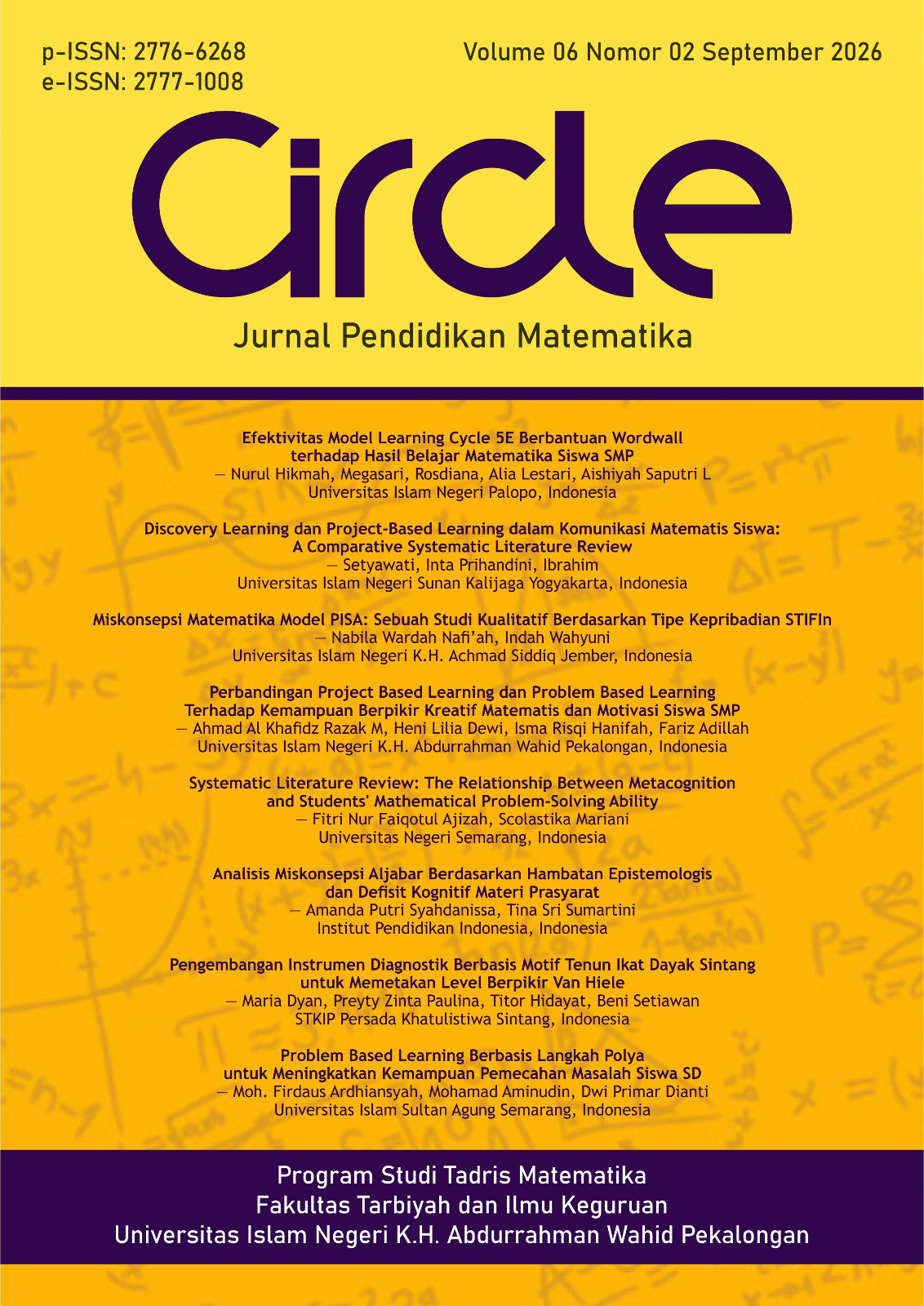
Discovery Learning dan Project-Based Learning dalam Komunikasi Matematis Siswa: A Comparative Systematic Literature Review
DOI:
https://doi.org/10.28918/circle.v6i2.2611Abstract
Mathematical communication is recognized as a fundamental competence in contemporary mathematics education; however, its development through effective learning models remains a significant pedagogical challenge. This study aims to examine the comparative roles of Discovery Learning (DL) and Project-Based Learning (PjBL) in enhancing students' mathematical communication skills. A Systematic Literature Review (SLR) was conducted following the PRISMA guidelines, analyzing 25 empirical studies published between 2016 and 2026. The findings indicate distinct functional differences between the two learning models. Discovery Learning primarily strengthens written mathematical communication, particularly in symbolic representation and formal reasoning, through structured stages such as data processing and verification. Conversely, Project-Based Learning is more effective in fostering oral communication and contextual argumentation through project design activities and collaborative presentations. This study also identifies several moderating variables, including learning styles and self-efficacy, which influence the effectiveness of both models in facilitating mathematical communication. Overall, the findings suggest that no single model is independently capable of covering all dimensions of mathematical communication. Therefore, a strategic integration of Discovery Learning and Project-Based Learning can provide a more comprehensive instructional approach to developing students' mathematical communication skills in the mathematics classroom.
Keywords:
References
Alfieri, L., Brooks, P. J., Aldrich, N. J., & Tenenbaum, H. R. (2011). Does discovery-based instruction enhance learning? Journal of Educational Psychology, 103(1), 1–18. https://doi.org/10.1037/a0021017
Pratiwi, G.I., Sova, F., Putra, F.G., Yunian Putra, R.W., Kusuma, A.P., & Rahmawati, N.K. (2020). The Influence of Project-based Learning (PjBL) and Learning Style om Mathematics Communication Skills of Junior High School Students. Journal of Physics: Conference Series, 1467. https://doi.org/10.1088/1742-6596/1467/1/012064
Baroody, A. J., Feil, Y., & Johnson, A. R. (2007). An alternative reconceptualization of procedural and conceptual knowledge. Journal for Research in Mathematics Education, 38(2), 115–131. https://doi.org/10.2307/30034952
Boaler, J. (2022). Seeing is achieving: The importance of fingers, touch, and visual thinking to mathematics learners. In S. L. Macrine & J. M. B. Fugate (Eds.), Movement matters: How embodied cognition informs teaching and learning (pp. 121–130). The MIT Press. https://doi.org/10.7551/mitpress/13593.003.0015
Bruner, J. S. (1961). The act of discovery. Harvard Educational Review, 31(1), 21–32.
Cholily, Y. M., Amalia, S., & Rosyadi, A. A. P. (2024). Student’s mathematical communication ability given self concept in learning mathematics through discovery learning. Prima: Jurnal Pendidikan Matematika, 8(1), 89–101. https://doi.org/10.31000/prima.v8i1.9902
Dani, U., & Zubaidah, T. (2020). Improving Year 7 students’ mathematics communication skills by the discovery learning model. Journal of Mathematics and Mathematics Education, 10(2), 87–96. https://doi.org/10.20961/jmme.v10i2.47084
Detiana, Johar, R., & Mailizar. (2020). Students’ mathematical communication in discovering the concept of graphs of trigonometric functions through instructional videos. Journal of Physics: Conference Series, 1460(1), 012020. https://doi.org/10.1088/1742-6596/1460/1/012020
Farokhah, L., Nurmulia, F., Herman, T., Jupri, A., Pratiwi, V., Nurkaeti, N., & Abidin, Z. (2021). The improvement of mathematical communication ability of elementary school students through project-based learning using mind map technique. Journal of Physics: Conference Series, 1806(1), 012105. https://doi.org/10.1088/1742-6596/1806/1/012105
Fauziyah, I., & Kisdiono, T. F. (2025). Improving students’ collaboration and communication skills through project-based learning model and a deep learning approach in Phase F statistics material. Radian Journal: Research and Review in Mathematics Education, 4(4), 212–220. https://doi.org/10.35706/radian.v4i4.13265
Fitriana, R. W., Isnarto, & Prabowo, A. (2018). The analysis of student’s mathematical communication ability viewed from learning styles through project based learning models on cylinder and cone materials. Unnes Journal of Mathematics Education, 7(3), 156–163. https://doi.org/10.15294/ujme.v7i1.22165
Fitriyani, Su’ad, & Sumaji. (2023). The effectiveness of mathematics teaching materials with project based learning models in improving students’ mathematical communication skills. AIP Conference Proceedings, 2733(1), 030020. https://doi.org/10.1063/5.0140509
Gustiani, D. S., Irman, A., & Fadhillah, F. M. (2019). Discovery learning model and props of statistical cenic in improving the mathematical communication ability of junior high school students. Journal of Innovative Mathematics Learning, 2(1), 29–38.
Hakim, A. R., Hasanuddin, Aulia, F. M., & Lee, J. W. (2025). A meta-analysis of project-based learning’s effect on mathematical communication skills across educational levels and group sizes. Reforma: Jurnal Pendidikan dan Pembelajaran, 15(2), 124–140. https://doi.org/10.30736/reforma.v15i2.1250
Halimatussadiah, A., & Halimah, L. (2017). Efektivitas pembelajaran metode discovery learning terhadap kemampuan komunikasi matematis. Antologi UPI, 5(1), 35–43.
Han, S., Capraro, R. M., & Capraro, M. M. (2016). How science, technology, engineering, and mathematics project based learning affects high-need students in the U.S. Learning and Individual Differences, 51, 157–166. https://doi.org/10.1016/j.lindif.2016.08.045
Hayati Dina, Z., Ikhsan, M., & Hajidin. (2019). The improvement of communication and mathematical disposition abilities through discovery learning model in junior high school. Journal of Research and Advances in Mathematics Education, 4(1), 11–22. https://doi.org/10.23917/jramathedu.v4i1.6824
In’am, A., Effendi, M. M., & Darmayanti, R. (2024). The effect of project-based learning (PjBL) using Pizzaluv-Mathematics media on self-efficacy and 4C skills. AKSIOMA: Jurnal Program Studi Pendidikan Matematika, 13(4), 1339–1360. https://doi.org/10.24127/ajpm.v13i4.11230
Kementerian Pendidikan, Kebudayaan, Riset, dan Teknologi. (2021). Buku saku tanya jawab Kurikulum Merdeka. https://repositori.kemendikdasmen.go.id/24917/
Krajcik, J. S., & Blumenfeld, P. C. (2006). Project-based learning. In R. K. Sawyer (Ed.), The Cambridge handbook of the learning sciences (pp. 317–334). Cambridge University Press. https://doi.org/10.1017/CBO9780511816833.020
Krajcik, J. S., & Czerniak, C. M. (2025). Teaching science in elementary and middle school: A project-based learning approach (6th ed.). Routledge. https://doi.org/10.4324/9781003473831
Lethulur, N. D., Juandi, D., & Dahlan, J. A. (2025). The effectiveness of discovery, inquiry, problem, and project-based learning in mathematics education: A systematic literature review. Jurnal Pendidikan MIPA, 26(1), 268–279. https://doi.org/10.23960/jpmipa.v26i1.pp268-279
Marfu’ah, S., Masrukan, & Walid. (2023). The effectiveness of project based learning with performance assessment on mathematical reasoning ability in view of self confidence students at SMA Negeri 7 Semarang. Jurnal Mercumatika: Jurnal Penelitian Matematika dan Pendidikan Matematika, 7(2), 58–68. https://doi.org/10.26486/jm.v7i2.3267
Mustafa, A. N., & Lasmaya, D. (2020). Discovery learning versus traditional learning: How effective discovery learning can improve mathematical creative thinking skills. Pasundan Journal of Mathematics Education: Jurnal Pendidikan Matematika, 10(1), 1–17. https://doi.org/10.23969/pjme.v10i1.2432
Nabilah, K., Khadijah, M., Utari, K., & Hasratuddin. (2024). Model guide discovery learning terhadap kemampuan komunikasi matematis. Ideguru: Jurnal Karya Ilmiah Guru, 9(1), 241–248. https://doi.org/10.51169/ideguru.v9i1.806
National Council of Teachers of Mathematics. (2000). Principles and standards for school mathematics.
Noor, H. J., Masrukan, M., & Dewi, N. R. (2024). Analysis of students’ mathematical communication skills in review of self-efficacy in the project-based learning model using project assessment. AlphaMath: Journal of Mathematics Education, 10(1), 12–24. https://doi.org/10.30595/alphamath.v10i1.20624
OECD. (2019). OECD Learning Compass 2030: A series of concept notes. https://www.oecd.org/content/dam/oecd/en/about/projects/edu/education-2040/1-1-learning-compass/OECD_Learning_Compass_2030_Concept_Note_Series.pdf
OECD. (2023). PISA 2022 results (Volumes I and II): Country notes—Indonesia. OECD Publishing.
Page, M. J., McKenzie, J. E., Bossuyt, P. M., Boutron, I., Hoffmann, T. C., Mulrow, C. D., Shamseer, L., Tetzlaff, J. M., Akl, E. A., Brennan, S. E., Chou, R., Glanville, J., Grimshaw, J. M., Hróbjartsson, A., Lalu, M. M., Li, T., Loder, E. W., Mayo-Wilson, E., McDonald, S., … Moher, D. (2021). The PRISMA 2020 statement: An updated guideline for reporting systematic reviews. Systematic Reviews, 10(1), 89. https://doi.org/10.1186/s13643-021-01626-4
Paruntu, P. E., Sukestiyarno, Y. L., & Budi Prasetyo, A. P. (2018). Analysis of mathematical communication ability and curiosity through project based learning models with scaffolding. Unnes Journal of Mathematics Education Research, 7(1), 26–34.
Prabaningrum, D., & Waluya, S. B. (2020). The improvement of mathematical communication skill through project based learning with STEM strategy. In Proceedings of the International Conference on Science and Education and Technology (ISET 2019) (pp. 646–651). Atlantis Press. https://doi.org/10.2991/assehr.k.200620.132
Prasetyowati, D., Rasiman, & Kartinah. (2022). The effect of video-assisted discovery learning model on junior high school students’ mathematical communication. KnE Social Sciences, 7(14), 204–212. https://doi.org/10.18502/kss.v7i14.11969
Rachmawati, R., Sitompul, N. C., & Rusmawati, R. D. (2026). The effectiveness of project-based learning integrated with Canva and mathematical aptitude on whole number learning in elementary school students. Jurnal Teknologi Pendidikan: Jurnal Penelitian dan Pengembangan Pembelajaran, 11(1), 90–104. https://doi.org/10.33394/jtp.v11i1.19377
Ruslan, R., Lu’mu, L., Fakhri, M. M., Ahmar, A. S., & Fadhilatunisa, D. (2024). Effectiveness of the flipped project-based learning model based on Moodle LMS to improve student communication and problem-solving skills in learning programming. Education Sciences, 14(9), 1021. https://doi.org/10.3390/educsci14091021
Saha, B., & Thakur, G. S. M. (2025). Project-based learning. In M. Athanasekou & A. Zagorianakos (Eds.), Project-based learning, competency-based assessments, and experiential education for modern learners (pp. 53–80). IGI Global. https://doi.org/10.4018/979-8-3373-4957-2.ch003
Schleicher, A. (2019). PISA 2018: Insights and interpretations. OECD Publishing. https://gpseducation.oecd.org/Content/ProjectsMaterial/PISA%202018%20Insights%20and%20Interpretations.pdf
Stoller, F. L., & Myers, C. C. (2019). Project-based learning: A five-stage framework to guide language teachers. In A. Gras-Velazquez (Ed.), Project-based learning in second language acquisition: Building communities of practice in higher education (pp. 25–47). Routledge. https://doi.org/10.4324/9780429457432-3
Stylianides, A. J., & Stylianides, G. J. (2014). Impacting positively on students’ mathematical problem solving beliefs: An instructional intervention of short duration. The Journal of Mathematical Behavior, 33, 8–29. https://doi.org/10.1016/j.jmathb.2013.08.005
Sutrisno, S. (2019). Meningkatkan hasil belajar siswa melalui pembelajaran dengan model discovery learning pada siswa kelas X MIPA 5 SMA N 1 Bantul tahun pelajaran 2018/2019. Ideguru: Jurnal Karya Ilmiah Guru, 4(1), 58–71. https://doi.org/10.51169/ideguru.v4i1.69
Syadevi, A. R. D., Heleni, S., & Siregar, S. N. (2025). Implementation of the Discovery Learning (DL) model to enhance the mathematical communication skills. Journal of Educational Sciences, 9(6), 6559–6569. https://doi.org/10.31258/jes.9.6.p.6559-6569
Widodo, H. S., Taufik, M., & Susanti, R. D. (2021). Application of discovery learning model in mathematics learning to determine students’ mathematical communication ability. Mathematics Education Journal, 5(1), 80–90. https://doi.org/10.22219/mej.v5i1.16008
Zulfa, A., Kartono, & Cahyono, A. N. (2021). Mathematical communication skills in terms of self-efficacy through guided discovery learning assisted immediate feedback. Unnes Journal of Mathematics Education Research, 10(1), 75–82. https://journal.unnes.ac.id/sju/index.php/ujmer/article/view/34665
Downloads
Published
License
Copyright (c) 2026 Setyawati, Inta Prihandini, Ibrahim

This work is licensed under a Creative Commons Attribution-ShareAlike 4.0 International License.