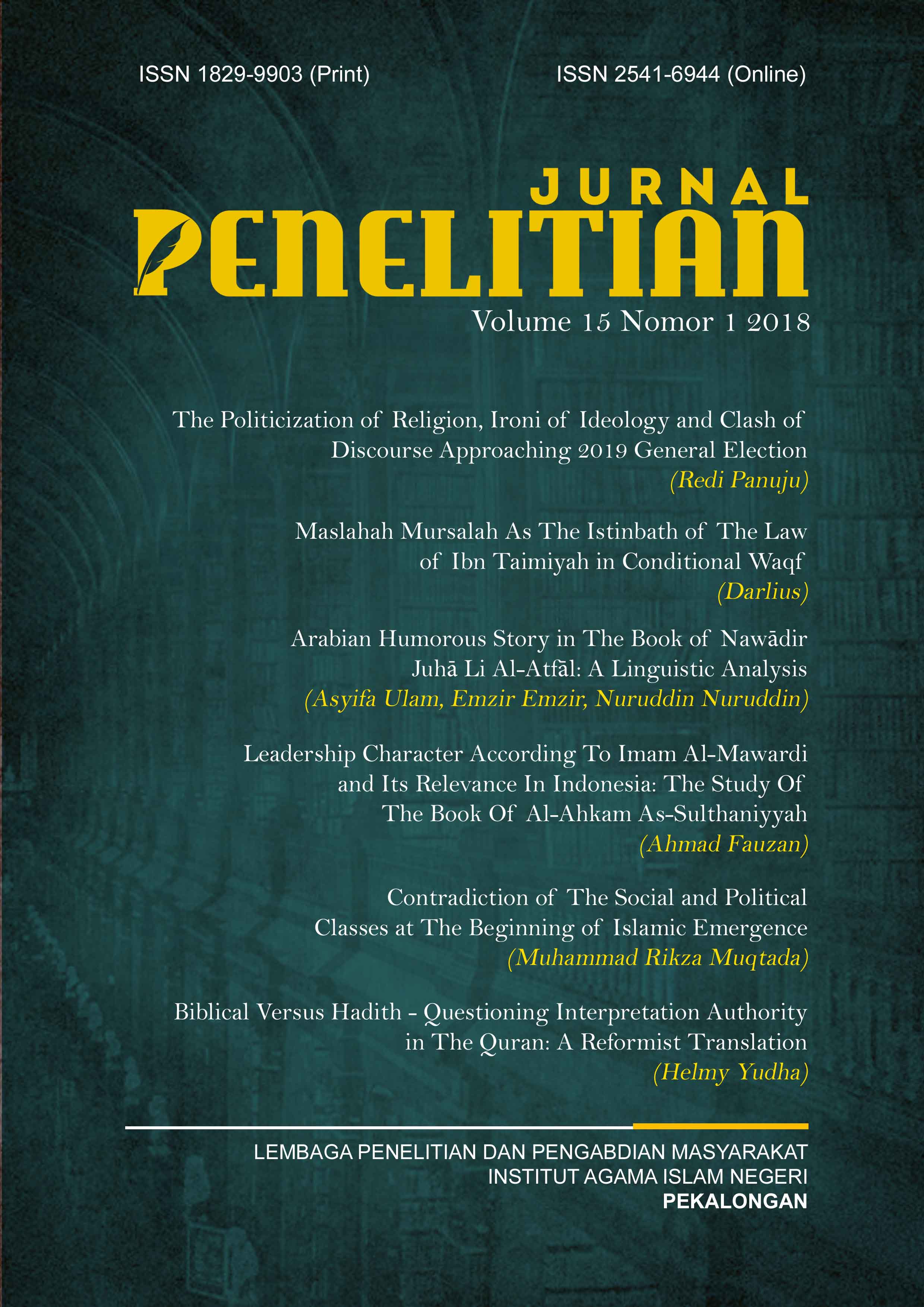
The Politicization of Religion, Ironi of Ideology and Clash of Discourse Approaching 2019 General Election
Abstract
This article is intended to see the politicization of religion as a political ideology, as well as examines the use of
communism discourse which is often used as issues to represent certain individuals, groups and relationships in
Indonesia. The method used is a qualitative method, through searching data from the internet, television and other
media regarding political religious discourse that developed in Indonesia through the 2019 election. The data was
analyzed with discourse analysis of the models of Althusser and Faucoult. This study concludes that the politicization
of religion and discourse of communism are still interesting issues in the political stage approaching general election of
2019. Discourse is used by certain parties as a way of communicating their purposes to attract attention, create
images, divide public opinion, and eventually as a channel to build political legitimacy.
Keywords:
References
Abdullah, Taufik (eds). (2012). Malam Bencana 1965 Dalam Belitan Krisis Nasional Bagian II
Konflik Lokal. Jakarta: Yayasan Pustaka Obor Indonesia.
Bjørnskov, C. (2005). Does political ideology affect economic growth?. Public Choice, 123(1-
, 133-146.
Bruinessen, Martin van, (2013). “Introduction Contemporary Developments in Indonesian
Islam and the ‘Conservative Trun’ of the Early Twenty-First Century.” In Contemporary
Developments in Indonesian Islam, Explaning the “Conservative Turn”, edited by Martin van
Bruinessen, 1–20. Singapore: ISEAS.
Clarkson, J. J., Chambers, J. R., Hirt, E. R., Otto, A. S., Kardes, F. R., & Leone, C. (2015).
The self-control consequences of political ideology. Proceedings of the National Academy of
Sciences, 112(27), 8250-8253.
Denny JA. (2006). Partai Politikpun Berguguran. Yogyakarta: LKiS
Dijk, Jan Van. (2012). The Network Society. California : SAGE Publications.
Eriyanto. (2001). Analisis Wacana Pengantar Analisis Teks Media. Yogyakarta: LKiS
Eriyanto. (2000). Kekuasaan Otoriter: Dari Gerakan Penindasan Menuju Hegemoni. Yogyakarta:
Insist Press.
Feldman, S., & Johnston, C. (2014). Understanding the determinants of political ideology:
Implications of structural complexity. Political Psychology, 35(3), 337-358.
Hefner, Robert W. (2010). Religious resurgence in contemporary Asia: Southeast Asian
perspectives on capitalism, the state, and the new piety. The Journal of Asian Studies,
(4), 1031-1047.
Hermawan, Anang. (2011). Mix Methodology Dalam Penelitian Komunikas. Yogyakarta:
ASPIKOM.
Ida, Rachmah. (2014). Metode Penelitian Studi Media dan Kajian Budaya. Jakarta: Prenada
Media.
Jacob, Tengku. (2004). Tragedi Negara Kesatuan Kleptokratis Catatan di Senjakala. Jakarta:
Yayasan Obor
Kamil, Sukron dkk. (2007). Syariah Islam dan HAM: Dampak Perda Syariah terhadapKebebasan
Sipil, Hak-hak Perempuan, dan Non-Muslim Jakarta: CRSC UIN Jakarta danKonrad
Adenauer Stiftung.
Liddle, R.William. (1992). Partisipasi & Partai Politik Indonesia pada Awal Orde Baru. Jakarta:
Grafit.
Littlejohn, Stephen W (edt). (2009). Enclyclopedia of Communication Theory. California: SAGE
Publication, Inc
Lull, James. (1998). Media Komunikasi Kebudayaan Suatu Pendekatan Global. Jakarta: Yayasan
Obor.
Maghfur, (2012) dkk, Islam Transformatif. Risalah kerja Intelektual Organik (Pekalongan:
STAIN Pekalongan Press)
Makin, Al (2009), “Benedict XVI and Islam: Indonesian Public Reactions to the
Regensburg Address.” Islam and Christian-Muslim Relations 20 (4): 409–21.
Makin, Al (2015)b. “Revisiting Indonesian Public Reactions against Danish Cartoons
Depicting Prophet Muhammad.” Indonesian Journal of Islam and Muslim Societies 5 (2):
–229
Mulyana, Deddy. (2012). Komunikasi Politik-Politik Komunikasi. Bandung: Rosdha Karya.
Muqtada, Rikza. (2017) "Utopia Khilāfah Islāmiyyah: Studi Tafsir Politik Mohammed
Arkoun." Jurnal Theologia 28.1: 145-164
Nasution, Harun (1983). Teologi Islam: Aliran-Aliran Sejarah Analisa Perbandingan, Jakarta: UI
Press
Panuju, Redi. (2002). Relasi Kuasa Negara,Media,dan Publik. Yogayakarta: Pustaka Pelajar.
Panuju, Redi. (2017). Komunikasi Politik Jokowi: Antara Pencitraan dan Jejaring Politik.
Jurnal Komunikatif. No 16 (2) 2017: 92-116. ISSN: 2597-6699
Panuju, Redi. (2017). Sistem Penyiaran Indonesia. Jakarta : Kencana Prenada Mediagroup. Cet2.
Simbolon, Parakitri T. (1998). Media Komunikasi Kebudayaan Suatu Pendekatan Global. Jakarta:
Yayasan Obor.
Siregar, Ashadi (eds). (1997). Ilusi Sebuah Kekuasaan. Surabaya: ISAI & Ubaya.
Susanto, N. H. (2017). Reinterpretasi Konsep Bidah Menuju Islam Transformatif. Jurnal
Madania, 21(2), 235-246.
Susanto, N. H. (2018). Menangkal Radikalisme Atas Nama Agama Melalui Pendidikan
Islam Substantif. Nadwa, 12(1), 65-88.
Yuliati, Dewi. (2000). Semaoen: Pers Bumi Putra dan Radikalisasi Sarekat Islam Semarang.
Semarang: Yayasan Akikarya IKAPI dan The Ford Foundation dan Penerbit Bendera.
Downloads
Published
Article Statistics
Issue
Section
License
Copyright (c) 2018 Jurnal Penelitian

This work is licensed under a Creative Commons Attribution 4.0 International License.

This work is licensed under a Creative Commons Attribution 4.0 International License.