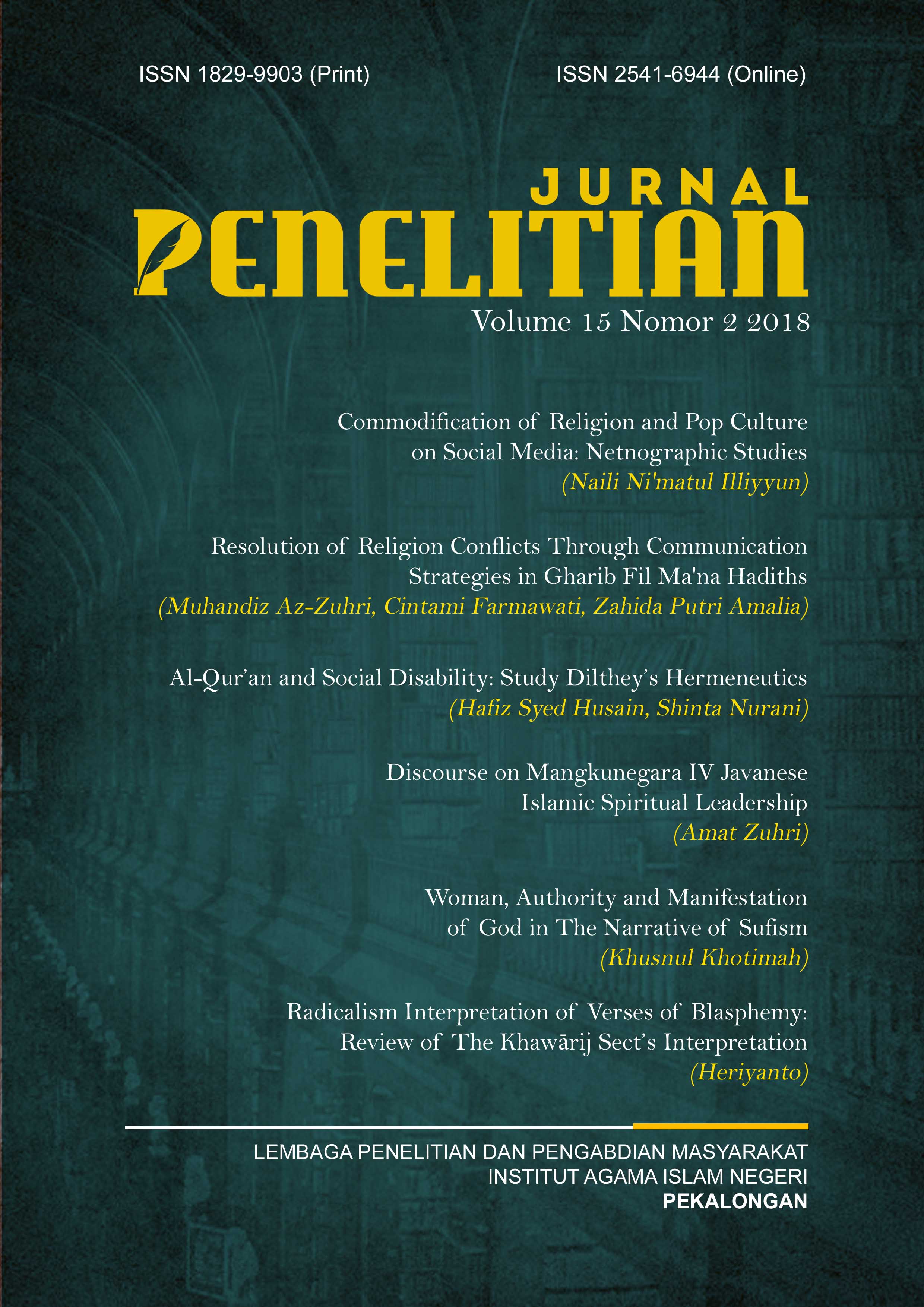
Radicalism Interpretation of Verses of Blasphemy: Review of The Khawārij Sect’s Interpretation
Abstract
This study questions the response of the Khawārij sect in interpreting the verses that speak of blasphemy. The study
will focused on exploring the results of the Khawārij interpretation of the blasphemy verses in the Tafsīr Haimayan
al-Zād Ilā Dār al-Ma’ād by Yusuf Wahbi, this book was chosen because it became a reference often used by the
Khawārij sect to this contemporary period. For this reason, the author tries to use the Gadamer-style hermeneuticsubjectivist approach so that the ideological dimension in the interpretation can be properly embodied. The results of
the study indicate that Khawārij tends to be textual and put forward their ideology in interpreting the verses of
blasphemy. This is evidenced by the existence of a bid'ah instrument which is used as a benchmark to set a ban on
sitting with the perpetrators such as the prohibition of sitting with people who deny and insult the Qur'an as in QS.
Al-Nisa ': 140. In addition, the results of the interpretation of Khawārij have reduced the preventive principle
contained in QS. Al-An'am 108 and their interpretation of QS. Al-Taubah: 12 has indirectly opened the
opportunity for the creation of excessive arrogance against religious offenders.
Keywords:
References
Abdullah, A. (2016). Gerakan Radikalisme dalam Islam: Perspektif Historis. ADDIN ,
(1), 1-28.
Abdullah, A. (2017). Membaca Komunikasi Politik Gerakan Aksi Bela Islam 212: Antara
Politik Identitas dan Ijtihad Politik Alternatif. Jurnal An-Nida’ – Jurnal Pemikiran Islam,
(2), 202-212.
Al-‘Uqal, N. A. K. (1998). Al-Khawārij Awwal al-Firāq Fī al-Islām – Manāhijuhum wa Uṣūluhum
wa Samātuhum Qadīman wa Hadiṡan wa Mauqif al-Salaf Minhum. Saudi Arabia: Dār
Syibailiya
Al-Bukhari, M. b. (1979). Al-Jami' al-Shahih. Kairo: Al-Mathba'ah al-Salafiyah.
Al-Munawir, A. W. (2002). Al-Munawwir Kamus Arab-Indonesia. Surabaya: Pustaka Progresif.
Al-Qaradhawi, Y. (2001). Al-Shahwah al-Islamiyyah Baina al-Juhud wa al-Tatharruf. Kairo: alTaqwa.
Al-Subki, T. A.-K. (2000). al-Saif al-Maslul 'Alla Man Sabba al-Rasul. Oman: Dar al-Fath.
Al-Wahbi, Y. (1993). Haimayān al-Zād Ilā Dār al-Ma’ād. Oman: Wazārah al-Turaṡ al-Qaumī
wa al-Ṡaqāfah.
Anshari, A. Y. (2009). Khawarij. Asy-Syir’ah, 43(11), 263-296
Ayoub, M. M. (2004). The Crisis of Muslim History: Akar-Akar Krisis Politik dalam Sejarah
Muslim. (Trans. Munir A. M.). Bandung: Mizan.
Berkowitz, D., & Eko, L. (2007). Blasphemy As Sacred Rite/Right: “The Mohammed
cartoons affair” and maintenance of journalistic ideology. Journalism Studies, 8(5), 779-
Departemen Pendidikan Nasional RI. (2008). Kamus Bahasa Indonesia. Jakarta: Pusat Bahasa
Departemen Pendidikan Nasional RI
Eliade, M., & et.al. (1986). The Encyclopedia of Religion. New York: Macmillan Library
Reference USA.
Fahrudin. (2014, 10 16). Fenomena Istihza’: Mencela dan Menghina Agama Islam. Retrieved 04
, 2018, from Kiblat: Berita-Visi-Investigasi:
https://www.kiblat.net/2014/09/16/fenomena-istihza-mencela-dan-menghinaagama-islam
Hodgson, M. G. (1999). The Venture of Islam Iman dan Sejarah Peradaban Dunia, Jilid Pertama:
Masa Klasik Islam. (Trans. M. Kartanegara). Jakarta: Paramadina.
Hung, E. (1997). The Nature Of Science: Problem and Perspectives. Belmont: Wardsworth
Publishing Company.
Imamuddin & Arifin, (2015). M. Z. Jangan Nodai Agama. Yogyakarta: Pustaka Pelajar
Kamsi, K. (2015). Prilaku Penistaan Agama dalam Struktur Budaya Politik Lokal Pada
Kerajaan Islam di Jawa (Sebuah Telaah Politik Hukum). Asy-Syirah, 49 (2), 406-424.
Mandzur, I. (t.Th). Lisan al-'Arab. Kairo: Dar al-Ma'arif.
Nabiel, M. (2017). Historiografi Blasphemy: Penistaan Figur-figur Suci Dalam Tiga Agama
Samawi. Al-Hikmah , 5 (1), 29-40.
Nasiruddin. (2017). Penistaan Agama Dalam Al-Qur’an (Tela’ah Penafsiran Wahbah alZuhaily dalam Tafsir al-Munir). Tesis Magister, Prodi Ilmu Al-Qur’an dan Tafsir
Pascasarjana UIN Sunan Ampel Surabaya.
Purnama, F. F. (2016). Khawarijisme: Pergulatan Politik Sektarian dalam Bingkai Wacana
Agama. Al-A'raf: Jurnal Pemikiran Islam dan Filsafat, 13(2), 213-232.
Rehman, J. (2010). Freedom of expression, apostasy, and blasphemy within Islam: Sharia,
criminal justice systems, and modern Islamic state practices: Javaid Rehman
investigates the uses and abuses of certain interpretations of Sharia law and the
Quran. Criminal Justice Matters, 79(1), 4-5.
Sabli, M. (2015). Aliran-aliran Teologi dalam Islam (Perang Shifn dan Implikasinya Bagi
Kemunculan Kelompok Khawarij dan Murjiah). Nur El-Islam, 2(1), 105-112.
Suastha, R. D. (2017, 05 10). Menyingkap UU Penistaan Agama di Berbagai Belahan Dunia.
Retrieved 09 21, 2018, from CNN Indonesia:
https://www.cnnindonesia.com/internasional/20170510162019-134-
/menyingkap-uu-penistaan-agama-di-berbagai-belahan-dunia
Theodorou, A. E. (2016, 07 29). Which countries still outlaw apostasy and blasphemy? Retrieved
21, 2018, from Pew Research Center: http://www.pewresearch.org/facttank/2016/07/29/which-countries-still-outlaw-apostasy-and-blasphemy/
Uddin, A. T. (2011). Blasphemy Laws in Muslim-Majority Countries. The Review of Faith &
International Affairs, 9(2), 47-55.
Wiktorowicz, Q. (2005). Radical Islam Rising: Muslim Extremism in the West. America:
Rowman & Littlefield Publishers, inc.
Zuhdi, M. H. (2010). Fundamentalisme Dan Upaya Deradikalisasi Pemahaman Al-quran
dan Hadis. RELIGIA – Jurnal Ilmu-ilmu Keislaman, 13(1), 81-102
Downloads
Published
Article Statistics
Issue
Section
License

This work is licensed under a Creative Commons Attribution 4.0 International License.

This work is licensed under a Creative Commons Attribution 4.0 International License.