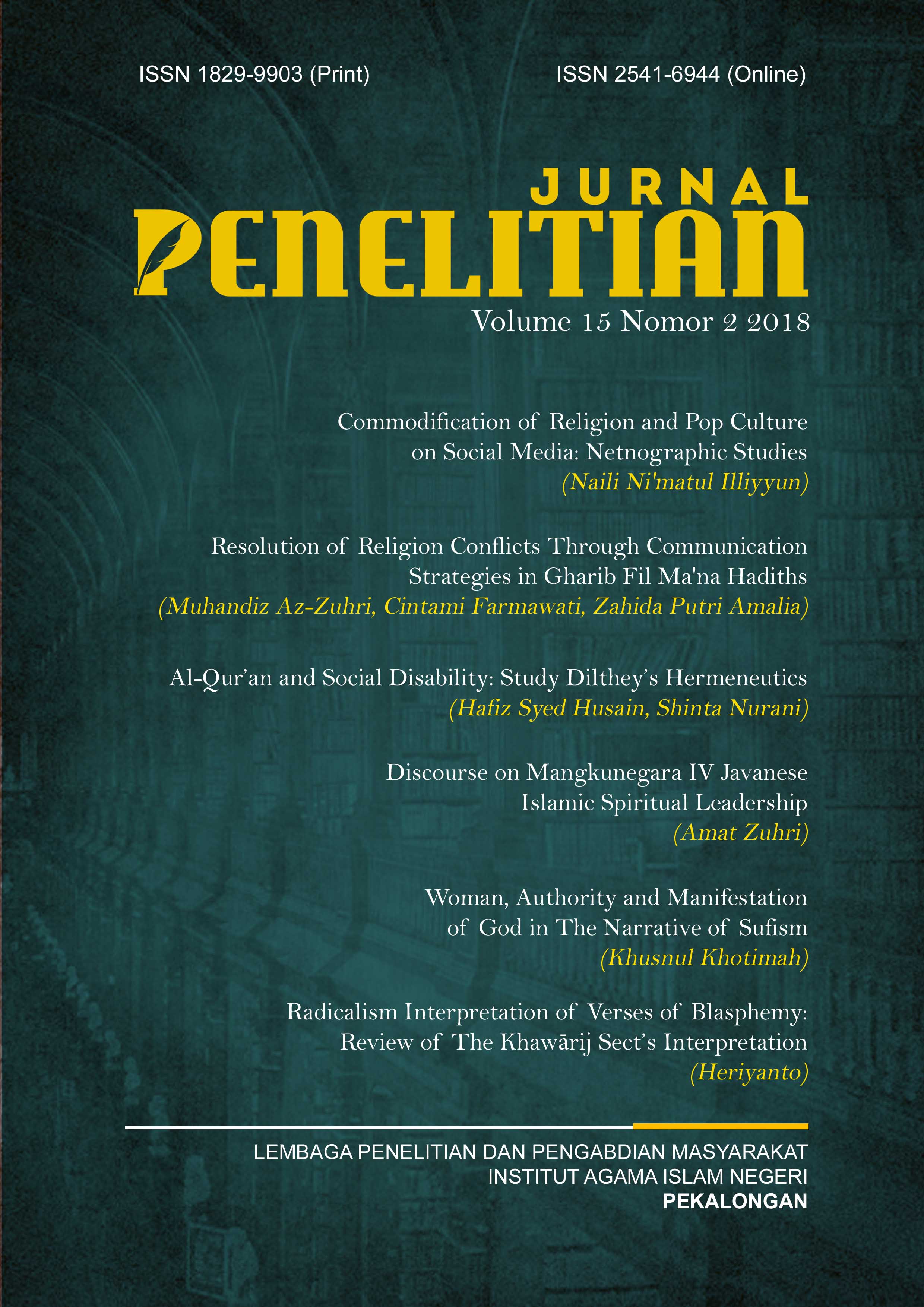
Discourse on Mangkunegara IV Javanese Islamic Spiritual Leadership
Abstract
This study aims to analyze the concepts and patterns of spiritual leadership according to Serat Wedhatama, especially
the ethical, ascetic and mystical potential of Mangkunegara IV Javanese Islamic spiritual leadership. In the context
of civilizations and the treasure of Javanese Islamic literatures, just to have the properties as a warrior is not enough
for a leader; one must also have the properties as a clergyman, or having Spiritual Leadership within oneself.
Spiritual Leadership has become one of the materials to teach (piwulang) a prince, a future king or a ruler. The basis
of this study is Serat Wedhatama by Mangkunegara IV which contains sublime teaching (piwulang luhur) which
must be a guide for a leader. This study is a qualitative research. The data is obtained from Serat Wedhatama. Data
were analyzed by descriptive method, with a scientific perspective of Sufism and hermeneutics. This study found that
Serat Wedhatama teaches that a leader must adhere to the ethical, ascetic and mystical dimensions. The ethical
dimension includes the behavior of a leader towards the community. Meanwhile, the ascetic dimension includes the
inner attitude of a leader in order to purify his soul. And the ascetic dimension includes the form of the relationship
between a leader and God.
Keywords:
References
Ahmad, M. (2017). Agama dan Psikoanalisa Sigmund Freud. Religia, Vol. 14 No. 2, October
: 277-296. doi:10.28918/religia.v14i2.92.
Ali, Y. (2002). Jalan Kearifan Sufi. Jakarta: Serambi Ilmu Semesta.
Any, A. (1993). Menyingkap Serat Wedhatama. Semarang: Aneka Ilmu.
Ardani, M. (1998). Al-Qur’an dan Sufisme Mangkunegara IV. Yogyakarta: PT. Dana Bhakti
Primayasa.
Biel, A., & Nilsson, A. (2005). Religious values and environmental concern: Harmony and
detachment. Social Science Quarterly, 86(1), 178-191.
Briunessen, M. V. & Howwel, J. D. (Ed.). (2008). Urban Sufisme. Jakarta: Raja Grafindo
Persada.
Briunessen, M. V. (1996). Sufis and Sultan in Southeast Asia ang Kurdistan; A Comparative
Survey. Studia Islamika. 3(3).
Chen, C. Y., & Yang, C. F. (2012). The impact of spiritual leadership on organizational
citizenship behavior: A multi-sample analysis. Journal of business ethics, 105(1), 107-
Crossman, J. (2011). Environmental and Spiritual Leadership: Tracing the Synergies from
an Organizational Perspective. Journal of Business Ethics, 103(4). 553-565.
Daryono. (2007). Etos Dagang Orang Jawa, Pengalaman Mangkunegara IV, Yogyakarta: Pustaka
Pelajar.
Edraswara, S. (2013). Falsafah Kepemimpinan Jawa, Yogyakarta: Narasi,
Edraswara, S. (2011). Kebatinan Jawa: Laku Hidup Utama Meraih Derajat Sempurna.
Yogyakarta: Lembu Jawa.
Fauzi, A. (2015). Membangun Epistemologi Pendidikan Islam Melalui Kepemimpinan
Spiritual: Suatu Telaah Diskursif. EMPIRISMA, 24(2). p. 155-167.
Graaf, H.J. D. (1987). Disintegrasi Mataram di Bawah Amangkurat I. Jakarta: Grafiti Pers.
Graaf, H.J. D. (1989). Kerajaan-kerajaan Islam di Jawa. Jakarta: Grafiti Pers.
Hadi, S. (2012). Kepemimpinan spiritual solusi mengatasi krisis kepemimpinan pendidikan
islam. Lisan al-Hal: Jurnal Pengembangan Pemikiran dan Kebudayaan, 4(1), 25-50.
Hidayat, K. (1996). Memahami Bahasa Agama. Jakarta: Paramadina.
Hidayat, K. (1998). Tragedi Raja Midas. Jakarta: Penerbit Paramadina,
Jatmiko, A. (2012). Tafsir Ajaran Serat Wedhatama. Yogyakarta: Pura Pustaka,
Al-Kalabadzi. (1985). Ajaran Kaum Sufi. Bandung: Mizan.
Kartodirdjo, S. (1987). Perkembangan Peradaban Priyayi. Yogyakarta: Gadjah Mada University
Press.
Suseno, F. M. (1993). Etika Jawa. Jakarta: Gramedia Pustaka Utama.
Mahzar, A. (2004). Kata Pengantar. dalam Abraham H. Maslow. Psikologi Sains, Terjemahan
oleh Hani'ah. Jakarta: Teraju.
Maslow, A. H. (1992). Motivasi dan Prilaku. Semarang: Dahara Prize.
Moertono, S. (1985). Negara dan Usaha Bina-negara di Jawa Masa Lampau. Jakarta: Yayasan
Obor Indonesia.
Muhammad, H. (2002). Dialog antara Tasawuf dan Psikologi. Yogyakarta: Pustaka Pelajar.
Mulder, N. 1996. Pribadi dan Masyarakat di Jawa. Jakarta: Pustaka Sinar Harapan.
Nasution, H. (1992). Filsafat dan Mistisisme dalam Islam. Jakarta: Bulan Bintang.
Nasution, H. (1985). Islam Ditinjau Dari Berbagai Aspeknya Jilid II. Jakarta: UI Press.
Noer, K. A. (2013). Tasawuf Perenial, Kearifan Kritis Kaum Sufi. Jakarta: Serambi Ilmu
Semesta.
Rafsanjani, H. (2017). Kepemimpinan Spiritual (Spiritual Leadership). Jurnal Masharif alSyariah. 2(1).
Ricklefs, M.C. (1995). Sejarah Indonesia Modern. Yogyakarta; gadjah Mada University Press.
Riyadi, A. K. (2014). Antropologi Tasawuf: Wacana Manusia Spiritual dan Pengetahuan. Jakarta:
LP3ES.
Simuh. (1988) Mistik Islam Kejawen Raden Ngabehi Ranggawarsita, Jakarta: UI Press.
Simuh. (2016). Sufisme Jawa, Transformasi Sufisme Islam ke Mistik Jawa. Yogyakarta: Narasi.
Sulistyo, H. (2009). “Analisis Kepemimpinan Spiritual dan kumunikasi Organisasional
terhadap Kinerja Karyawan” Jurnal Ekonomi dan Bisnis, Unissula 1 July 2009.
Supadjar, D. (1988). Harmonitas dalam Budaya Jawa: Konsep Kawula-Gusti. Jurnal
Pesantren, 5(4).
Al-Taftazani, A. W. G. (1997). Sufi dari Zaman ke Zaman, Bandung: Pustaka.
Thobroni. (2005). The Spiritual Leadership. Malang: UMM Pres.
Tombaugh, J. R., & Tombaugh, E. F. (2009). Can Spiritual Leadership Lead Us Not Into
Temptation?. Business and Professional Ethics Journal, 28(1/4), 95-119.
Wilson, S. (2004). Building and supporting young women's leadership for social
justice. Agenda, 18(60), 16-21.
Downloads
Published
Article Statistics
Issue
Section
License

This work is licensed under a Creative Commons Attribution 4.0 International License.

This work is licensed under a Creative Commons Attribution 4.0 International License.