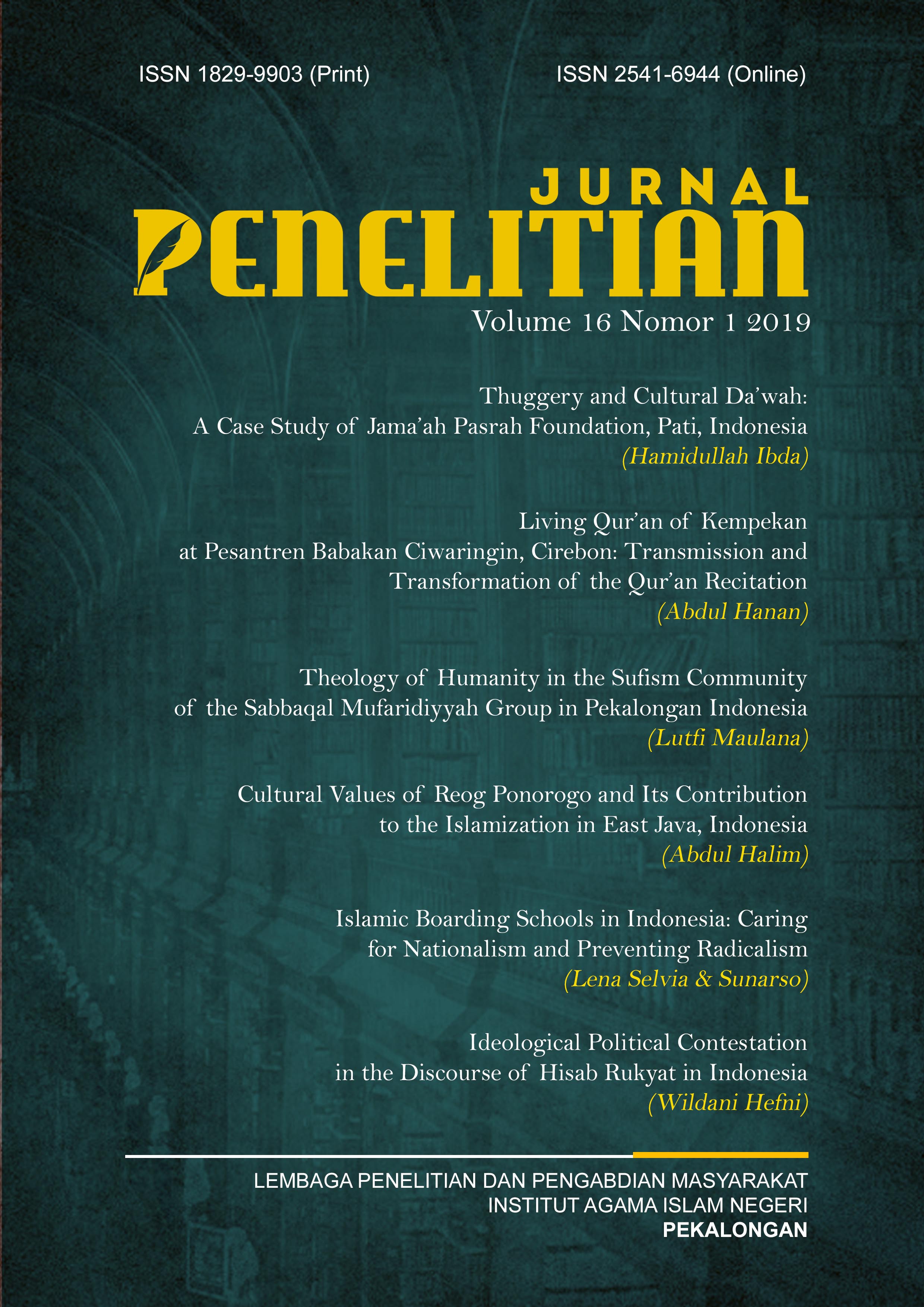
Ideological Political Contestation in the Discourse of Hisab Rukyat in Indonesia
Abstract
This article discusses the ideological contestation of the two mass organizations, Muhammadiyah and
Nahdlatul Ulama (NU), that are the spearhead of the two paradigms in determining the beginning of the
month of qamariah. Hisab is initiated by Muhammadiyah and rukyat is pioneered by Nahdlatul Ulama
(NU). These two paradigms are the cause of the emergence of tension conflict due to the non-uniformity of
the method of determining the beginning of the qamariah month in Indonesia. By using a power relations
approach and reading of religious commodification, this article concludes that fragmentation of religious
authority has given rise to a real phenomenon in the midst of society in the form of ideological political
contestation played by two large mass organizations in Indonesia in determining the beginning of the
qamariah month, NU and Muhammadiyah. The conception of power relations with the government is a
problem that is often used as a basis for maintaining ideology and belief in a paradigm that has long been
built. Moreover, religious issues drawn in ideological interests have led to a layer of group fanaticism which
often makes religion a commodification of pragmatic interests.
Keywords:
References
Ahmad, M. (2017). Nahdlatul Ulama dan Penegakan Hak Asasi Manusia di Indonesia.
Religia, 13 (2). doi:10.28918/religia.v13i2.181.
Anwar, S. (2008). Hari Raya & Problematika Hisab-Rukyat. Yogyakarta: Suara
Muhammadiyah.
Azhari, S. (2006). Karakteristik Hubungan Muhammadiyah dan NU dalam Menggunakan
Hisab dan Rukyat. Al-Jamiah: Journal Of Islamic Studies, 44 (2).
https://doi.org/10.14421/ajis.2006.442.453-485
Azhari, S. (2012) Kalender Islam, Kearah Menuju Integrasi Muhammadiyah NU. Yogyakarta:
Musium Astronomi Islam.
Azra, A. (1999). Islam Reformis, Dinamika Gerakan dan Intelektual, Jakarta: Raja Grafindo
Persada.
Bruinessen, M. B (1997). Mencari Ilmu dan Pahala di Tanah Suci, Orang Nusantara Naik Haji,
dalam Dick Douwes dan Nico Kaptein, Indonesia dan Haji. Jakarta: INIS.
Foucault, M. (1998). The Ethic of Care for The Selt as A Practce of Freedom dalam The
Final Foucault, Bernauer. Boston: MIT Press.
Hefni, W. (2018). Dinamikiyyatu Jam’iyati Nahdlatil Ulama fi Itsbati Awail al-Syuhur alQamariah bi Indonesia. Al-Ahkam, 28 (2),
http://dx.doi.org/10.21580/ahkam.2018.18.2.2689.
Hidayat, M. N. (2012). Otoritas Pemerintah Dalam Penetapan Awal Bulan Qamariah
Perspektif Fiqh Siyasah Yusuf Qardhawi. Jurisdicte: Jurnal Hukum dan Syariah, 3 (1). https://doi.org/10.15642/alhukama.2013.3.2.165-
http://dx.doi.org/10.18860/j.v0i0.2177.
Ichtijanto. (1981). Almanak Hisab-Rukyat. Jakarta: Proyek Pembinaan Badan Peradilan
Agama Islam.
Izzuddin, A. (2007). Fiqh Hisab Rukyah, Menyatukan NU dan Muhammadiyah dalam Penentuan
Awal Ramadhan, Idul Fitri, dan Idul Adha. Jakarta: Erlangga.
Latif, Y. (2005). Intelegensia Muslim dan Kuasa: Genealogi Intelegensia Muslim Indonesia Abad ke20. Bandung: Mizan.
Madaniy, M. (2003). Penentuan Awal Bulan Qamariah Sepanjang Ketentuan Syara. AsySyir’ah, 37 (2).
Madjid, N. (1984). Ibn Taimiyya on Kalam and Falsafa, A Problem of Reason and Relevation in
Islam, A Dissertation Submitted to The Faculty of Division on The Humanities in
Candidacy for The Degree of Doctor of Philosophy: Chicago.
Masroeri, G. (2006). Pedoman Hisab dan Rukyat Nahdlatul Ulama. Lajnah Falakiyah Pengurus
Besar Nahdlatu Ulama, Jakarta.
Munhanif, A. (1998). Prof. Dr. Mukti Ali: Modernisasi Politik-Keagamaan Orde Baru
dalam Menteri-Menteri Agama RI: Biografi Sosial-Politik. Azra. Jakarta: Indonesian
Netherlands Cooperation in Islamic Studies (INIS) dan Pusat Pengkajian Islam
dan Masyarakat (PPIM) serta Badan Litbang Agama Departemen Agama RI.
Mushonnif, A. (2013). Fragmentasi Otoritas Antar Organisasi Pemerintahan dan Organisasi
Keagamaan dalam Penentuan Awal Bulan Islam. Al-Hukama: The Indonesian Journal
of Islamic Family Law, 3 (2). https://doi.org/10.15642/alhukama.2013.3.2.165-179.
Mosco, V. (1996). The Political Economy of Communicataion, London: Sage Publication,
London.
McQuail, D. (1983). Mass Communication Theory: An Introduction. London: Sage Publication.
Nawawi, M. (2004). Menegakkan Madzhab Negara, dalam Hisab Rukyah dan Perbedaannya.
Jakarta: Peningkatan Pengkajian Kerukunan Umat Beragama, Puslitbang
Kehidupan Beragama, Badan Litbang Agama dan Diklat Keagamaan Departemen
Agama RI.
Noer, D. (1980). Gerakan Modern Islam di Indonesia: 1900-1942. Jakarta: Lembaga Penelitian,
Pendidikan dan Penerangan Ekonomi dan Sosial (LP3S).
Poster, M. (1974). Althusser History Without Man. Political Theory, 2 (4).
Robinson, K. (2011). Sawerigading Vs Sharia: Identities and Political Contestation in
Decentraliced Indonesia. Asian Journal of Science, 39 (2).
Rohmat, H. (2014). Penentuan Awal Bulan Qamariah Menurut Muhammadiyah. Ijtimaiyya,
(1).
Sharpe, K. (2013). Rival Representation in Rebranding Rule. Yale University Press.
Stuart, R.S. (1986). Ideology, Theory, and Mentality: Some Issues in The Historical Study
of Ideology. Labour History, Liverpol University Press, 50.
Ulum, M. (2015). Fatwa Ulama NU (Nahdlatul Ulama) dan Muhammadiyah Jawa Timur
Tentang Hisab Rukyat. Syaikhuna: Jurnal Pendidikan dan Pranata Islam, 10 (2).
Zulian, P. B. (2018). An Analysis of Dominant Legal Ideas and Mode of Thought of Fatwa
Making Agencies and Their Implications in The Post-New Order Period in Fatwa
in Indonesia. Amsterdam University Press. https://www.jstor.org/stable/j.ctv157bk2.9.
Zahro, A. (2001). Lajnah Bahtsul Masail Ulama 1926-1999, Telaah Kritis Terhadap Keputusan
Hukum Fiqih. Disertasi Program Doktor UIN Sunan Kalijaga Yogyakarta.
Downloads
Published
Article Statistics
Issue
Section
License

This work is licensed under a Creative Commons Attribution 4.0 International License.

This work is licensed under a Creative Commons Attribution 4.0 International License.