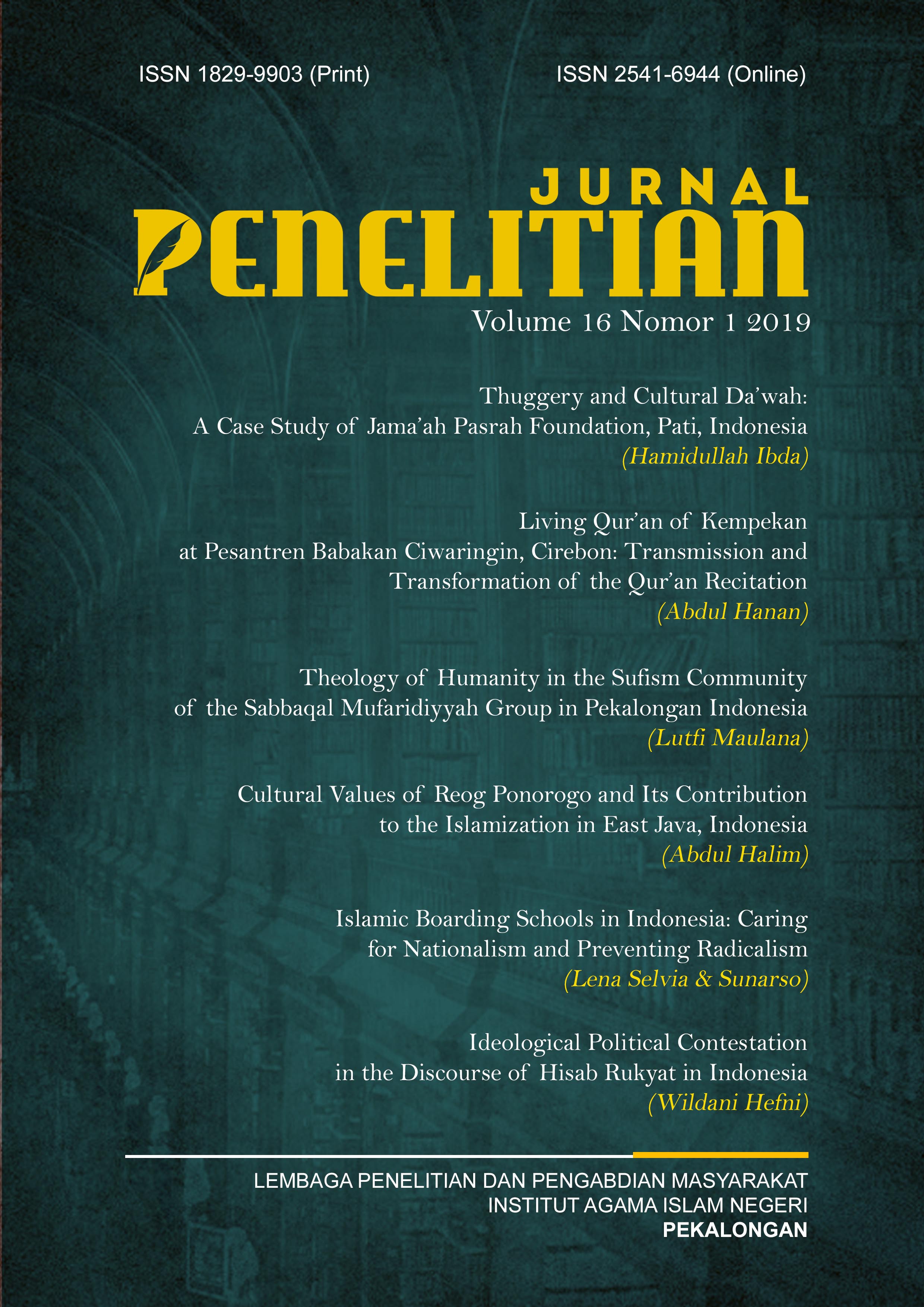
Cultural Values of Reog Ponorogo and Its Contribution to the Islamization in East Java, Indonesia
Abstract
Reog Ponorogo dance performance has an entertainment nuances also saves social values and the history of
Islamization in Ponorogo. Historical figures such as Suryo Alam, Betoro Katong, Ki Ageng Merah, and
Sunan Kalijaga who play a major role in the formation of the value structure of the Reog Ponorogo dance
that is reflected in the dance movements. This paper discusses the interpretation of the values contained in
Reog Ponorogo both the values of customs, culture, social, politics, and history of the transformation of the
life of the old people towards the life of a new society. The method of analysis with Pierre F. Bourdieu’s
theory of social action to see that in behavior that is objectified by the Ponorogo community after being
observed and conducting in-depth interviews shows that there is a dynamic relationship between the social
behavior of the Ponorogo community and the values contained in Reog dance. On the other hand, the history
of Ponorogo Islamization can also be read from the Reog Ponorogo dance. In the end, the Reog Ponorogo
dance art became an accumulation of values, ranging from history, custom-culture, to social behavior that
formed a dynamic, inclusive, and transformative society to openly develop, and always dialectic with the
times.
Keywords:
References
Achmadi, A. (2013). Pasang Surut Dominasi Islam terhadap Kesenian Reog Ponorogo.
Analisis 13(1),
Achmadi, A. (2014). Aksiologi Reog Ponorogo Relevansinya Dengan Pembangunan
Karakter Bangsa. Teologia 25 (1).
Adamson, M. (2018). “Language and Symbolic Power-- Pierre Bourdieu,” in
Hup.harvard.edu, diakses 9 Juni.
Bourdieu, P. (1984). Distinction: A Social Critique of the Judgement of Taste. London: Routledge.
Bourdieu, P. (1977). Outline of a Theory of Practice. Cambridge and New York: Cambridge
Univ Press.
Cattani, G., Ferriani, S., & Allison, P. D. (2014). Insiders, outsiders, and the struggle for
consecration in cultural fields: A core-periphery perspective. American Sociological Review,
(2), 258-281.
Dance, F. (2018). In https://en.wikipedia.org/wiki/Folk_dance, diakses 1 November 2018.
Forcini, S., Maturo, A., & Ventre, A. G. (2013). The role of folk dance in the processes of
individual and social wellbeing: a comparison with other popular recreational activities
through models of decision theory and game theory. Procedia-Social and Behavioral
Sciences, 84, 1750-1756.
Hagevi, M. (2017). Religious Change over the Generations in an Extremely Secular Society:
The Case of Sweden. Journal Review of Religious Research, 59 (4).
Hesmondhalgh, D. (2006). Bourdieu, the media and cultural production. Media Culture &
Society. SAGE Publications.
Jenkins, R. (2014). Pierre Bourdieu. New York: Routledge.
Kencanasari, L. S. (2009). Warok dalam Sejarah Kesenian Reog Ponorogo: Perspektif
Eksistensialisme. Jurnal Filsafat 19 (2).
Lane, J. (2000). F. Pierre Bourdieu: A Critical Introduction. London: Pluto Press.
Van Der Lans, J., & Jablonski, P. (1994). Religious language interpretation: A social
psychological approach. Archive for the Psychology of Religion, 21(1), 208-219.
Lawson, J. (1970). European Folk Dance: Its National & Musical Characteristics. Michigan:
Imperial Society of Teachers of Dancing.
Multazam, D. (2016). Dinamika Tegalsari: Santri dan Keturunan Kiai Pesantren Tegalsari Ponorogo
Abad XIX-XX. Jakarta: PPM Islam Nusantara STAINU Jakarta.
Packer, M. J. (2017). The Science of Qualitative Research. Cambridge University Press.
Purwowijoyo. (1985). Babad Ponorogo, Jilid I. Ponorogo: Dinas Kebudayaan, Pariwisata,
Pemuda dan Olah Raga Kabupaten Ponorogo.
Shay, A. (2007). Choreographing Identities: Folk Dance, Ethnicity and Festival in the United States
and Canada. Jefferson, North Carolina, and London: McFarland & Company, Inc.
Snodgrass, M. E. (2016). The Encyclopedia of World Folk Dance. Lanham, Boulder, New York,
London: Rowman & Littlefield.
Sujud, S. P.J. (2007). Kajian Historis Legenda Reog Ponorogo. Bahasa dan Seni, 35(1).
Tim Penyusun Buku Pedoman Dasar Kesenian Reog Ponorogo dalam Pentas Budaya
Bangsa. (2006). Buku Pedoman Seni Reog Ponorogo. Ponorogo: Tim Penyusun.
Wacquant, L. (2006). “Pierre Bourdieu”, in R. Stones (ed.), Key Contemporary Thinkers.
London: Macmillan.
Wulandari, R. (2012). Eksistensi Reog Ponorogo pada Masyarakat Desa Sumoroto. Skripsi.
Surakarta: Universitas Sebelas Maret.
Downloads
Published
Article Statistics
Issue
Section
License

This work is licensed under a Creative Commons Attribution 4.0 International License.

This work is licensed under a Creative Commons Attribution 4.0 International License.