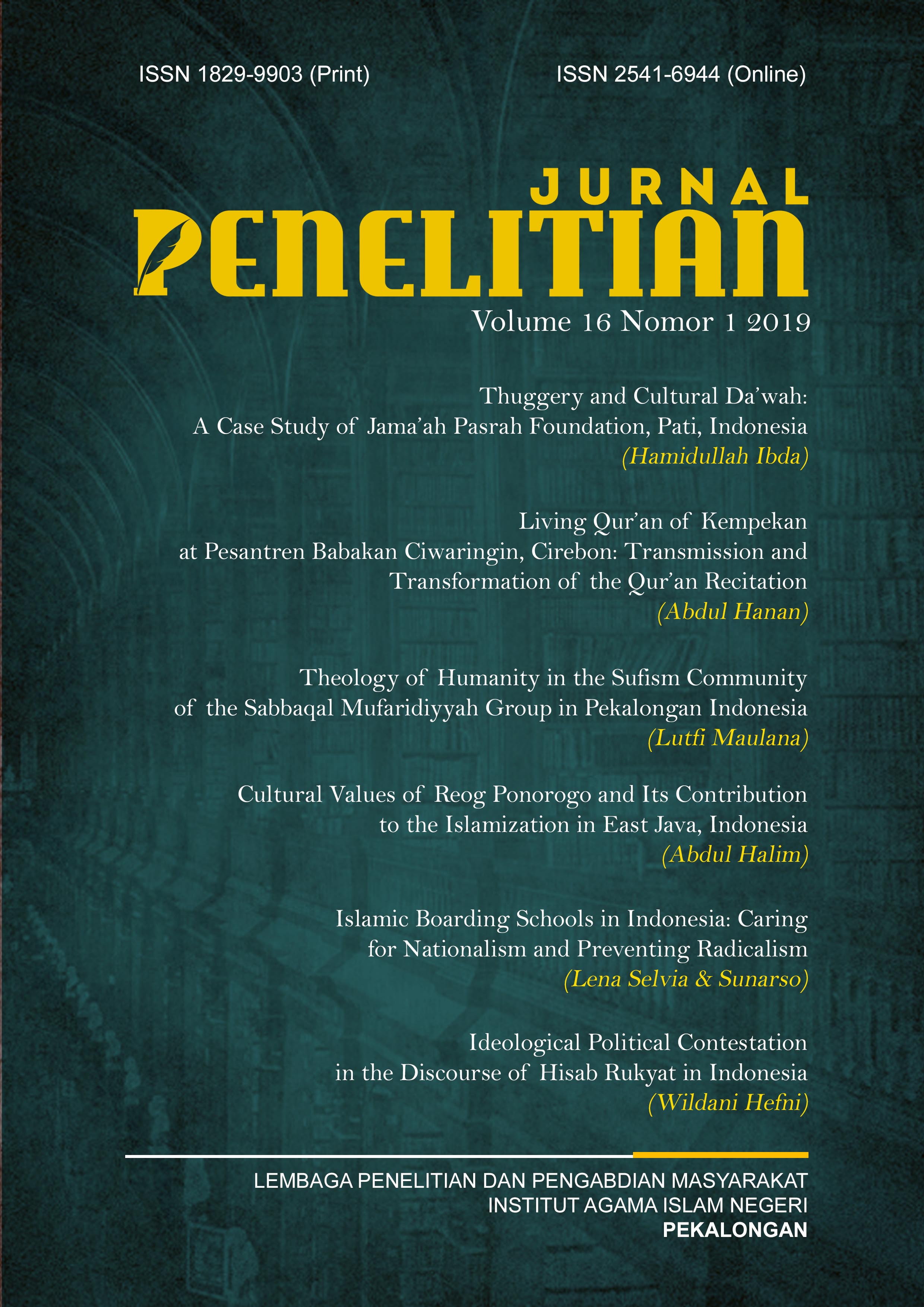
Thuggery and Cultural Da’wah: A Case Study of Jama’ah Pasrah Foundation, Pati, Indonesia
Abstract
This study aims to analyze the model of cultural preaching carried out by Jama'ah Pasrah in reducing
thuggery. Through ethnographic and phenomenological research, data were obtained from in-depth interviews
with the administrators of Jama'ah Pasrah, the Dukuhseti village community, and ulama. The results of
this study revealed that thuggery can be muted through a cultural preaching model, which dialogues culture
and Islam Jama'ah Pasrah acculturated through several approaches. The first one was by approaching the
thug leaders to participate in tahlilan, zibaan, yasinan, manakiban, and ziarah kubur. Second, providing
preaching with nuances of religious art through the establishment of a burdah group. Third, da'wah through
tahlilan, yasinan, and manakiban by providing alms or ayam ingkung to eat together. Fourth, giving
spiritual guidance through wirid, selawat, hadrah, and also a kind of therapy with recitations of the Holy
Qur'an. Fifth, invite ex-thugs to fast for one week with one sahur only. All of those approaches were
realized in 12 forms of activities, which were in annual, monthly, and weekly bases. Cultural Da'wah of
the Jamaah Pasrah Foundation was able to minimize thuggery from all categories, both Korea, gentlemen
and bastard classes.
Keywords:
References
Ahmad, M. (2011). Agama dan Psikoanalisa Sigmund Freud. Religia, 14 (2), 277-296 .
DOI:10.28918/Religia.V14i2.92.
Ahmad, M. (2012). Strategi Kelangsungan Hidup Gelandangan-Pengemis (Gepeng). Jurnal
Penelitian, 7(2), 1-16.
Almond, G. A., & Verba, S. (1989) The Civic Culture: Political Attitudes and Democracy
in Five Nations, London: SAGE Publications, Inc.
Aibak, K. (2016). Dakwah Kultural Strategi dalam Konteks Indonesia. Mawa`izh, 1 (2).
Anwar, K. (2018). “Proyek Pembangunan Pemerintah Juga Diteror.” Tabayuna.Com.
Retrieved from http://www.tabayuna.com/2018/05/proyek-pembangunanpemerintah-juga.html.
Atika, A. (2013). Penanggulangan Premanisme Menurut Pandangan Majelis Ulama
Indonesia (MUI) Kota Palembang. Intizar, 19(2), 249-262.
Aziz, M. A. (2014). Ilmu Dakwah. Jakarta: Kencana.
Basit, A. (2013). Filsafat Dakwah. Jakarta: Rajawali Press.
Brennan, M. A., Barnett R.V., & Baugh, E. (2007). Youth Involvement in Community
Development: Implication and Possibilities for extension. Journal of Extension, 45(4),
-213.
Fadli, F., & Susanto, N. H. (2017). Model Pendidikan Islam Kreatif Walisongo, Melalui
Penyelenggaraan Pendidikan Yang Menyenangkan. Jurnal Penelitian, 11(1), 25-54.
Handayani, A. Y., & Purnaningsih, N. (2015). Persepsi Pemuda terhadap Peranan Karang
Taruna dalam Penanganan Masalah Sosial. Jurnal Penyuluhan, 11(1).
Hasan, N. (2017). "Religious Diversity and Blasphemy Law: Understanding Growing
Religious Conflict and Intolerance in Post-Suharto Indonesia." Al-Jami'ah: Journal of
Islamic Studies 55 (1), 105-126.
Jufri, M. (2014). Penanaman Nilai-Nilai Dakwah Kultural Nahdlatul Ulama terhadap
Kerukunan Umat Beragama dalam Pendekatan Hadis/Sunnah di Kota Parepare.
Kuriositas, VII (2), 1–17.
Kafid, N. (2016). Dari Islamisme ke “Premanisme”: Pergeseran Orientasi Gerakan
Kelompok Islam Radikal di Era Desentralisasi Demokrasi. Masyarakat: Jurnal Sosiologi,
-79.
Latif, M. U. (2017). Metode Dakwah Khalifah Abu Bakar Assiddiq (1st ed.). Semarang:
Formaci.
Lindsey, T. (2001). The criminal state: premanisme and the new Indonesia. Indonesia today:
Challenges of history, 283, 284-85.
Makaampoh, M. F. (2013). “Kedudukan dan Tugas Polri untuk Memberantas Aksi
Premanisme serta Kaitannya dengan Tindak Pidana Kekerasan dalam KUHP.” Lex et
Societatis, II, 71–83.
Martianto, D. H. (2002). Pendidikan Karakter: Paradigma Baru dalam Pembentukan Manusia.
Yogyakarta: BPFE.
Millie, J. (2012). Oratorical innovation and audience heterogeneity in Islamic West Java.
Indonesia, 93(1), 123-145.
Moleong, L. J. (2005). Metodologi Penelitian Kualitatif (II). Bandung: PT. Remaja Rosdakarya.
Myers, J. D. (2013). Preaching Philosophy: The Kerygmatic Thrust of Paul Ricoeur’s
Philosophy and its Contributions to Homiletics. Literature and Theology, 27(2), 208-
Parwito. (2015). “Pentas Dangdut Berujung Pembunuhan Sadis di Pati Jawa Tengah.” Merdeka.Com. Retrieved from https://www.merdeka.com/peristiwa/pentas-dangdut-berujung-pembunuhan-sadis-di-pati-jawa-tengah.html.
Purwaningsih, E. (2015). Kajian Terhadap Potensi Anak Jalanan Dan Masyarakat
Pedongkelan Pulogadung Jakarta Timur Dalam Rangka Peningkatan Mutu Kehidupan
Dan Kesadaran Hukum Masyarakat (Suatu Penelitian Pemberdayaan). ADIL: Journal
of Law, 4(1), 123-149.
Rofiq, A. C. (2017). Dakwah Kultural Bathoro Katong di Ponogoro. Islamuna, IV (2), 304–
Savitri, D. (2009). Kajian Yuridis terhadap Tindak Pidana yang Dilakukan oleh Premanisme (Studi
Kasus di Poltabes Surakarta)". Universitas Sebelas Maret Surakarta.
Shofwan, A. M. (2017). Dakwah Sufistik KH. Abdoel Madjid Ma’roef Melalui Tarekat
Wahidiyah. Jurnal SMaRT, 3 (1), 91–104.
Susanto, H. (2015). “Dukuhseti Pati Dulu Dikenal Kota Preman, Sekarang Menjadi Kota
Santri.” Harianjateng.Com. Retrieved from
Susanto, N. H., & Lestari, C. (2018). Mengurai Problematika Pendidikan Islam Berbasis
Teori Motivasi Abraham Maslow dan David McClelland. Lembaran Ilmu Kependidikan
1 (2018): 30-39.
Susanto, N. H. (2018). Menangkal Radikalisme Atas Nama Agama Melalui Pendidikan
Islam Substantif. Nadwa, 12(1), 65-88.
Susanto, N. H. (2017b). Walisongo’s Educational Leadership through Modelling and
Fulfilment of Human Basic Needs. Jurnal Pendidikan Islam, 6(2), 311-330.
Tibi, B. (2012). Islamism and Islam. New Haven, CT: Yale University Press.
Downloads
Published
Article Statistics
Issue
Section
License

This work is licensed under a Creative Commons Attribution 4.0 International License.

This work is licensed under a Creative Commons Attribution 4.0 International License.