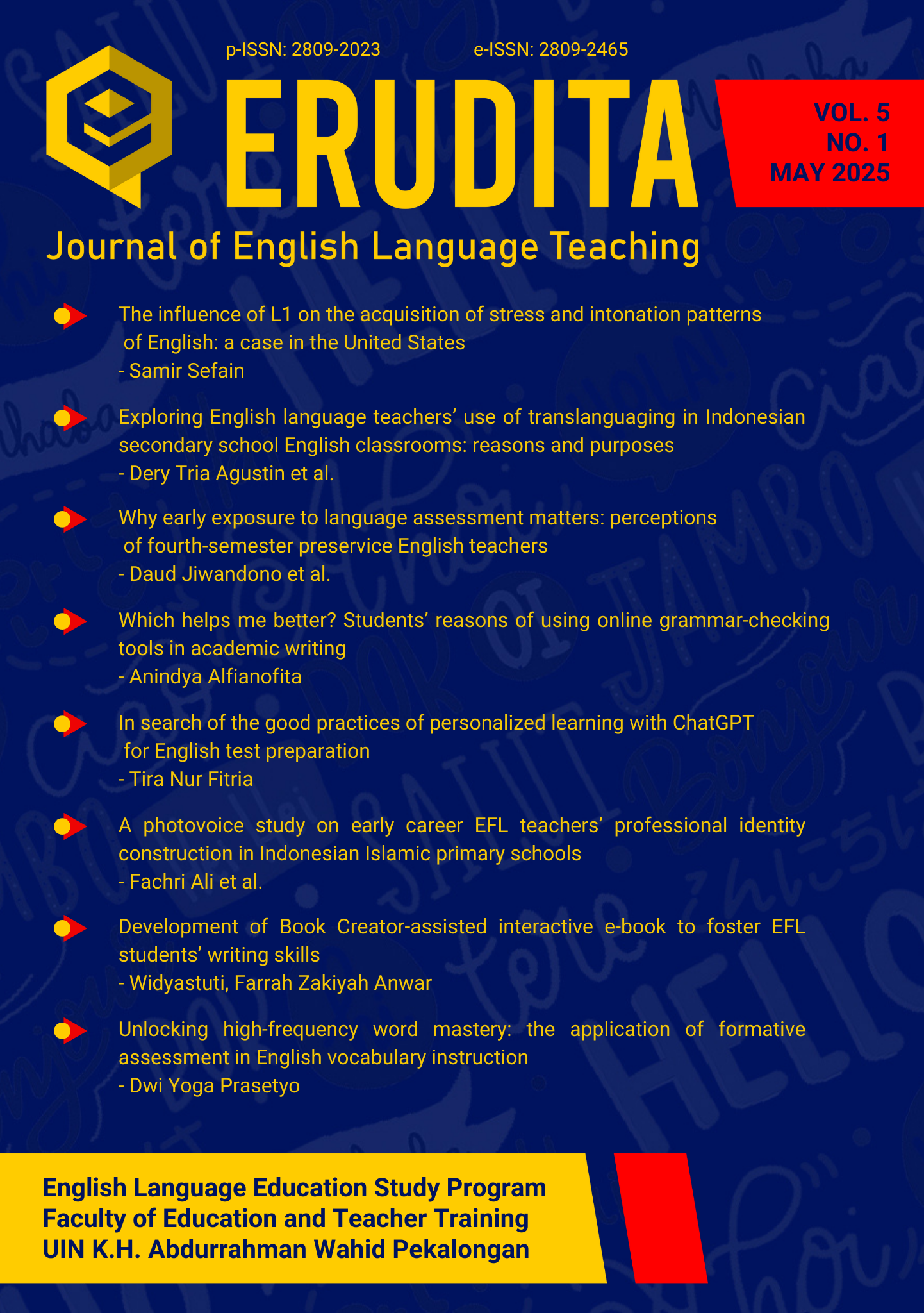
Unlocking high-frequency word mastery: the application of formative assessment in English vocabulary instruction
DOI:
https://doi.org/10.28918/erudita.v5i1.10992Abstract
In terms of foreign language learning, the role of vocabulary mastery is crucial for understanding course materials. However, some students still struggle with mastering English vocabulary, so formative assessment is implemented to explore students’ mastery of high-frequency words (HFWs). Thus, the aim of this research is to investigate the implementation and challenges of employing formative assessment in the learning process for students’ English vocabulary mastery on HFWs. The researcher used the descriptive case study method by conducting a semi-structured interview and observation to collect the data. One class of twelfth graders in this high school was used as the object of observation, and the English teacher and four students were recruited as interview participants. The results of the study showed that variations in formative assessment and providing feedback needed to be considered in the implementation of formative assessment for HFW mastery because all two were continuous in the success of formative assessment. Meanwhile, there were several challenges that arose when carrying out the implementation, such as time constraints, differences in student abilities, and student engagement, each of which is interrelated. These findings can improve teaching practices, emphasize the importance of formative assessment variations, feedback, and contextual HFW instruction.
Keywords:
References
Akhmedina, A. (2017). Challenges of implementing formative assessment at Nazarbayev Intellectual School [Master’s thesis, Nazarbayev University Graduate School of Education, Rusia]. Nazarbayev University Graduate School of Education Repository. https://nur.nu.edu.kz/items/a8b6a761-5124-49d1-92b9-327631817f37
Alizadeh, I. (2016). Vocabulary teaching techniques: A review of common practices. International Journal of Research in English Education, 1(1), 23−30. https://ijreeonline.com/article-1-25-en.html
Alonzo, A. C., Wooten, M. M., & Christensen, J. (2022). Learning progressions as a simplified model: Examining teachers’ reported uses to inform classroom assessment practices. Science Education, 106(4), 852−889. https://doi.org/10.1002/sce.21713
Al-Shaboul, Y., Al-Azaizeh, M., & Al-Dosari, N. (2021). Differentiated instruction between application and constraints: Teachers’ perspective. European Journal of Educational Research, 10(1), 127−143. https://doi.org/10.12973/eu-jer.10.1.127
Asare, E. & Afriyie, E. (2023). Barriers to basic school teachers’ implementation of formative assessment in the Cape Coast Metropolis of Ghana. Open Education Studies, 5(1), 20220193. https://doi.org/10.1515/edu-2022-0193
Aswar, M. (2018). The effectiveness of formative assessment in evaluating students’ speaking ability [Master’s thesis, Universitas Muhammadiyah Makassar]. Digital Library Universitas Muhammadiyah Makassar. https://digilibadmin.unismuh.ac.id/upload/868-Full_Text.Pdf
Bachman. (1999). Introduction to language classroom assessment. Oxford University Press.
Bennett, R. E. (2011). Formative assessment: A critical review. Assessment in Education: Principles, Policy & Practice, 18(1), 5−25. https://doi.org/10.1080/0969594x.2010.513678
Binu, M. (2020). The role of feedback in classroom instruction. The Journal of ELTIF, 5(4), 7−11.
Black, P., & Wiliam, D. (1998). Assessment and classroom learning. Assessment in Education: Principles, Policy & Practice, 5(1), 7−74. https://doi.org/10.1080/0969595980050102
Braun, V., & Clarke, V. (2006). Using thematic analysis in psychology. Qualitative Research in Psychology, 3(2), 77–101. https://doi.org/10.1191/1478088706qp063oa
Braun, V., & Clarke, V. (2012). Thematic Analysis. In H. Cooper, P. M. Camic, D. L. Long, A. T. Panter, D. Rindskopf, & K. J. Sher (Eds.), APA handbook of research methods in psychology (pp. 57–71). Research designs: Quantitative, qualitative, neuropsychological, and biological. American Psychological Association. https://doi.org/10.1037/13620-004
Brown, H. D. (2004). Language assessment: Principles and classroom practices. Pearson PTR Interactive.
Brown, H. D. (2007). Principles of language learning and teaching. Pearson.
Cambay, D. J. D., & Paglinawan, D. J. L. (2024). Classroom management strategies and school environment on student engagement. International Journal of Research and Innovation in Social Science, 8(12), 1−13. https://dx.doi.org/10.47772/IJRISS.2024.8120001
Childers, P. B., & Lowry, M. (1997). Engaging students through formative assessment in science. The Clearing House: A Journal of Educational Strategies, Issues and Ideas, 71(2), 97−102. https://doi.org/10.1080/00098659709599334
Crisp, G. (2001). Teacher’s handbook on e-assessment. Creative Common.
Crisp, G., Waycott, J., Thompson, C., Clerehan, R., Sheard, J., Hamilton, M., & Richardson, J. (2011). Teacher’s handbook on e-assessment: A handbook to support teachers in using e-assessment to improve and evidence student learning and outcomes. Creative Common.
Dakhi, S., & Fitria, T. N. (2019). The principles and the teaching of English vocabulary: a review. JET (Journal of English Teaching), 5(1), 15−21. https://doi.org/10.33541/jet.v5i1.956
Dang, T. N. (2019). High-frequency words in academic spoken English: corpora and learners. ELT Journal, 74(2), 146−155. https://doi.org/10.1093/elt/ccz057
Dmitrenko, N., Budas, I., Koliadych, Y., & Poliarush, N. (2021). Impact of formative assessment on students’ motivation in foreign language acquisition. East European Journal of Psycholinguistics, 8(2). https://doi.org/10.29038/eejpl.2021.8.2.dmi
Estaji, M. & Mirzaii, M. (2018). Enhancing EFL learners’ vocabulary learning through formative assessment: Is the effort worth expending? Language Learning in Higher Education, 8(2), 239−264. https://doi.org/10.1515/cercles-2018-0015
Fitchett, P. G., Heafner, T. L., & VanFossen, P. (2014). An analysis of time prioritization for social studies in elementary school classrooms. Journal of Curriculum and Instruction, 8(2), 7−35. https://doi.org/10.3776/joci.2014.v8n2p7-35
Gamlem, S. M., & Vattoy, K. (2023). Feedback and classroom practice. International Encyclopedia of Education (4th ed.), 89−95. https://doi.org/10.1016/b978-0-12-818630-5.09019-9
Gardner, D. (1997). Vocabulary, semantics, and language education. Cambridge University Press.
Glas, C. A., Scheerens, J., & Thomas, S. (2003). Educational evaluation, assessment, and monitoring: A systemic approach (1st ed.). Taylor & Francis Group. https://doi.org/10.4324/9780203971055
Harmer, J. (2001). Book review: The practice of English language teaching. RELC Journal, 32(1), 135−136. https://doi.org/10.1177/003368820103200109
Harrison, H., Birks, M., Franklin, & R., Mills, J. (2017). Case study research: foundations and methodological orientations. Forum Qualitative Sozialforschung/Forum: Qualitative Social Research, 18(1), 1−17. https://doi.org/10.17169/fqs-18.1.2655
Hattie, J., & Timperley, H. (2007). The power of feedback. Review of Educational Research, 77(1), 81−112. https://doi.org/10.3102/003465430298487
Hussein, H. J. (2019). The impact of using Socrative-based formative assessment to enhance student achievement in a nutrition course: A digital forward assessment. Journal for Researching Education Practice and Theory (JREPT), 2(1), 34−56.
Johns J. L. & Wilke K. H. (2018). High-frequency words: some ways to teach and help students practice and learn them. Texas Journal of Literacy Education, 6(1), 3–13.
Jordan, A., Schwartz, E., & McGhie-Richmond, D. (2009). Preparing teachers for inclusive classrooms. Teaching and teacher education, 25(4), 535−542. https://doi.org/10.1016/j.tate.2009.02.010
Kulasegaram, K., & Rangachari, P. K. (2018). Beyond “formative”: Assessments to enrich student learning. Advances in Physiology Education, 42(1), 5−14. https://doi.org/10.1152/advan.00122.2017
Lambert, V.A. & Lambert, C.E. (2012). Qualitative descriptive research: An acceptable design. Pacific Rim International Journal of Nursing Research, 16(4), 255−256.
Leenknecht, M., Wijnia, L., Köhlen, M., Fryer, L., Rikers, R., & Loyens, S. (2020). Formative assessment as practice: The role of students’ motivation. Assessment & Evaluation in Higher Education, 46(2), 236−255. https://doi.org/10.1080/02602938.2020.1765228
Lim, W. M. (2024). What is qualitative research? An overview and guidelines. Australasian Marketing Journal, 33(2), 199−229. https://doi.org/10.1177/14413582241264619
Lokare, V. T., & Jadhav, P. M. (2024). An AI-based learning style prediction model for personalized and effective learning. Thinking Skills and Creativity, 51, 101421. https://doi.org/10.1016/j.tsc.2023.101421
Maftuh, M. S. J. (2023). Understanding learning strategies: A comparison between contextual learning and problem-based learning. Educazione: Journal of Education and Learning, 1(1), 54−65. https://doi.org/10.61987/educazione.v1i1.496
Marks, C. B., Doctorow, M. J., & Wittrock, M. C. (1974). Word frequency and reading comprehension. The Journal of Educational Research, 67(6), 259−262. https://doi.org/10.1080/00220671.1974.10884622
Masrai, A. (2019). Vocabulary and reading comprehension revisited: Evidence for high-, mid, and low-frequency vocabulary knowledge. SAGE Open, 9(2). https://doi.org/10.1177/2158244019845182
Mills, M., Monk, S., Keddie, A., Renshaw, P., Christie, P., Geelan, D., & Gowlett, C. (2014). Differentiated learning: From policy to classroom. Oxford review of education, 40(3), 331−348. https://doi.org/10.1080/03054985.2014.911725
Moghadam, S. H., Zainal, Z., & Ghaderpour, M. (2012). A Review on the important role of vocabulary knowledge in reading comprehension performance. Procedia: Social and Behavioural Sciences, 66, 555−563. https://doi.org/10.1016/j.sbspro.2012.11.300
Muenks, K., & Miele, D. B. (2017). Students’ thinking about effort and ability: The role of developmental, contextual, and individual difference factors. Review of Educational Research, 87(4), 707−735. https://doi.org/10.3102/0034654316689328
Nahavandi, N., & Mukundan, J. (2014). The impact of textual input enhancement on iranian elementary EFL learners’ vocabulary intake. Asian Social Science, 10(21). https://doi.org/10.5539/ass.v10n21p216
Nation, I. S. P. (2001). Learning vocabulary in another language. Cambridge University Press.
Nunan, D. (1991). Language teaching methodology: A textbook for teachers. Prentice-Hall International, Ltd.
Nurhasanah, F., & Khasanah, N. (2020). The effectiveness of socrative application for formative assessment in teaching vocabulary at SMA Muhammadiyah 1 Ponorogo. ELTALL: English Language Teaching, Applied Linguistic and Literature, 1(2), 51−56. https://doi.org/10.21154/eltall.v1i2.2448
Özkan, Y. Ö., & OZKAN, M. (2025). Decoding teachers’ dilemma: Unveiling the real obstacles to implementing formative assessment in the classroom. Journal of Qualitative Research in Education, 41, 95−118. https://doi.org/10.14689/enad.41.2062
Papadopoulou, S., & Vlachos, K. (2014). Using digital storytelling to develop foundational and new literacies. Research Papers in Language Teaching and Learning, 5(1), 235−258.
Pentaraki, A., & Burkholder, G. J. (2017). Emerging evidence regarding the roles of emotional, behavioural, and cognitive aspects of student engagement in the online classroom. European Journal of Open, Distance and E-Learning, 20(1), 1−21. https://doi.org/10.1515/eurodl-2017-0001
Rahman, A., Yap, N. T., & Darmi, R. (2018). The association between vocabulary size and language dominance of bilingual Malay-English undergraduates. 3L, Language, Linguistics, Literature, 24(4), 85–101. http://doi.org/10.17576/3L-2018-2404-07
Rahman, K. A., Hasan, M. K., Namaziandost, E., & Ibna Seraj, P. M. (2021). Implementing a formative assessment model at the secondary schools: Attitudes and challenges. Language Testing in Asia, 11(1), 1–18. https://doi.org/10.1186/s40468-021-00136-3
Richards, J. C., & Renandya, W. A. (2002). Methodology in language teaching: An anthology of current practice. Cambridge University Press.
Rustan, R. M., & Andriyanti, E. (2021). High-frequency words in English textbooks for Indonesian senior high schools. Studies in English Language and Education, 8(1), 181−196. https://doi.org/10.24815/siele.v8i1.18141
Sardi, A. (2022). Building up of students’ vocabulary mastery through knowing by heart strategy. LETS: Journal of Linguistics and English Teaching Studies, 4(1), 62−72. https://doi.org/10.46870/lets.v4i1.318
Schildkamp, K., Van der Kleij, F. M., Heitink, M. C., Kippers, W. B., & Veldkamp, B. P. (2020). Formative assessment: A systematic review of critical teacher prerequisites for classroom practice. International Journal of Educational Research, 103. https://doi.org/10.1016/j.ijer.2020.101602
Schmitt, N. (2000). Vocabulary in language teaching. Cambridge University Press.
Szymkowiak, A., Melović, B., Dabić, M., Jeganathan, K., & Kundi, G. S. (2021). Information technology and Gen Z: The role of teachers, the internet, and technology in the education of young people. Technology in Society, 65. https://doi.org/10.1016/j.techsoc.2021.101565
Terry, G.; Hayfield, N.; Clarke, V.; Braun, V. Thematic analysis. In Willig, C., Rogers, W.S. The SAGE Handbook of Qualitative Research in Psychology (pp.17–36). SAGE Publications Ltd.
Thornbury, S. (2007). How to teach vocabulary. Longman Pearson.
Wei, L. (2010). Formative assessment: Opportunities and challenges. Journal of Language Teaching and Research, 1(6). https://doi.org/10.4304/jltr.1.6.838-841
Wolpert-Gawron, H., Platt, R., Corales, G., Skae-Jackson, L., & Good, M. W. (2022). It’s vital to focus on student engagement. Edutopia.
Wu, S., Lin, S., Huang, R., & Tsai, I. (2021). High frequency words produced by typically developing Mandarin-speaking children between 3 and 6 years of age. SAGE Open, 11(3), 1–23. https://doi.org/10.1177/21582440211036109
Yarahmadzehi, N., & Goodarzi, M. (2020). Investigating the role of formative mobile based assessment in vocabulary learning of pre-intermediate EFL learners in comparison with paper-based assessment. Turkish Online Journal of Distance Education, 21(1), 181−196. https://doi.org/10.17718/tojde.690390
Yin, R. K. (2013). Case study research: Design and methods, applied social research methods (5th ed.). Sage.
Zainal, Z. (2007). Case study as a research method. Jurnal Kemausiaan, 5(1). https://jurnalkemanusiaan.utm.my/index.php/kemanusiaan/article/view/165
Zarei, N., Hussin, S., & Rashid, T. (2015). Overcoming learning time and space constraints through technological tool. Advances in Language and Literary Studies, 6(4), 151−157. https://doi.org/10.7575/aiac.alls.v.6n.4p.151
Zelenska, O., Kondra, O., & Galaidin, A. (2022). Formative assessment as effective classroom practice. Scientific Journal of Polonia University, 50(1), 151−155. https://doi.org/10.23856/5018
Downloads
Published
License
Copyright (c) 2025 Dwi Yoga Prasetyo

This work is licensed under a Creative Commons Attribution-ShareAlike 4.0 International License.
Erudita: Journal of English Language Teaching is licensed under a Creative Commons Attribution-ShareAlike 4.0 International License. An author who publishes in Erudita: Journal of English Language Teaching agrees to the following terms:
- Author retains the copyright and grants the journal the right of first publication of the work simultaneously licensed under the Creative Commons Attribution-ShareAlike 4.0 License that allows others to share the work with an acknowledgment of the work's authorship and initial publication in this journal
- Author is able to enter into separate, additional contractual arrangements for the non-exclusive distribution of the journal’s published version of the work (e.g., post it to an institutional repository or publish it in a book) with the acknowledgment of its initial publication in this journal.
- Author is permitted and encouraged to post his/her work online (e.g., in institutional repositories or on their website) prior to and during the submission process, as it can lead to productive exchanges, as well as earlier and greater citation of the published work (See The Effect of Open Access).