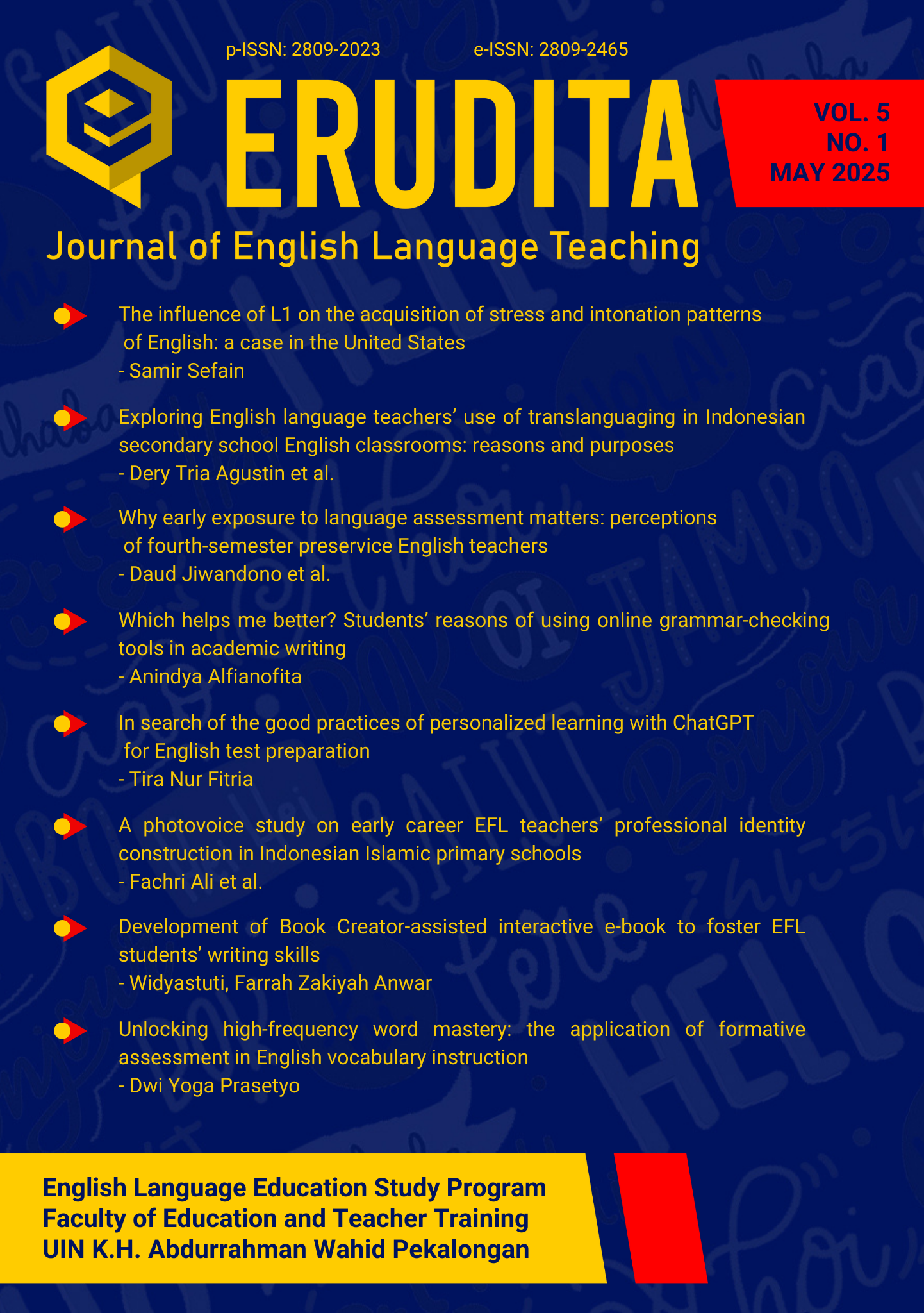
Why early exposure to language assessment matters: perceptions of fourth-semester preservice English teachers
DOI:
https://doi.org/10.28918/erudita.v5i1.10776Abstract
Although language assessment literacy (LAL) has received increasing attention globally, studies on pre-service teachers’ initial awareness in the Indonesian context are still relatively limited. This study examines the perceptions of fourth-semester pre-service English teachers toward language assessment, focusing on three main aspects: their views on the initial introduction of assessment theory, their understanding of assessment practices, and the importance of assessment. Using a qualitative descriptive design, the data were collected from 58 participants through questionnaires and semi-structured interviews with 15 participants. The results showed that the participants found the initial introduction to assessment theory to be very beneficial because it increased their self-confidence and provided a structured direction in planning their future teaching. Most participants initially viewed assessment as a tool to assess students. However, after gaining an understanding of assessment principles such as validity, reliability, practicality, and washback, their perceptions changed. They began to see assessment as an important part of the teaching process. These findings underscore the importance of incorporating language assessment literacy early in the teacher education curriculum to develop reflective and assessment-literate educators. The study recommends that language assessment instruction should not only be delivered comprehensively but also contextualized in practical teaching experiences.
Keywords:
References
Burns, A. (2010). Doing action research in English language teaching: A guide for practitioners. Routledge.
Davies, J. A. (2023). In search of learning-focused feedback practices: A linguistic analysis of higher education feedback policy. Assessment & Evaluation in Higher Education, 48(8), 1208–1222. https://doi.org/10.1080/02602938.2023.2180617
DeLuca, C., & Klinger, D. A. (2010). Assessment literacy development: Identifying gaps in teacher candidates’ learning. Assessment in Education: Principles, Policy & Practice, 17(4), 419–438. https://doi.org/10.1080/0969594X.2010.516643
Dewi, Y. L., & Mutammam, M. (2022). Formative assessment in distance learning: Narratives of Indonesian senior secondary school EFL teachers. Erudita: Journal of English Language Teaching, 2(1), 26–37. https://doi.org/10.28918/erudita.v2i1.5329
Farmasari, S., Wardana, L. A., Baharudin, D., Herayana, D., & Suryaningsih, H. (2023). Pre-service EFL teachers’ language assessment literacy satisfaction and assessment preparedness. International Journal of Language Education, 7(4), 15–25. https://doi.org/10.26858/ijole.v7i4.47445
Fulcher, G. (2012). Assessment literacy for the language classroom. Language Assessment Quarterly, 9(2), 113–132. https://doi.org/10.1080/15434303.2011.642041
Giraldo, F. (2018). Language assessment literacy: Implications for language teachers. Profile: Issues in Teachers’ Professional Development, 20(1), 179–195. https://doi.org/10.15446/profile.v20n1.62089
Hatch, J. A. (2002). Doing qualitative research in education settings. State University of New York Press.
Jeong, H. (2013). Defining assessment literacy: Is it different for language testers and non-language testers? Language Testing, 30(3), 345–362. https://doi.org/10.1177/0265532213480336
Kianinezhad, N. (2023). Language assessment literacy: The role of self-reflection. Journal of English Language and Culture, 14(1), 40–55. https://doi.org/10.30813/jelc.v14i1.4662
Kömür, Ş. (2018). Preservice English teachers’ assessment awareness: Level of readiness for classroom practice. Journal of Language Teaching and Learning, 8(1), 1–15. https://jltl.com.tr/index.php/jltl/article/view/60
Lam, R. (2015). Language assessment training in Hong Kong: Implications for language assessment literacy. Language Testing, 32(2), 169–197. https://doi.org/10.1177/0265532214554321
Laundon, M., Cunningham, S., & Cathcart, A. (2023). Institutional approaches to evaluation of learning and teaching: A sector scan of Australasian universities. Journal of Higher Education Policy and Management, 45(5), 511–528. https://doi.org/10.1080/1360080X.2023.2196646
Mellati, M., & Khademi, M. (2018). Exploring teachers’ assessment literacy: Impact on learners’ writing achievements and implications for teacher development. Australian Journal of Teacher Education, 43(6), 1–17. https://doi.org/10.14221/ajte.2018v43n6.1
Pill, J., & Harding, L. (2013). Defining the construct of language proficiency in the context of health professions. Language Testing, 30(3), 271–290. https://doi.org/10.1177/0265532212469045
Prastikawati, E. F., Mujiyanto, J., Saleh, M., & Fitriati, S. W. (2024). Surveying pre-service EFL teachers’ conceptions of assessment: Implication for teacher education. Proceedings of UNNES-TEFLIN National Conference, 6, (pp. 1–10). https://proceeding.unnes.ac.id/utnc/article/view/4054
Stiggins, R. (2014). Defensible teacher evaluation: Student growth through classroom assessment. Corwin Press.
Sulistio, P. H. (2023). Language assessment literacy: Cases of pre-service English teachers. International Journal of Language Education and Cultural Review, 9(1), 1–10. https://doi.org/10.21009/ijlecr.v9i1.33032
Taylor, L. (2013). Language assessment literacy for language teachers. Language Testing, 30(3), 319–336. https://doi.org/10.1177/0265532213480127
Tosuncuoglu, I. (2018). Importance of assessment in ELT. Journal of Education and Training Studies, 6(9), 163–167. https://eric.ed.gov/?id=EJ1188961
Tsagari, D. (2021). Language assessment literacy: Concepts, challenges, and prospects. In D. Tsagari & J. Banerjee (Eds.), Language assessment literacy: Issues and challenges (pp. 13–30). Routledge.
Vattøy, K. D., & Gamlem, S. M. (2020). Teacher–student interactions and feedback in English as a foreign language classrooms. Cambridge Journal of Education, 50(3), 371–389. https://doi.org/10.1080/0305764X.2019.1707512
Vogt, K., & Tsagari, D. (2014). Assessment literacy of foreign language teachers: Findings of a European study. Language Assessment Quarterly, 11(4), 374–402. https://doi.org/10.1080/15434303.2014.960046
Volante, L., & Fazio, X. (2007). Exploring teacher candidates’ assessment literacy: Implications for teacher education reform and professional development. Canadian Journal of Education, 30(3), 749–770.
Winna, W., & Sabarun, S. (2023). The language assessment in teaching-learning English. DIAJAR: Jurnal Pendidikan dan Pembelajaran, 14(5), 413–419. https://doi.org/10.54259/diajar.v2i4.1894
Xu, Y., & Brown, G. T. L. (2016). Teacher assessment literacy in practice: A reconceptualization. Teaching and Teacher Education, 58, 149–162. https://doi.org/10.1016/j.tate.2016.05.010
Yan, X., & Fan, J. J. (2021). “Am I qualified to teach assessment?”: Pre-service English language teachers’ assessment literacy development. Language Assessment Quarterly, 18(1), 31–49. https://doi.org/10.1080/15434303.2020.1844543
Downloads
Published
License
Copyright (c) 2025 Daud Jiwandono, Riana Permatasari, Kushardiyanti Novinda, Khairiyah Eka Januaristi

This work is licensed under a Creative Commons Attribution-ShareAlike 4.0 International License.
Erudita: Journal of English Language Teaching is licensed under a Creative Commons Attribution-ShareAlike 4.0 International License. An author who publishes in Erudita: Journal of English Language Teaching agrees to the following terms:
- Author retains the copyright and grants the journal the right of first publication of the work simultaneously licensed under the Creative Commons Attribution-ShareAlike 4.0 License that allows others to share the work with an acknowledgment of the work's authorship and initial publication in this journal
- Author is able to enter into separate, additional contractual arrangements for the non-exclusive distribution of the journal’s published version of the work (e.g., post it to an institutional repository or publish it in a book) with the acknowledgment of its initial publication in this journal.
- Author is permitted and encouraged to post his/her work online (e.g., in institutional repositories or on their website) prior to and during the submission process, as it can lead to productive exchanges, as well as earlier and greater citation of the published work (See The Effect of Open Access).