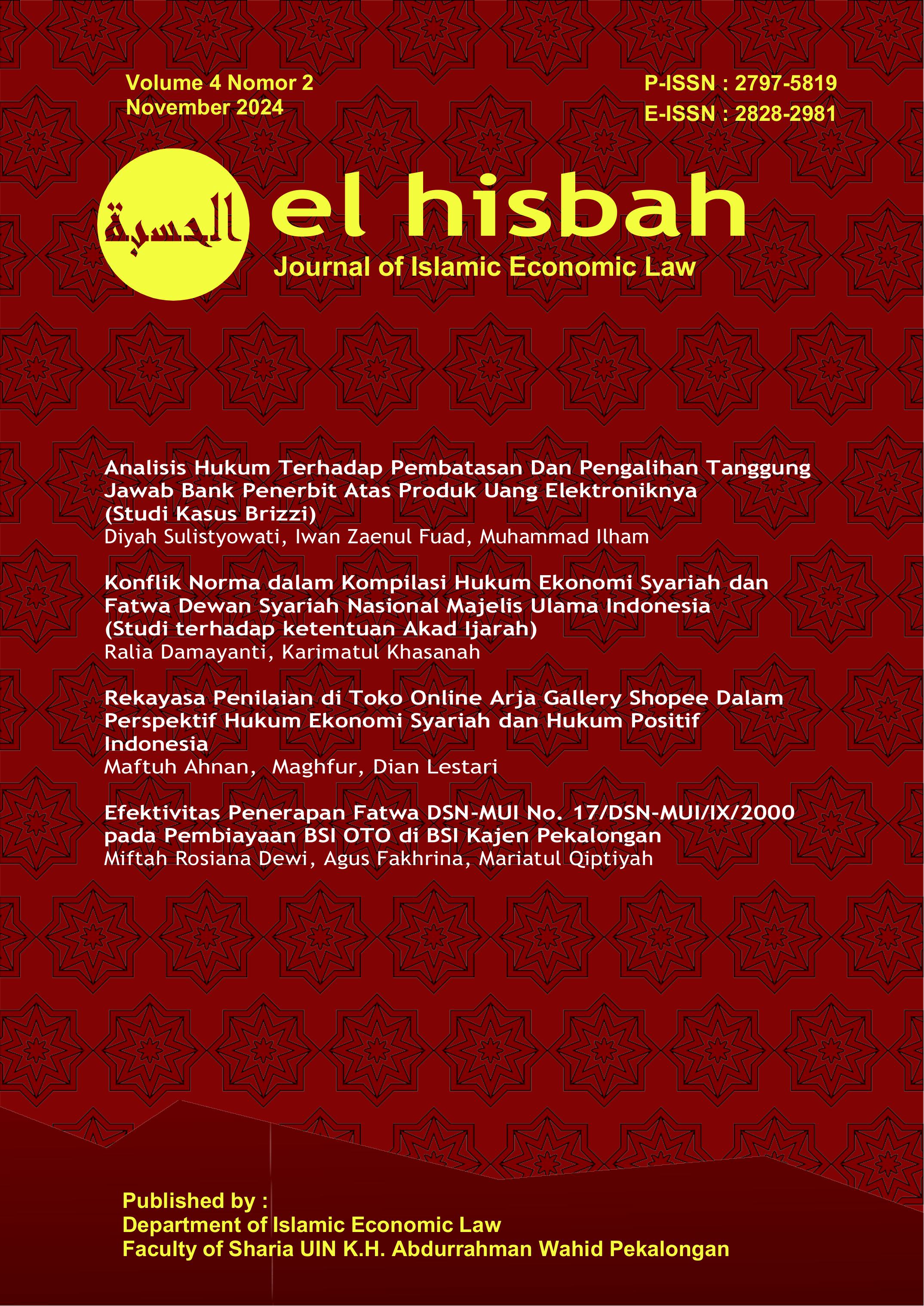
Rekayasa Penilaian di Online Shop : Studi Perbandingan Hukum Ekonomi Syariah dan Hukum Positif Indonesia
DOI:
https://doi.org/10.28918/elhisbah.v4i2.9229Abstract
The purpose of this research is to analyze the engineering of reviews conducted by online stores on the Shopee platform, as well as to review their validity and implications based on the Sharia Economic Law and the Indonesian Positive Law. The research conducted uses a qualitative type. In accordance with the issues raised, using field research. The data sources in this study, namely primary data sources, were obtained through interviews with business actors who use the shopee marketplace platform. Secondary data sources are obtained from books and research reports related to the Salam sale and purchase agreement. Based on the analysis of Islamic economic law, it is not appropriate because the shop does a fake review first to attract customers, this method is not in accordance with Islamic law because it contains elements of gharar, shop owners should be able to use promotional methods for their business in accordance with buying and selling in general. Meanwhile, from the perspective of Indonesian positive law, fictitious orders are a form of criminal fraud that harms others and is regulated in the ITE law with a penalty of up to 12 years in prison or a fine of Rp12 billion. This research makes a scholarly contribution by examining the practice of valuation engineering in the market from the perspective of Shariah economic law, thus enriching the literature on business ethics and consumer protection in Shariah-based online buying and selling transactions.
Keywords:
References
Chandana, P., Sree, N. P., Ramya, V., & Bhavana, G. (2021). Analyzing the Extremist Reviewer Groups on Online Products. 2021 Third International Conference on Inventive Research in Computing Applications (ICIRCA), 1–4.
Chen, L., Li, W., Chen, H., & Geng, S. (2019). Detection of fake reviews: Analysis of sellers’ manipulation behavior. Sustainability (Switzerland), 11(17). https://doi.org/10.3390/su11174802
Clarisa, H., & Areta A, H. (2022). Fake Review and Liabilities Defect Goods in E-Commerce. The Lawpreneurship Journal, 2(1), 19–42. https://doi.org/10.21632/tlj.2.1.19-42
Dewi, E. W. (2015). Hukum perlindungan konsumen.
Edi Darmawijaya, Faisal Fauzan, & Fadlan Mera. (2020). Delivery Order Barang Bangunan Menurut Perspektif Salam Pada Tb. Puga Jaya Di Kota Banda Aceh. Al-Mudharabah: Jurnal Ekonomi Dan Keuangan Syariah, 2(1), 61–76. https://doi.org/10.22373/al-mudharabah.v2i1.816
Farki, A., & Baihaqi, I. (2016). Pengaruh Online Customer Review dan Rating Terhadap Kepercayaan dan Minat Pembelian pada Online Marketplace di Indonesia. Jurnal Teknik ITS, 5(2). https://doi.org/10.12962/j23373539.v5i2.19671
Gusniarti, G. (2015). Distorsi Pasar dalam Proses Transaksi Sekuritas Syariah di Pasar Sekunder. Etikonomi, 14(2), 194848.
Harahap, D. A., & Amanah, D. (2018). Perilaku belanja online di Indonesia: Studi kasus. Jurnal Riset Manajemen Sains Indonesia (JRMSI), 9(2).
Hardianti, S. (2019). Pengaruh Iklan Dan Word Of Mouth Terhadapminat Berbelanja Online Melalui Aplikasi Shopee Padamahasiswa Fakultas Ekonomi Dan Bisnis Universitasmuhammadiyah Sumatera Utara. Skripsi. Universitas Muhammadiyah Sumatera Utara.
Haris Simal, A. (2019). Pelaksanaan Jual Beli Dengan Menggunakan Akad As-Salam Ditinjau Dari Prinsip Tabadul Al-Manafi. Jurnal Tahkim, xv(1), 110–124.
Hidayat, E. (2019). Kaidah Fikih Muamalah. PT Remaja Rosdakarya.
Mujtahid, M. (2020). Publikasi Pelaku Jarimah dan Tindak Pidana Pers dalam Islam. Media Syari’ah: Wahana Kajian Hukum Islam Dan Pranata Sosial, 22(1), 93–100.
Munanda, E. (2020). Hukuman Tindak Pidana Penipuan Menggunakan Identitas Palsu Di Tinjau Menurut Hukum Islam. UIN AR-RANIRY.
Nugroho, A. P., Luthfi, M., Alfiana, A., Bakri, A. A., & Zulbetti, R. (2024). Analisis Akad Salam (PSAK Syariah 103) pada Transaksi Jual Beli Online. Al-Kharaj: Jurnal Ekonomi, Keuangan & Bisnis Syariah, 6(3), 2997–3007.
Prasetyo, H. L., Ahmad, S., & Lutfi, A. (2024). Pengawasan KPPU Pada Pelaku Usaha Mikro, Kecil dan Menengah Dalam Persaingan Usaha Tidak Sehat di Era Digital. Binamulia Hukum, 13(1), 225–237. https://doi.org/10.37893/jbh.v13i1.646
Prawira, F., & Andriansyah. (2024). ANALISIS HUKUM TERHADAP JASA PENILAIAN PRODUK SHOPEE PADA APLIKASI FASTWORK DITINJAU DENGAN HUKUM POSITIF DAN HUKUM ISLAM (Vol. 15, Issue 1). Universitas Islam Negeri Syarif Hidayatullah Jakarta.
Qori, D. El. (2020). TRANSAKSI E-COMMERCE BERBASIS MARKET PLACE: ANTARA AKAD SALAM DAN GHARAR PERSPEKTIF FIQIH MADZHAB SYAFI`I). 16, 414–429.
Khrisyantara, I. P. F., Rosyidi, F. A., Ratulangi, A. P. A., & Rakhmawati, N. A. (2024). ANALISIS PENGARUH TRANSAKSI PALSU ( FAKE REVIEW ) TERHADAP PERSEPSI RISIKO DAN MINAT BELI MAHASISWA SISTEM INFORMASI ITS. December. https://doi.org/10.5281/zenodo.14238817
Saprida, S. (2018). Akad Salam Dalam Transaksi Jual Beli. Mizan: Journal of Islamic Law, 4(1).
Wahyuni, D. S. (2020). PRAKTIK MYSTERY SHOPPER UNTUK MEMPEROLEH KONSUMEN PERSPEKTIF JUAL BELI DALAM FIKIH MUAMALAH (Studi di Outlet Minuman X Mall Olympic Garden Malang). 1–23.
Waruwu, V., Nainggolan, O., & Sinaga, J. (2020). Pertanggungjawaban Pidana Pelaku Orderan Fiktif Ojek Online Yang Mengakibat Kerugian Pt. Grab Indonesia ( Studi Putusan Nomor 1507/Pid.Sus/2018/Pn.Mdn). Jurnal Hukum PATIK, 9(3), 174–190. https://doi.org/10.51622/patik.v9i3.247
Wawo, A., & Amiruddin, A. (2020). Corporte Social Responsibility dalam Perspektif Etika Bisnis dan Hukum Islam. Jurnal Mirai Management, 5(2).
Widyaningrum, D. A. S. F. (2020). TINJAUAN HUKUM ISLAM TERHADAP PERSAINGAN USAHA PEDAGANG PLASTIK DI PASAR NGILO-ILO KECAMATAN SLAHUNG KABUPATEN PONOROGO. Journal GEEJ, 7(2).
Wingate, N. (2019). The Influence of Fake Reviews on Consumer Perceptions of Risks and Purchase Intentions. Journal of Marketing Development and Competitiveness, 13(3), 133–143. https://doi.org/10.33423/jmdc.v13i3.2244
Zhorifi, S. A., Mutia, A., & Agusriandi, A. (2023). Persaingan Antar Pedagang Dalam Perspektif Etika Bisnis Islam: Studi Pasar Tradisional Keramat Tinggi Kecamatan Muara Bulian. Jurnal Penelitian Ilmu Ekonomi Dan Keuangan Syariah, 1(4), 63–76.
Downloads
Published
License
Copyright (c) 2024 el_hisbah

This work is licensed under a Creative Commons Attribution-NonCommercial 4.0 International License.
 Journal El Hisbah : Journal of Islamic Economic Law by Faculty of Sharia, UIN K.H. Abdurrahman Wahid Pekalongan, Central Java, Indonesia is licensed under a Creative Commons Attribution 4.0 International License.
You are free to:
- Share ” copy and redistribute the material in any medium or format
- Adapt ” remix, transform, and build upon the material for any purpose, even commercially.
Under the following terms:
-
Attribution ” You must give appropriate credit, provide a link to the license, and indicate if changes were made. You may do so in any reasonable manner, but not in any way that suggests the licensor endorses you or your use.
- No additional restrictions ” You may not apply legal terms or technological measures that legally restrict others from doing anything the license permits.