
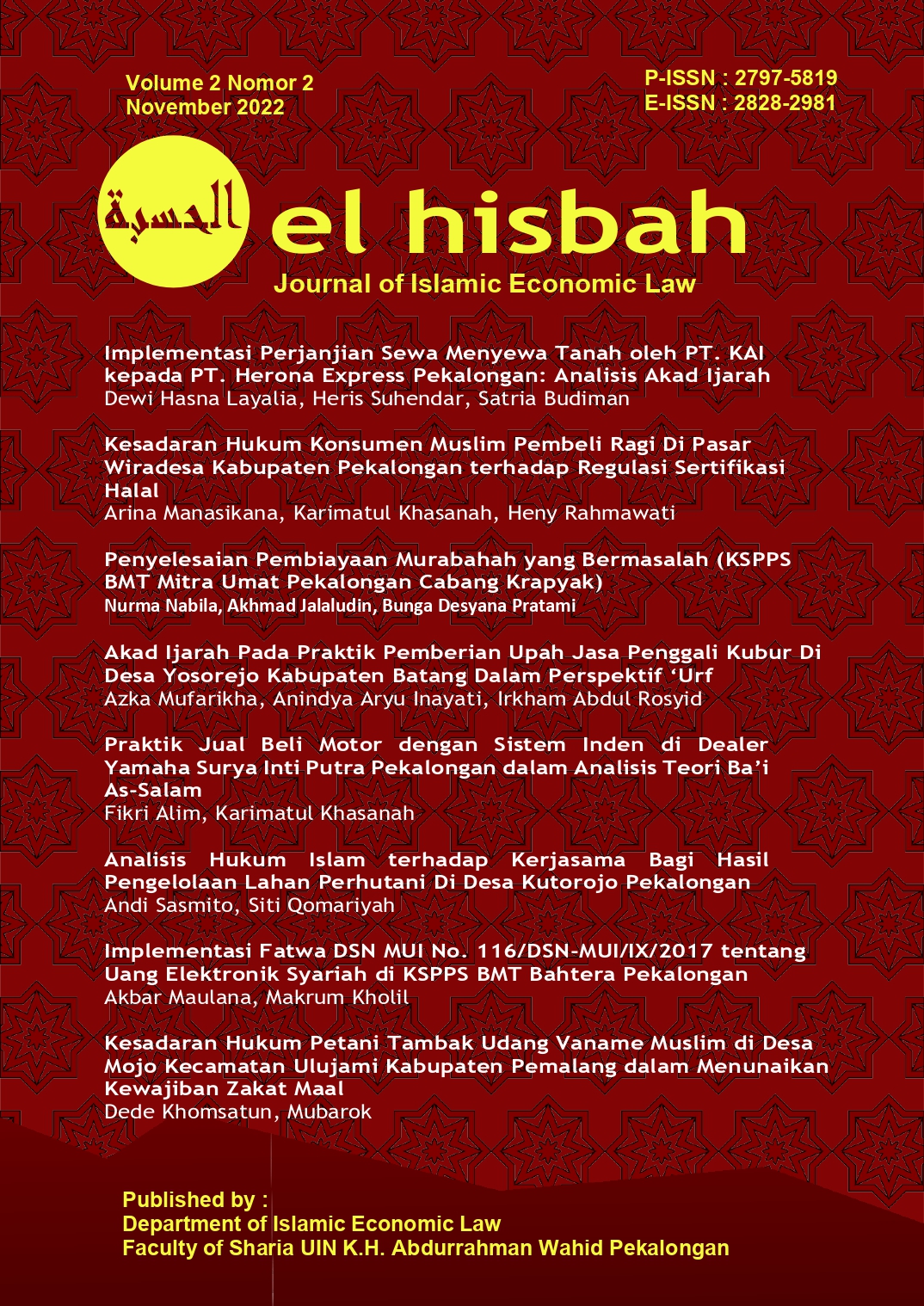
Akad Ijarah Pada Praktik Pemberian Upah Jasa Penggali Kubur Di Desa Yosorejo Kabupaten Batang Dalam Perspektif ‘Urf
DOI:
https://doi.org/10.28918/elhisbah.v2i2.825Abstract
Every human being cannot fulfill his needs without other people. So, Allah ordered His servants to fulfill the help. Human relations according to Islamic law are muamalah. In general, wages are the agreed total amount of replacement services determined by workers covering certain periods and conditions. This study aims to explain the practice of giving grave diggers wages in Yosorejo Village, Batang Regency in the 'Urf Perspective and to analyze the Conformity between the Ijarah Agreement and the Practice of Grave Digger Service Wages in Yosorejo Village, Batang Regency. This type of research is a socio legal research approach or empirical legal research and a conceptual approach. Primary data sources were obtained from observations and interviews by gravediggers and the community. Sources of secondary data obtained from research journals, previous research, and fiqh books related to research problems obtained by documentation techniques. Data analysis is carried out continuously. The results of this study indicate that the practice of providing wages for gravediggers in Yosorejo Village, it appears that the practice of wages is an inherent and long-standing tradition. Tradition in a society is a custom that is not easy to abolish or replace with new habits.
Keywords:
References
Adam, P. (2021). Fikih Muamalah Kontemporer: Perkembangan Akad-akad dalam Hukum Ekonomi Syariah. Intelegensia Media.
Al-Faifi, S. S. A. Y. (2016). Ringkasan Fikih Sunnah Sayid Sabiq. Pustaka Al-Kautsar.
Andini, S. (2019). Tinjauan Hukum Islam Tentang Praktik Upah Dalam Proses Pemakaman Jenazah (Studi di Desa Lematang, Tanjung Bintang, Lampung Selatan). UIN Raden Intan Lampung.
Bachtiar. (2018). Metode Penelitian Hukum. Unpam Press.
Hasan, M. A. (2003). Berbagai Macam Transaksi dalam Islam. PT. Raja Grafindo Persada.
Hidayatulloh, A., Sail, S. I., & Masykur, I. G. (2011). At-Thayib Al-Qur’an Transliterasi Kata per Kata. Cipta Bagus Segara.
Inayati, A. A. (2021). Epistemologi Hukum Islam Sir Muhammad Iqbal: Kajian Filosofis Hukum Islam. Ulumul Syar’i: Jurnal Ilmu-Ilmu Hukum Dan Syariah, 10(1), 38–50.
Ishaq. (2017). Metode penelitian hukum dan penulisan Skripsi, Tesis serta disertasi. Alfabeta.
Jamaluddin, J. (2019). Elastisitas Akad Al-Ijarah (Sewa-Menyewa) Dalam Fiqh Muamalah Persfektif Ekonomi Islam. Jurnal At-Tamwil: Kajian Ekonomi Syariah, 1(1), 17–31.
Karim, H. (1997). Fiqih Muamalah. Raja Grafindo persada.
Latif, U. (2016). Konsep Mati dan Hidup Dalam Islam. Jurnal Al-Bayan, 22(2), 34.
Pitaloka, I. S. (2020). Ujrah Tanah Pemakamam Menurut Perspektif Hukum Islam di Desa Purwosari Kec. Batanghari Nuban Kab. Lampung Timur. IAIN Metro.
Putri, A. N. (2021). Tinjauan Hukum Islam Terhadap Praktik Jasa Pengurusan Jenazah, Studi Kasus Di Desa Silungkang Tigo, Kecamatan Silungkang, Kota Sawahlunto, Sumatera Barat. Institut Ilmu Al-Qur’an.
Semmawi, R. (2010). Urgensi Akad Dalam Hukum Ekonomi Islam. Jurnal Ilmiah Al-Syir’ah, 8(2), 498–517. https://doi.org/10.30984/as.v8i2.23
Subandi, A., & Anshor, S. bin. (2020). Fatwa MUI Tentang Pengurusan Jenazah Muslim yang Terinfeksi Covid-19 Ditinjau dari Perspektif Mazhab Syafi’i. BUSTANUL FUQAHA: Jurnal Bidang Hukum Islam, 1(2), 235–250.
Sugiono. (2014). Metode Penelitian Kuantitatif Kualitatif dan R&D. Alfabeta.
Suhendi, H. (2008). Fiqh Muamalah. PT. Raja Grafindo Persada.
Syarifuddin, A. (2008). Ushul Fiqh 2. Kencana Prenada Media.
Tamam, B. (2022). Pengantar Hukum Adat. Pustaka Radja.
Yusanto, M. I., & Widjajakusuma, M. K. (2002). Menggagas Bisnis Islam. Gema Insani Press.
Downloads
Published
License
 Journal El Hisbah : Journal of Islamic Economic Law by Faculty of Sharia, UIN K.H. Abdurrahman Wahid Pekalongan, Central Java, Indonesia is licensed under a Creative Commons Attribution 4.0 International License.
You are free to:
- Share ” copy and redistribute the material in any medium or format
- Adapt ” remix, transform, and build upon the material for any purpose, even commercially.
Under the following terms:
-
Attribution ” You must give appropriate credit, provide a link to the license, and indicate if changes were made. You may do so in any reasonable manner, but not in any way that suggests the licensor endorses you or your use.
- No additional restrictions ” You may not apply legal terms or technological measures that legally restrict others from doing anything the license permits.