
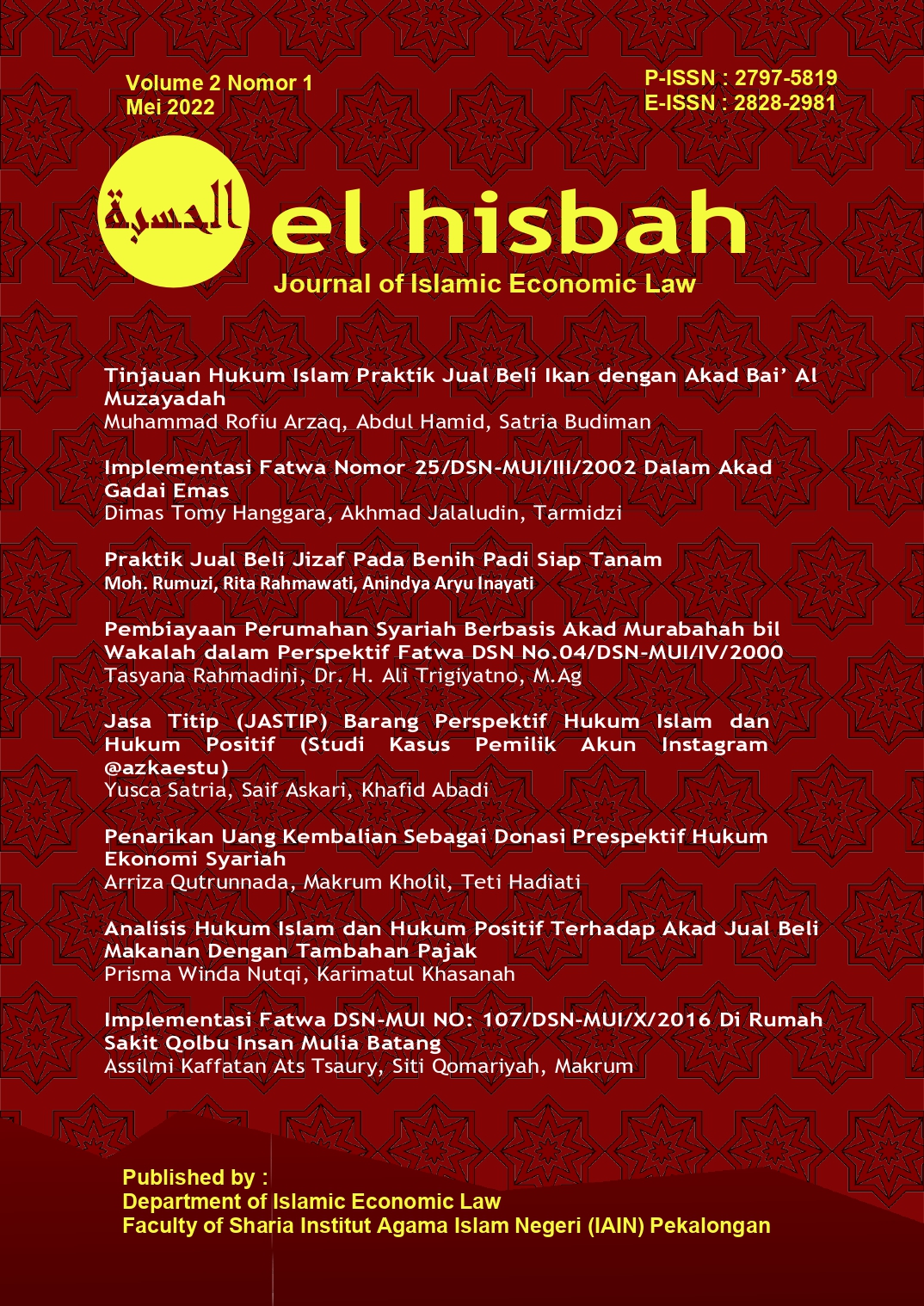
Jasa Titip (JASTIP) Barang Prespektif Hukum Islam dan Hukum Positif
(Studi Kasus Pemilik Akun Instagram @azkaestu)
DOI:
https://doi.org/10.28918/elhisbah.v2i1.730Abstract
Goods delivery service (jastip) is a service assistance service to buy certain goods that are presented through web-based media, and for this assistance the perpetrators of the delivery service will receive fees or wages. The owner of the Instagram account @azkaestu provides this web-based buying and selling service by applying the price of goods and estimates combined with the cost or wage rate for the service if the customer does not ask directly, and does not explain what the cost of the store is. Based on the above background, the formulation of the problem in this study are: 1. How is the practice of goods deposit services on the @azkaestu Instagram account owner?, 2. What is the perspective of Islamic law on goods deposit services?, 3. What is the positive legal perspective on goods deposit services? ?
The conclusion that can be drawn is the mechanism for determining ujrah on the @azkaestu Instagram account by entering administrative wages which are combined into the product cost price called include. The wage rate for administration usually ranges from 10-50% of the product cost and this depends on the operational services of the goods or the needs of the custodians. Meanwhile, the positive legal view on online application-based transactions involving online deposit services is essentially an engagement.
Keywords:
References
Dewi, Wirdianingsih., dkk. 2005. Hukum Perikatan Islam di Indonesia. Cet. 2. Jakarta: Ken
Elisa. 2018. Tinjauan Hukum Islam Terhadap Jasa Titip pada Praktik Jual Beli Online. Skripsi. Yogyakarta: UIN Sunan Kalijaga.
Ernantika, D. (2019). Analisis Fatwa DSN-MUI No.113/DSN-MUI/IX/201 tentang Akad Wakalah bil Ujrah Terhadap Bisnis Personal Shopper di Wilayah Ponorogo. Skripsi. Ponorogo: IAIN Ponorogo.
Faster “Hak dan Kewajiban Para Pihak Dalam KUHPerdata” https://www.porosilmu.com/2016/11/hak-dan-kewajiban-para-pihak-dalam-kuh.html.
Indonesia (Sistem Informasi) Undang-Undang No. 11 Tahun 2008 Tentang Informasi dan Transaksi Elektronik Pasal 1.
Mardani, 2012. Fiqh Ekonomi Syariah: Fiqih Muamalah. Jakarta: Kencana Prenada Media Group.
Maulida, E.R., Sa’adah dan Hanafiah. (2019). Pola Akad Personal Shopper dalam Jual Beli Online di Kota Banjarmasin. Journal of Islamic and Law Studies: Vol. 3, No. 1.
Mughniyah, J.M. (2009). Fiqih Imam Ja’far Shadiq. Terj. Abu Zaenab. Jakarta: Lentera.
Muslich, A. W. (2010). Fiqh Muamalat. Jakarta: Amzah.
Muslich, Ahmad Wardi. 2010. Fiqih Muamalat. Jakarta: Amzah.
Perlindungan Hukum Bagi Konsumen Belanja Online”, http://www.hukumonline.com/ klinik/detail/lt50bf69280b1ee/perlindungan-konsumen-dala-e-commerce/ diakses tanggal 9 oktober 2017.
Sari, Z.D. (2018). Analisis Fiqh Muamalah terhadap Praktik Jasa Titip Online dalam akun Instagram @Storemurmersby. Skripsi. Surabaya: UIN Sunan Ampel.
Subekti, R. (1992). Kitab Undang-undang Hukum Perdata. Jakarta: Pradya Pramita.
Subekti, R. (2005). Hukum Perjanjian. Jakarta: Intermasa.
Sudirman, E. (2013). Perlindungan Hukum Bagi Pengguna Jasa Transportasi Online di Kota Makassar. Makassar: UNM.
Downloads
Published
License
 Journal El Hisbah : Journal of Islamic Economic Law by Faculty of Sharia, UIN K.H. Abdurrahman Wahid Pekalongan, Central Java, Indonesia is licensed under a Creative Commons Attribution 4.0 International License.
You are free to:
- Share ” copy and redistribute the material in any medium or format
- Adapt ” remix, transform, and build upon the material for any purpose, even commercially.
Under the following terms:
-
Attribution ” You must give appropriate credit, provide a link to the license, and indicate if changes were made. You may do so in any reasonable manner, but not in any way that suggests the licensor endorses you or your use.
- No additional restrictions ” You may not apply legal terms or technological measures that legally restrict others from doing anything the license permits.