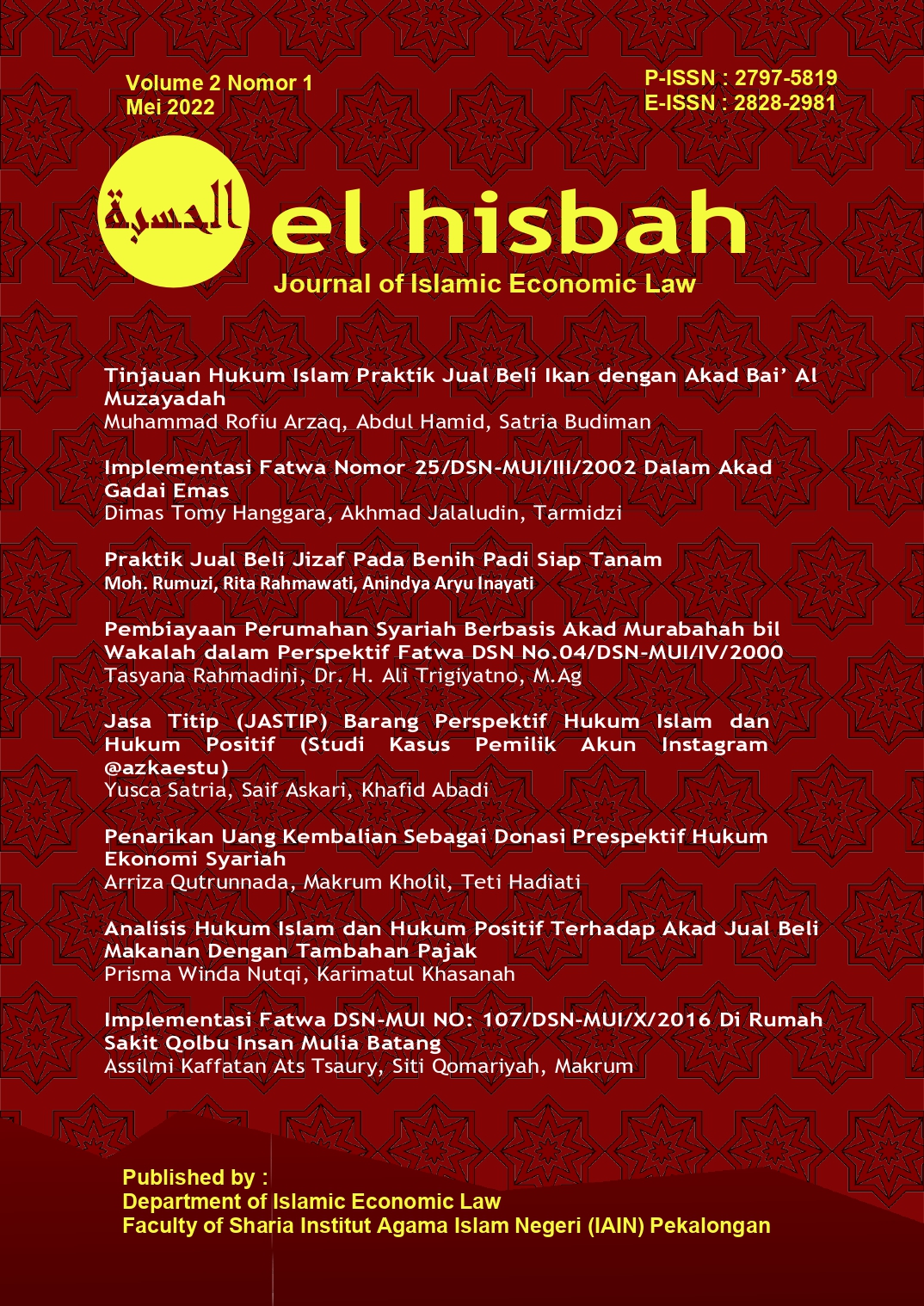
Penarikan Uang Kembalian sebagai Donasi Prespektif Hukum Ekonomi Syariah
DOI:
https://doi.org/10.28918/elhisbah.v2i1.716Abstract
This article examines the withdrawal of change as a donation to the Retail Franchise at Alfamart Kebonsari Petarukan Pemalang. His writing was inspired by the fact that Alfamart's management had difficulty in providing second change, so the policy was to choose change into donations. The problem is how to practice withdrawing money as a donation, how and how to practice withdrawing money from the perspective of Sharia Economic Law. This research uses an approach approach other than that the data sources used are primary and secondary data sources, primary data sources are direct data sources obtained by interview and observation techniques while the primary data sources in this study are sellers, buyers, cashiers. While secondary data sources are obtained from other sources such as books, journal articles, and other information that will be discussed by researchers as supporters. With an approach approach, the results of the study show that: the practice of withdrawing change as a donation at the Retail Franchise at Alfamart Kebonsari Petarukan Pemalang is carried out voluntarily, without coercion from consumers; and the amount generated is very large, because it is distributed to the poor, so withdrawal of change as a contribution in Economic Law is allowed because it is suitable for worship.
Keywords:
References
Afandi, M. Yazid. (2009). Fiqh Muamalah dan Implementasinya Dalam Lembaga Keuangan Syariah. Yogyakarta : Logung Pustaka.
Al Jauzi, Ahmad Qoyim, and Muhammad Zakiy. (2021).”Analisis Tingkat Kepercayaan Masyarakat terhadap Dana Donasi pada Uang Kembalian Belanja di Alfamart." Prosiding UMY Grace.
Ali, Zainnudin. (2009). Hukum Ekonomi Syariah. Jakarta: Sinar Grafika.
Astuti, Wulan Widiya. (2018). Pandangan Hukum Islam Terhadap Pengembalian Sisa Pembelian Dengan Barang (Studi Kasus Pada Kantin Syariah UIN Raden Intan Lampung). UIN Raden Intan Lampung. http://repository.radenintan.ac.id/3815//1/SKRIPSI.pdf
Fachrian, Ratu Shasqi, Asep Ramdan Hidayat, and Ramdan Fawzi. (2020) "Analisis Hukum Islam terhadap Penarikan Uang Kembalian untuk Program Donasi." Prosiding Hukum Ekonomi Syariah 6.2.
Hasanah, Huswatun. (2018) Fenomena Praktik Pengembalian Sisa Harga Diganti dengan Barang Menurut Perspektif Ekonomi Islam (Studi Kasus Kasir Swalayan Royal Mart Samata). UIN Alauddin Makassar. http://repositori.uin-alauddin.ac.id/id/eprint/12597
Ishaq. (2017). Metode Penelitian Hukum dan Penulisan Skripsi, Tesis serta Disertasi. Bandung: Alfabeta.
Muhaimin. (2020). Metodologi penelitian Hukum. Mataram: Mataram University Press.
Nurhadi. (2019). Rahasia Hikmah Dibalik Akad-Akad Dalam Ekonomi Islam. Jurnal Ilmiah Ekonomi Islam Vol 5, No 01. http://jurnal.stie-aas.ac.id/index.php/jei/article/view/346
Ridwan, Amaliah Asriyani.(2021) "Tinjauan Al-Maslahat Al-Mursalah Terhadap Transaksi Uang Kembalian Menjadi Donasi." FAWAID: Sharia Economic Law Review 3(2).
Rivai, Veitzah dan Andi Buchari. (2013). Islamic Economics. Jakarta: Bumi Aksara.
Rosmini. (2016). Falsafah Infak Dalam Perspektif Al-Qur’an. Jurnal Madania. 20 (1).
Salamah, Muhimmatus. (2015). Perspektif hukum ekonomi syari’ah terhadap praktek pengalihan sisa pembeli dalam transaksi jual beli di Toko Arafah Cirebon. Cirebon: IAIN syekh nurjati Cirebon. http://repository.syekhnurjati.ac.id.pdf
Syafe’i, Rachmat. (2004). Fiqh Muamalah. Bandung: Pustaka Setia.
Urbanus, Uma Leu. (2014). Akad Dalam Transaksi Ekonomi Syariah. Jurnal Tahkim. 10 (1).
Usman, Husaini. Dkk. (2016). Metodologi Penelitian Sosial. Jakarta : PT, Bumi Askara.
Downloads
Published
License
 Journal El Hisbah : Journal of Islamic Economic Law by Faculty of Sharia, UIN K.H. Abdurrahman Wahid Pekalongan, Central Java, Indonesia is licensed under a Creative Commons Attribution 4.0 International License.
You are free to:
- Share ” copy and redistribute the material in any medium or format
- Adapt ” remix, transform, and build upon the material for any purpose, even commercially.
Under the following terms:
-
Attribution ” You must give appropriate credit, provide a link to the license, and indicate if changes were made. You may do so in any reasonable manner, but not in any way that suggests the licensor endorses you or your use.
- No additional restrictions ” You may not apply legal terms or technological measures that legally restrict others from doing anything the license permits.