
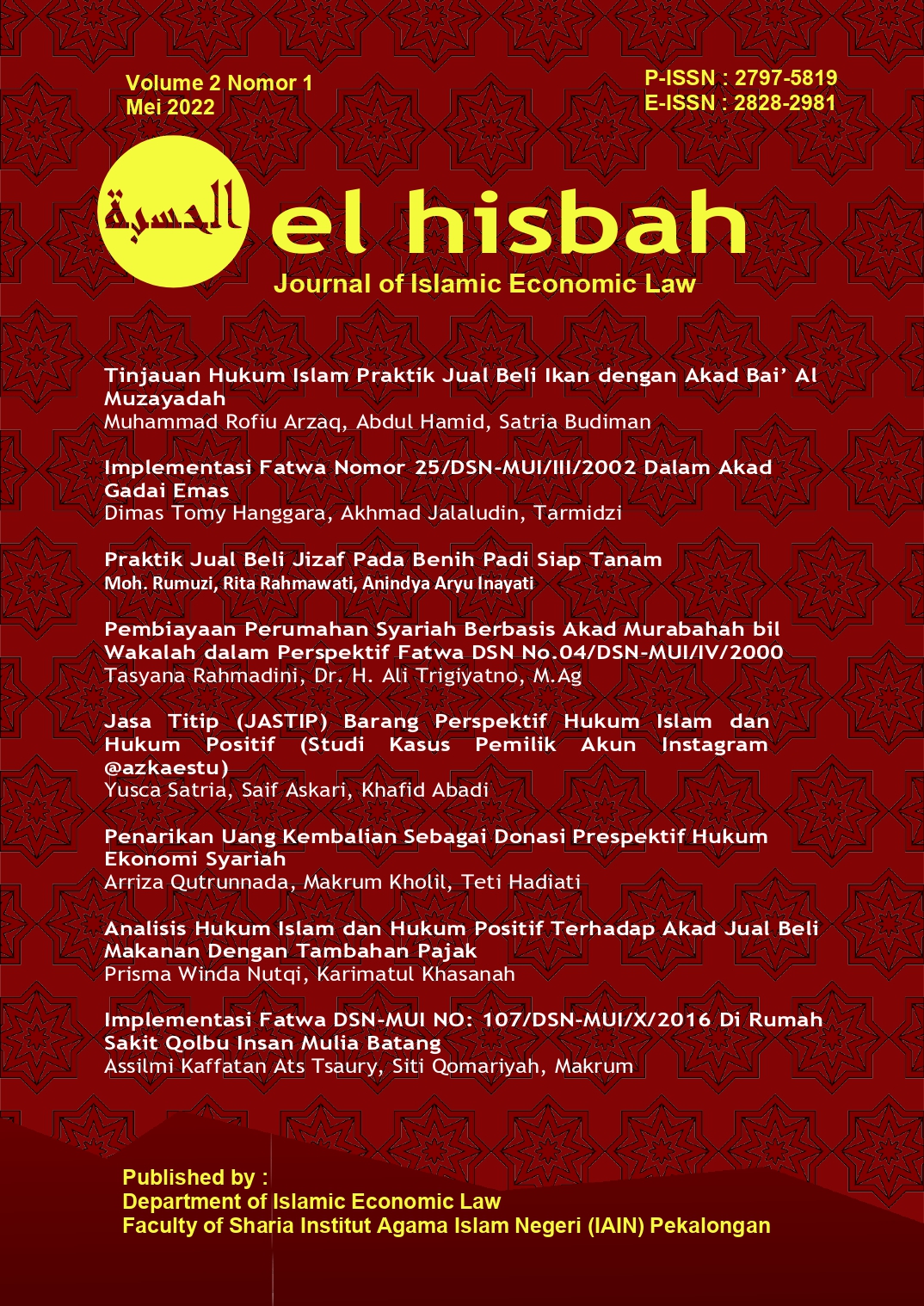
Implementasi Fatwa Nomor 25/DSN-MUI/III/2002 Dalam Akad Gadai Emas
DOI:
https://doi.org/10.28918/elhisbah.v2i1.715Abstract
The purpose of this study was to determine the practice of pawning gold, the implementation of the DSN MUI fatwa no. 25/DSN-MUI/III/2002 regarding Rahn and the reasons why the DSN MUI fatwa no. 25/DSN-MUI/III/2002 was not fully implemented. At PT. Pekalongan Sharia Pawn Services. This type of research is a field research (field-research) with the object of research is the implementation of the fatwa DSN MUI number 25/DSN-MUI/III/2002 in the gold pawn contract at PT. Sharia Pawn Services. Sources of data in the form of primary and secondary data, primary data obtained by observation and interview techniques while secondary data obtained by documentation that is utilizing sources of books, journal articles, websites or websites. And the data analysis used descriptive qualitative which was concluded by means of inductive thinking. The conclusion of this study is that the implementation of the DSN MUI fatwa no. 25/DSN-MUI/III/2002 regarding rahn.at PT. The Sharia Pawn Service has been in accordance with its practice, although in the sales process it is not in accordance with the provisions of the MUI DSN fatwa, but the purpose of the sale of collateral goods that are not redeemed in accordance with the MUI DSN fatwa is to pay off debtors' debts and pay their ujrah.
Keywords:
References
Anshori, Abdul Ghofur. (2011), Gadai Syariah diIndonesia: Konsep, Implementasi, dan Institusionlisasi. Yogyakarta: Gadjah Mada University press.
Awaludin dan Andis Febrian. (2020). Kedudukan Fatwa DSN-MUI Dalam Transaksi Keuangan Pada Lembaga Keuangan Syariah di Indonesia. Jurnal Hukum Islam Vol. 06 No. 02.
Awaludin dan Febrian, Andais. (2020). Kedudukan Fatwa DSN-MUI Dalam Transaksi Keuangan Pada Lembaga Keuangan Syariah di Indonesia. Al-Hikmah : Jurnal Dakwah, 10(2).
Farihah, Siti. (2017). Analisis Pelaksanaan Lelang Benda Jaminan Gadai Berdasarkan Faatwa Dewan Syariah Nasional No. 25/DSN-MUI/III/2002 tentang Rahn di Pengadaian Syariah Cabang Majapahit Semarang. Skripsi, UIN Walisongo Semarang.
Harhap, Raja Sakti Putra. (2016). Hukum Multi Aqad dalam Transaksi Syariah. Jurnal Al-Qasd, 1(1).
Janwari, Yadi. (2015). Fikih Lembaga Keuangan Syariah. Bandung : PT. Remaja Rosdakarya Offset.
Moleong, Lexy J. (2011). Metodologi Penelitian Kualitatif. Bandung: Remaja Rosdakarya.
Muhaimin. (2020). Metode Penelitian Hukum. Mataram: Mataram University Press.
Mukhlisin, Ahmad., Suhendri, Aan., dan Dimyati. Muhammad. (2018). Metode Penetapan Hukum Dalam Berfatwa. Al-Istinbath : Jurnal Hukum Islam, 3(2).
Mustofa, Imam. (2016). Fikih Mu’amalah Kontemporer. Depok : PT. Raja Grafindo.
Riadi, M. Erfan. (2010). Kedudukan Fatwa Ditinjau Dari Hukum Islam Dan Hukum Positif (Analisis Yuridis Normatif). ejournal.umm.ac.id. VI(IV).
Sutedi, Adrian. (2011). Hukum Gadai Syariah. Bandung: CV. Alfabeta.
Sutedi, Rachmat. (2020). Fiqih Muamalah. Bandung : CV. Pustaka Setia.
Tim Penyusun KHES. (2008). Kompilasi Hukum Ekonomi Syariah. Jakarta: Kencana.
Wahyudi, Heri Fadli dan Fajar. (2018). Metode Ijtihad Komisi Fatwa Majelis Ulama Indonesia dan Aplikasinya dalam Fatwa. Cakrawala : Jurnal Studi Islam, 12(2).
Wawancara pribadi bersama Ibu Dina Fitriana, Staff di Jasa Gadai Syariah Pekalongan, pada tanggal 2 November 2021.
Downloads
Published
License
Copyright (c) 2022 El Hisbah: Journal of Islamic Economic Law

This work is licensed under a Creative Commons Attribution-NonCommercial 4.0 International License.
 Journal El Hisbah : Journal of Islamic Economic Law by Faculty of Sharia, UIN K.H. Abdurrahman Wahid Pekalongan, Central Java, Indonesia is licensed under a Creative Commons Attribution 4.0 International License.
You are free to:
- Share ” copy and redistribute the material in any medium or format
- Adapt ” remix, transform, and build upon the material for any purpose, even commercially.
Under the following terms:
-
Attribution ” You must give appropriate credit, provide a link to the license, and indicate if changes were made. You may do so in any reasonable manner, but not in any way that suggests the licensor endorses you or your use.
- No additional restrictions ” You may not apply legal terms or technological measures that legally restrict others from doing anything the license permits.