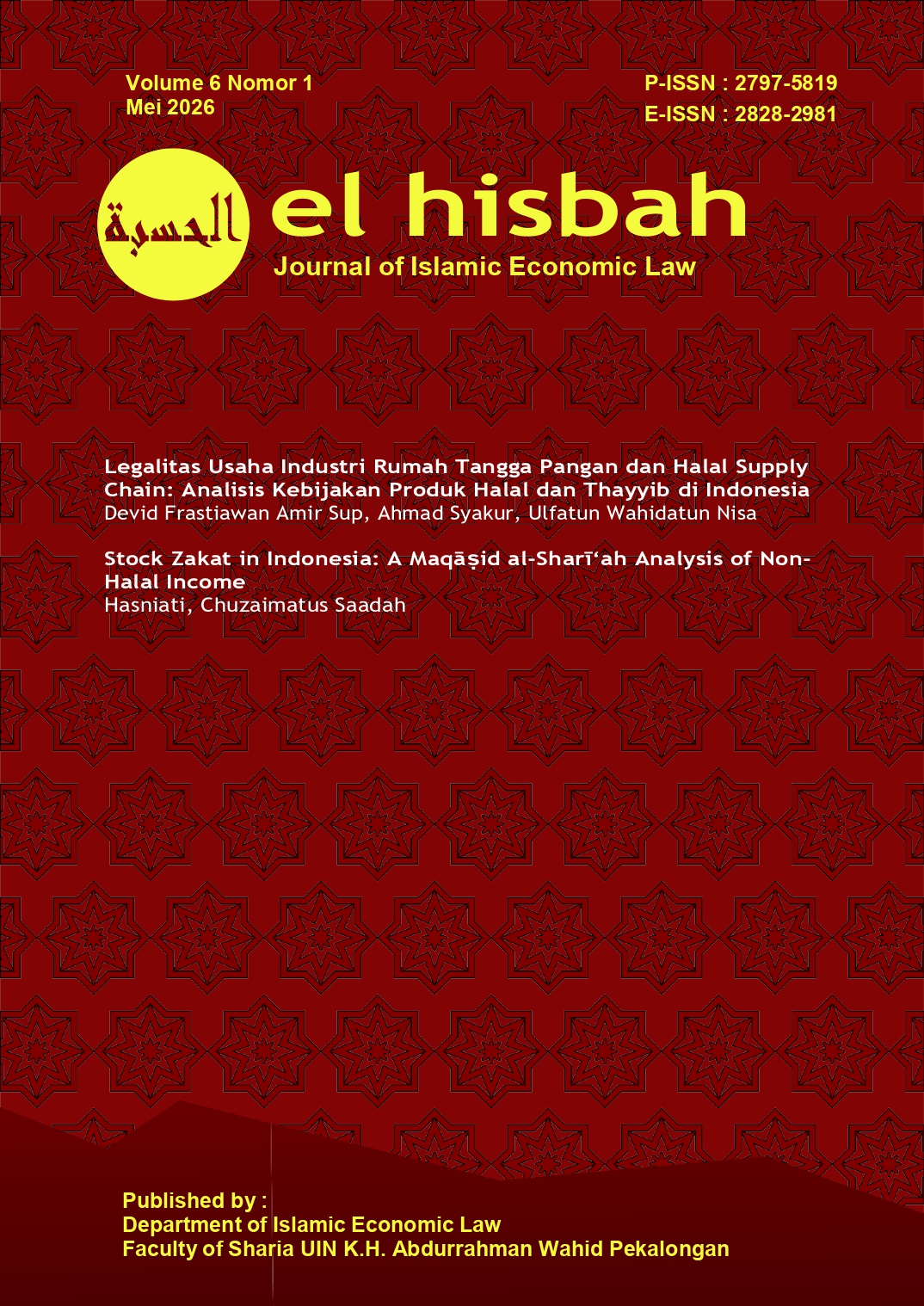
Stock Zakat in Indonesia: A Maqāṣid al-Sharī‘ah Analysis of Non-Halal Income
DOI:
https://doi.org/10.28918/elhisbah.v6i1.14979Abstract
This study examines the policy of tolerance toward interest and non-halal income in sharia-compliant stocks and analyzes its application to stock zakat. Using a normative juridical approach, this study analyzes relevant regulations, namely DSN-MUI Fatwa No. 135/DSN-MUI/V/2020, POJK No. 35/POJK.04/2017, and POJK No. 8 of 2025, through the framework of maqāṣid al-sharī‘ah. The data were analyzed using descriptive qualitative analysis to understand the legal norms related to the tolerance of interest and non-halal income in sharia-compliant stocks. The findings show that stock zakat in Indonesia faces significant challenges in terms of sharia compliance, particularly regarding the tolerance of riba and non-halal income. Although tolerance may be permitted to address urgent needs (ḍarūrah), the principles of maqāṣid al-sharī‘ah require that the tolerance of interest and non-halal income be viewed as a short-term mitigation measure rather than a permanent justification. This policy must continue to uphold the fundamental values of Islam, particularly those oriented toward hifz al-dīn and hifz al-māl. The contribution of this study lies in providing a deeper understanding of the application of maqāṣid al-sharī‘ah in the context of stock zakat. It also offers policy recommendations that are more oriented toward protecting fundamental Islamic principles, especially hifz al-dīn and hifz al-māl, within the regulation of stock zakat in Indonesia.
Keywords:
References
Adi, R. (2005). Metode Penelitian Sosial dan Hukum. Granit.
Al-Qardhawi, Y. (2002). Fiqh az-Zakat Terjemahan Salman Harun, Didin Hafidhuddin, Hasanuddin. PT. Pustaka Literasi AntarNusa.
Alias, M. N., Abdullah, M. N., Osman, M. F., Ismail, N. F., & Kamis, M. S. (2025). The Position of Maqasid al-Shariah within Islamic Legal Sources: A Comprehensive Analysis. Samarah: Jurnal Hukum Keluarga Dan Hukum Islam, 9(2). https://doi.org/10.22373/q4byre51
Ayedh, A. M. A., Shaharuddin, A., & Kamaruddin, M. I. H. (2019). Shariah Screening Methodology: Does It ‘Really’ Shariah Compliance? IQTSHADIA: Jurnal Kajian Ekonomi Dan Bisnis Islam, 12(2).
Balgis, P. D., Fitrijanti, T., & Sukmadilaga, C. (2021). Perbedaan Penerapan Standar Islamic Stock Screening Dan Social Environment Index Terhadap Kinerja Portofolio Saham Bei. Apssai Accounting Review, 1(1), 1–19. https://doi.org/10.26418/apssai.v1i1.7
Cahyani. (2014). Teori dan Aplikasi Maqashid Al-Syari’ah. Jurnal Al-Qadau Peradilan Dan Hukum Keluarga, 1(2), 19–29.
Chikwira, C., & Mohammed, J. I. (2023). The Impact of the Stock Market on Liquidity and Economic Growth: Evidence of Volatile Market. Economies, 11(6). https://doi.org/10.3390/economies11060155
Dakhoir, A. (2019). Al-Qardawi’s Thought on Zakat of Stocks in a Modern Indsutry: an Experience of Indonesia. AL-Manahij: Jurnal Kajian Hukum Islam, 8(2), 159–168. https://doi.org/10.24090/mnh.v13i2.2023
Diantha, I. M. P. (2017). Metodologi Penelitian Hukum Normatif dalam Justifikasi Teori Hukum. Prenadamedia Group.
Disemadi, H. S., Al-Fatih, S., Silviani, N. Z., Rusdiana, S., & Febriyani, E. (2024). Revitalizing Intellectual Property Rights in Indonesia: A Maqasid al-Sharia Perspective on Communal Ownership. Al-Istinbath: Jurnal Hukum Islam, 9(2). https://doi.org/10.29240/jhi.v9i2.11039
Djati, D. H., & Rosadi, D. (2025). Bibliometric Analysis of Indonesia’s Potential to Become the World Halal Industry Centre. Journal of Economic Cooperation and Development, 46(2), 133–154.
Eva Nurul Huda, P. S. (2023). Comparative Analysis of Sharia Stock Screening Methods in Indonesia, Malaysia, and the United States. Maliki Islamic Economics Journal, 3(1), 1–18. https://doi.org/10.18860/miec.v3i1.19808
Fakhruddin, F., Hasan, S., Firdaus, D. H., & Hidayat, H. (2024). From Fiqh al-Ibadat to Muamalat: Repositioning Zakat Management in Indonesia in the Perspective of Maqāṣid Al-Sharī’ah. Samarah: Jurnal Hukum Keluarga Dan Hukum Islam, 8(1), 495. https://doi.org/10.22373/sjhk.v8i1.19637
Fatchurrohman, M., Hadi, N., Takhim, M., & Bahri, S. (2024). Shari’a Stock Zakat: Alternative Financial Inclusion for Empowering Mustaḥiq MSMEs with Qarḍ al-Ḥasan Products. Al-Ahkam, 34(2). https://doi.org/10.21580/ahkam.2024.34.2.21936
Fernando, Z. J., Pujiyono, P., Susetyo, H., Candra, S., & Putra, P. S. (2022). Preventing bribery in the private sector through legal reform based on Pancasila. Cogent Social Sciences, 8(1). https://doi.org/10.1080/23311886.2022.2138906
Fielnanda, R. (2017). Konsep Screening Saham Syariah di Indonesia. Al Falah: Journal of Islamic Economics, 2(2). https://doi.org/10.29240/jie.v2i2.255
Güney, N. (2024). Maqāsid al-Sharī‘a in Islamic Finance: A Critical Analysis of Modern Discourses. Religions, 15(1). https://doi.org/10.3390/rel15010114
Hamdani, Soemitra, A., & Harahap, M. I. (2025). The Influence of Knowledge, Awareness and Income on the Interest in Paying Zakat Shares of Investors in North Sumatra. Amkop Management Accounting Review (AMAR), 5(1). https://doi.org/10.37531/amar.v5i2.2769
Hardi, E. A. (2020). Filantropi Islam: Zakat Saham di Pasar Modal Syariah Indonesia. Jurnal Bimas Islam, 13(1), 51–72. https://doi.org/10.37302/jbi.v13i1.106
Helhel, Y. (2026). Stock Market Development and Economic Growth Nexus: Evidence from the Fragile Five Countries. Economies, 14(2). https://doi.org/10.3390/economies14020052
Lenap, I. P., Karim, N. K., & Sasanti, E. E. (2021). Pendapatan Non-Halal, Zakat, Dewan Pengawas Syariah dan Reputasi Perbankan Syariah di Indonesia. JAS: Jurnal Akuntansi Syariah, 5(1). https://doi.org/10.46367/jas.v5i1.312
Mahmudin, M. (2020). ‘Umum Al-Balwa Dalam Perspektif Hukum Islam. Al-Falah: Jurnal Ilmiah Keislaman Dan Kemasyarakatan, 20(1), 1–20. https://doi.org/10.47732/alfalahjikk.v20i1.135
Mu’minin, N. (2025). Rekonstruksi Hukum Ekonomi Islam: Antara Idealitas Syariah dan Realitas Pasar Giwangan Yogyakarta Indonesia. El Hisbah: Journal of Islamic Economic Law, 5(2), 111–125. https://doi.org/10.28918/elhisbah.v5i2.12569
Muallimah, S. (2024). Eksplorasi Zakat Saham Dalam Tinjauan Ekonomi Islam. J-EBIS: Jurnal Ekonomi Dan Bisnis Islam, 9(1). https://doi.org/10.32505/j-ebis.v9i1.7048
Muchlis, M., & Habbe, H. (2021). Exploring Sharia Screening Review in Islamic Capital Market in Indonesia (Jakarta Islamic Index). Laa Maisyir : Jurnal Ekonomi Islam, 8(1), 40–54. https://doi.org/10.24252/lamaisyir.v8i1.20320
Muhammad Fakhrur Rasyid, Ahmad Syairofi, M. A. K. (2023). Kajian Zakat Kontempporer dan Manajemen Lembaga di Indonesia. ZISWAF ASFA JOURNAL: Zaka, Infaq, Sadaqah, Wakaf, 1(1), 48–68.
Nasfi, N., & Sabri, S. (2022). Maqashid Syariah Sebagai Basis Pengembangan Ekonomi Islam. El-Kahfi | Journal Of Islamic Economics, 3(1). https://doi.org/10.58958/elkahfi.v3i01.81.
Novida, I., Junarti, J., Hidayatulloh, Hidayah, N., & Maman, U. (2026). Rethinking Profit and Loss Sharing: Regulatory Paradoxes in Mudharabah Savings and the Operationalization of Maqasid al-Shariah. Al-Istinbath: Jurnal Hukum Islam, 11(1). https://doi.org/10.29240/jhi.v11i1.11364
Nurbaidah, S. U., Hidayat, R., & Saharuddin, D. (2025). Vol. 4 No. 3 (2025): APRIL The Dynamics of Indonesia’s Sharia Capital Market Development 2014–2024: Opportunities, Challenges, and Strategic Futures. CASHFLOW, 4(3). https://doi.org/10.55047/cashflow.v4i3.1888
Renie, E., Iska, S., Thaidi, H. ’Azeemi A., & Yusof, U. A. binti. (2022). Tafriq Al-Halal ’An al-Haram Theory The Selection of Sharia Stocks: The Comparative Studi in the Sharia Capital Market in Indonesia and Malaysia. JURISDICTIE: Jurnal Hukum Dan Syariah, 13(1). https://doi.org/10.18860/j.v13i1.17044
Ridlwan, A. A., Ilmi, N., Timur, Y. P., & Keshminder, .S. (2025). Does Gender Influence Zakat Compliance Among Indonesian Muslim Entrepreneurs? A Multi-Group Analysis. Journal of Islamic Accounting and Busniness Researh. https://doi.org/10.1108/JIABR-01-2024-0040
Sabri, F. A. (2014). Konsep Raf’ Al-Haraj Dalam Perspektif Ushul Fiqih. AL-IHKAM: Jurnal Hukum & Pranata Sosial, 9(1), 1–21. https://doi.org/10.19105/al-lhkam.v9i1.356
Said, H. A., Mukri, M., Anggriani, J., & Wakhid, A. A. (2025). Maqashid Based Quránic Interpretation. Samarah: Jurnal Hukum Keluarga Dan Hukum Islam, 9(2). https://doi.org/10.22373/pdjqc552
Shabir, M., Rosyid, M., Dahri, H., & Tasfiq, M. S. (2026). Religious Moderation as Living Islamic Law: A Maqāṣid Perspective in Indonesia and Brunei Darussalam. Al-Ahkam, 36(1). https://doi.org/10.21580/ahkam.2026.36.1.31446
Sunaryo, A., & Fahmi, A. H. (2024). Evaluation of the Maqāṣid al-Sharī’ah Liberalization: An Examination of the Notion of ‘Prioritizing Public Interest over Textual Evidence.’ Al-Manahij: Jurnal Kajian Hukum Islam, 18(1), 1–16. https://doi.org/10.24090/mnh.v18i1.9886
Syatibi, I. (n.d.). Al-Muwâfaqât fī Usul al-Syarīah. Dar al-Kutûb al-Ilmiyyah, t.th.
Tuseno, Nasution, M. S. A., & Tanjung, D. (2025). Dissecting OJK Requirements for Companies that Go Public that Issue Shatia Shares. Sosioedukasi: Jurnal Ilmiah Ilmu Pendidikan Dan Sosial, 14(1), 184–193. https://doi.org/10.36526/sosioedukasi.v14i1.5347
Wardiwiyono, S., Hamdun, N. G., & Pambudi, D. S. (2025). Determining Islamic Banks’ Reputation: Do Islamic CSR, zakat, non-Halal Fund, and Islamic Corporate Governance Matter? Journal of Accounting and Investment, 26(3). https://doi.org/10.18196/jai.v26i3.27686
Zaenal, M. H. (2023). Zakat saham. Puskas BAZNAS.
Downloads
Published
License
Copyright (c) 2026 Hasniati, Chuzaimatus Saadah

This work is licensed under a Creative Commons Attribution-NonCommercial 4.0 International License.
 Journal El Hisbah : Journal of Islamic Economic Law by Faculty of Sharia, UIN K.H. Abdurrahman Wahid Pekalongan, Central Java, Indonesia is licensed under a Creative Commons Attribution 4.0 International License.
You are free to:
- Share ” copy and redistribute the material in any medium or format
- Adapt ” remix, transform, and build upon the material for any purpose, even commercially.
Under the following terms:
-
Attribution ” You must give appropriate credit, provide a link to the license, and indicate if changes were made. You may do so in any reasonable manner, but not in any way that suggests the licensor endorses you or your use.
- No additional restrictions ” You may not apply legal terms or technological measures that legally restrict others from doing anything the license permits.