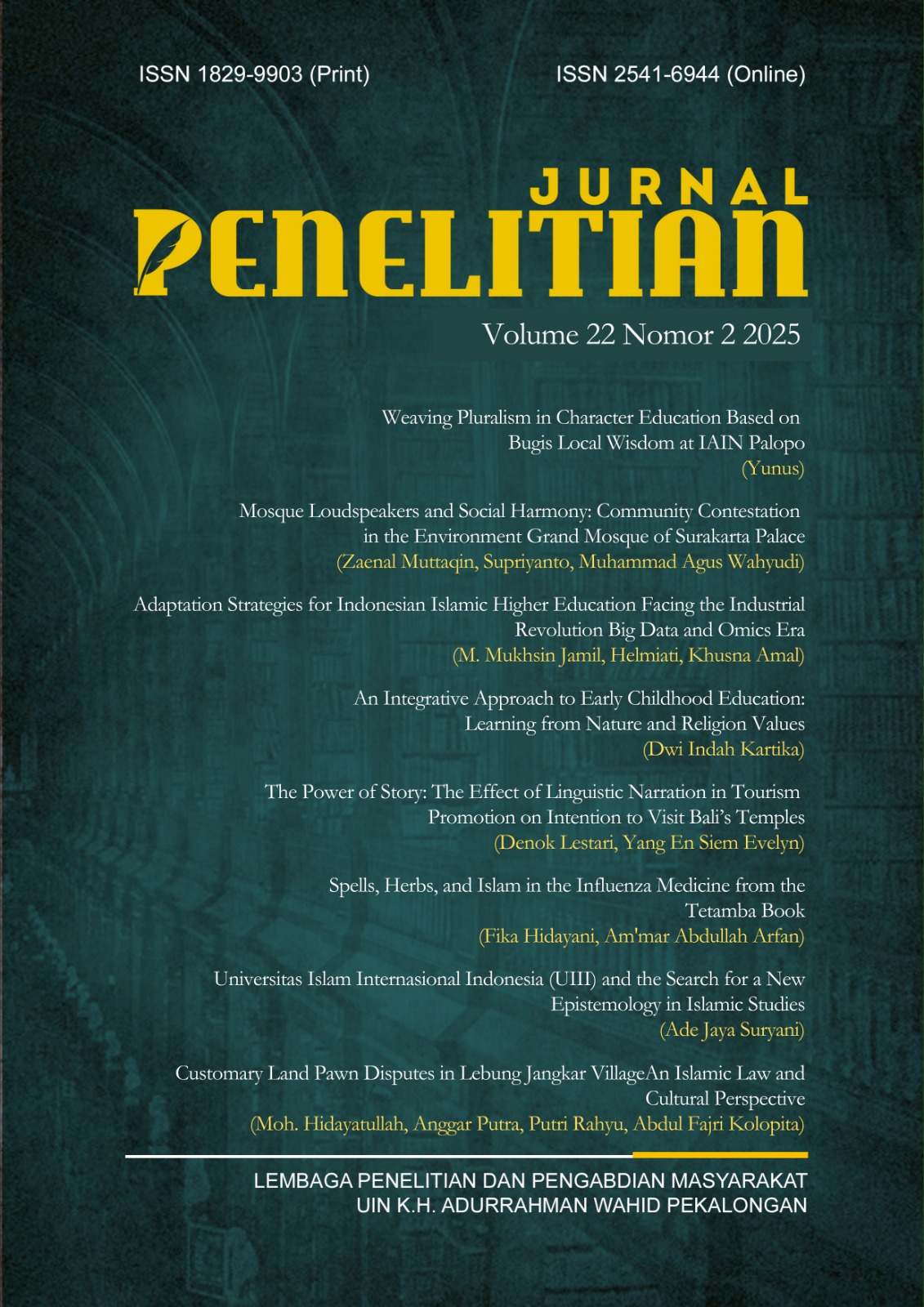
Customary Land Pawn Disputes in Lebung Jangkar Village
An Islamic Law and Cultural Perspective
DOI:
https://doi.org/10.28918/jupe.v22i2.14054Abstract
Prolonged agricultural land pawn practices in indigenous communities often create structural inequalities and recurring disputes due to unclear legal boundaries. This article examines the dynamics of customary land rights (hak ulayat) in agricultural land pawn practices and the resolution of related disputes within the indigenous community of Lebung Jangkar Village. Land is perceived as ancestral heritage with strong social and cultural significance, making pawn practices socially accepted as temporary economic instruments without transferring ownership. However, extended pawn periods and the continuous utilization of pawned land by pawn recipients frequently result in unequal power relations and latent agrarian disputes. Focusing on rice field pawn disputes, this study analyzes the relationship between customary land rights, pawn practices, and dispute resolution through traditional elders (kriye). Using a qualitative normative-empirical approach through interviews, observation, and document analysis, the study finds that dispute resolution through the kriye functions as an effective living law grounded in deliberation, social harmony, and substantive justice, substantively aligning with the Islamic legal principles of ṣulḥ and rahn. Nevertheless, the absence of written documentation and the weak integration of Article 7 of Law Number 56 of 1960 indicate the need for greater normative harmonization to ensure legal certainty and equitable protection for customary landholders.
Keywords:
References
Abd Rahman R, H. J., Abdullah, I., Supardin, Hasan, H., Tangngareng, T., & Yusuf, M. (2023). Local wisdom in economic practice: An empowerment Fiqh analysis of the tesang tradition of the Buginese and Makassarese. Cogent Social Sciences, 9(1), 2194112. https://doi.org/10.1080/23311886.2023.2194112
Al-Islami, M. A.-A., Putra, A., & Pajarudin, P. (2024). Cultural Threads: ‘Kalembo Ade’ and its Islamic Roots in Bima. Mimbar Agama Budaya, 41(2), 187–195. https://doi.org/10.15408/mimbar.v41i2.41402
Amrin, Muhammad Dwi Fajri, Emil Salim, & Amirullah. (2025). Teka Ra Ne’e: The Integration of Islamic Values and Local Culture in Strengthening Community-Based Economic Development and Customary Law in Bima. Jurnal Penelitian, 22(1), 13–26. https://doi.org/10.28918/jupe.v22i1.9583
Arrasid, S. E. (2021). Eksistensi Hak Ulayat Masyarakat Adat Dalam Undang-Undang Pokok Agraria. IPMHI Law Journal, 1(1), 80–88. https://doi.org/10.15294/ipmhi.v1i1.49861
Asrawijaya, E. (2024). Traditional Ecological Wisdom for the Resilience of Indigenous Peoples in Indonesia. Besari Journal of Social and Cultural Studies, 1(2), 59–77. https://doi.org/10.71155/besari.v1i2.29
Ayuni, Q. (2023). Optimalisasi Pembaruan Undang-Undang No. 56 Tahun 1960 tentang Penetapan Luas Tanah Pertanian. Jurnal Riset Ilmu Hukum, 3(2), 205–222. https://jurnal.untirta.ac.id/index.php/jurisprudence/indexDOI:http://dx.doi.org/10.51825/sjp.v3i2.
Falahy, L. El, Giyarsi, G., & Birahmat, B. (2025). Customary Land Rights in Positive Law (Agrarian Law) and Islamic Law in Indonesia. Jurnal Kawakib, 5(2), 106–113. https://doi.org/10.24036/kwkib.v5i02.227
Gobel, I., Thalib, M. C., & Achir, N. (2021). Legal Protection Guarantee Agricultural Land Pawn System. Estudiente Law Journal, 3(1), 2021. https://ejurnal.ung.ac.id/index.php/eslaw/index
Haning, S. (2025). The Role of Customary Law in Resolving Land Disputes in Indonesia’s Indigenous Communities. International Journal of Social and Human, 2(2), 205–215. https://doi.org/10.59613/m15tkg12
Huda, M. I., & Mujib, A. (2025). Effectiveness Of The Role Of The Sharia Supervisory. Istinbáth: Jurnal Hukum Dan Ekonomi Islam, 24(1), 16–30. https://doi.org/10.20414/ijhi.v24i1.765
Husein, M. H. A. ., Mujib, A., & Suleman, N. H. (2022). the Urgency of Rescheduling Policy As a Solution To Sharia Banking Dispute on Murabahah Agreements. Tasharruf: Journal Economics and Business of Islam, 7(2), 170. https://doi.org/10.30984/tjebi.v7i2.2106
Kristiani, V. (2020). Hukum Yang Berkeadilan Bagi Hak Ulayat Masyarakat Hukum Adat (Kajian Dan Implementasi). ADIL: Jurnal Hukum, 11(1), 144–162. https://doi.org/10.33476/ajl.v11i1.1449
Muhtarom, M., Iswandi, I., & Aminulloh, A. (2022). Pawn Paddy Practices According to Islamic Law and Positive Law. Journal of Legal Research, 4(5), 1223–1240. https://doi.org/10.15408/jlr.v4i5.28248
Nugroho, S. S., Tohari, M., & Pudjiono, M. J. (2019). Konstruksi Hukum Penyelesaian Sengketa Gadai Tanah Berbasis Hukum Adat Di Kabupaten Ngawi. YUSTISIA MERDEKA: Jurnal Ilmiah Hukum, 3(3), 26–34. https://doi.org/10.33319/yume.v5i1.24
Purnama, E. N., Kismartini, K., & Astuti, R. S. (2021). Peran Lembaga Masyarakat Adat (LMA) Suku Marind dalam Penyelesaian Sengketa Tanah Ulayat Di Kota Merauke. Syntax Literate: Jurnal Ilmiah Indonesia, 6(6), 2799–2812. https://doi.org/10.36418/syntax-literate.v6i6.2916
Putra, A. (2025). Analisis Konstitusionalitas Pengujian Ex-Ante Review Perspektif Siyasah Syar’iyyah di Indonesia. Journal of Excellence Humanities and Religiosity, 2(1), 104–121.
Rachmat Syafe’i. (2001). Fiqh Muammalah. Pustaka Setia.
Ritonga, S. K. (2023). Pawn Agricultural Land (boroh) as Debt Guarantee in the Legal Perspective of Mu’amalah Fiqh in Sibio-bio village, East Angkola District, South Tapanuli. Jurnal Mahkamah Kajian Ilmu Hukum Dan Hukum Islam, 8(1), 31–44. https://doi.org/10.25217/jm.v8i1.2712
Rizky, Husein, M. H. A. ., & Suleman, N. H. (2023). The Law of Receiving Wages for Teachers of the Qur’an, The Perspective of Ulama Syafiiyah and Hanafiyyah. Justisia Ekonomika Jurnal, 7(1), 636–648. https://doi.org/10.30651/justeko.v7i1.15919
Shalehah, F., & Irfan, M. M. (2022). Jasser Auda ’ s Maqasid Sharia Application in the ’ Iddah for Career Women. Al-Qisthu: Jurnal Kajian Ilmu-Ilmu Hukum, 20(1), 15–26. https://doi.org/10.32694/qst.v20i1.1270
Soleman, W., Ambo, S., & Thalita, M. Della. (2022). Fiqih Mawaris dan Hukum Adat Waris Indonesia. Al-Mujtahid: Journal of Islamic Family Law, 2(2), 92. https://doi.org/10.30984/ajifl.v2i2.1958
Sriyana Sriyana. (2025). Cultural and Environmental Dynamics in Social Transformation: The River-to-Land Transition in Central Kalimantan, Indonesia. Fikri : Jurnal Kajian Agama, Sosial Dan Budaya, 10(1), 148–164. https://doi.org/10.25217/jf.v10i1.5782
Sugianto, H., & Rini, E. (2025). Socio-Cultural Analysis of Household Asset Pawning Behavior in Indonesia: The Relationship between Values, Economic Cruciality, and Stigma. Journal of Social Science and Economics, 4(2), 2829–3312. https://jurnal.istaz.ac.id/index.php/josse
Tan, D. baolin. (2022). Revisiting Pound’s Law in Action and Ehrlich’s Living Law to Find the “Gap”: A Compilation of Lecture Notes. Journal of Judicial Review, 23(2), 225–238. https://doi.org/10.37253/jjr.v24i2.7220
Tumiwa, A. J., & Husein, H. A. K. (2018). Local Wisdom of the Multicultural Society of North Sulawesi Makes Manado the Most Tolerant City in Indonesia. 2018 International Student Conference on Islamic Studies (ISCIS) “Contemporary Islam in the Eyes of Young Researchers,” 29.
Wahyudhi, D., Herlambang, H., & Sudarti, E. (2025). Customary-Based Restorative Justice: Philosophical Foundations and Normative Relevance in the Indonesian Criminal Justice System. Edunity: Kajian Ilmu Sosial Dan Pendidikan, 4(12), 819–831. https://doi.org/10.57096/edunity.v4i12.460
Wiguna, A. I., & Makruf, A. (2025). The Practice of Pawning Rice Fields in Palembayan: Social Impacts and an Islamic Legal Perspective. El-Rusyd: Jurnal Sekolah Tinggi Ilmu Tarbiyah STIT Ahlussunnah Bukittinggi, 10(1), 1–10. https://doi.org/10.58485/elrusyd.v10i1.331
Downloads
Published
License
Copyright (c) 2025 Jurnal Penelitian

This work is licensed under a Creative Commons Attribution 4.0 International License.

This work is licensed under a Creative Commons Attribution 4.0 International License.