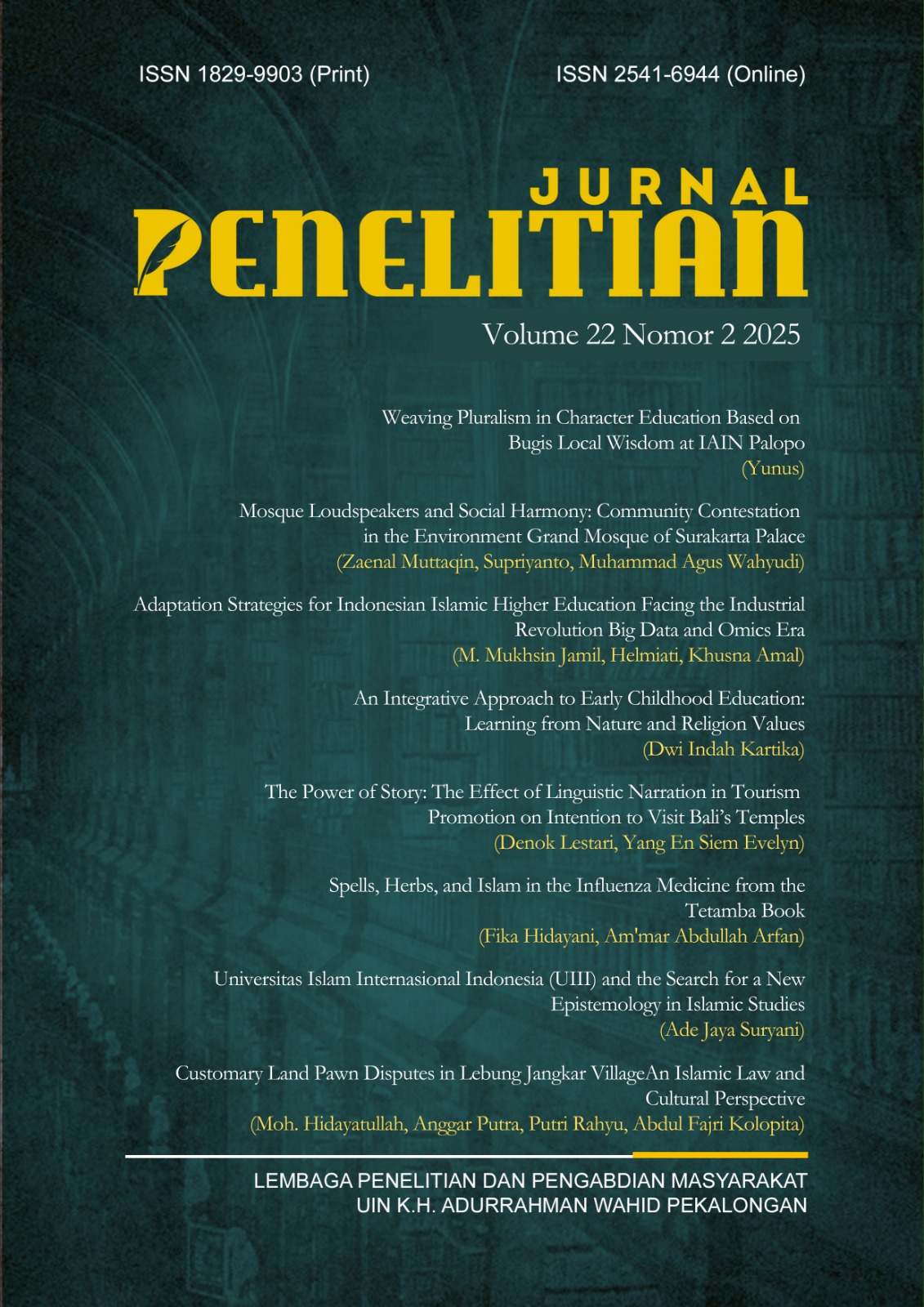
Universitas Islam Internasional Indonesia (UIII) and the Search for a New Epistemology in Islamic Studies
DOI:
https://doi.org/10.28918/jupe.v22i2.13366Abstract
Formed through Presidential Regulation No. 57/2016, UIII represents a state initiative to globalise Indonesian Islam and to position it as an intellectual actor in the global academic landscape. This article aim to analyses the epistemological transformation in Indonesian Islamic scholarship through the establishment of the Universitas Islam Internasional Indonesia (UIII). By using document analysis of government policies, journalistic reports, the university’s official website, observation, and scholarly discourse, this study argues that UIII marks a paradigmatic shift in Indonesian Islamic higher education, from a normative-theological model towards a secular-academic epistemology with a global orientation. Nevertheless, this orientation also reveals ambiguities, for UIII simultaneously seeks to undertake a decolonial process, namely challenging Western paradigms on the one hand while embracing the Islamic intellectual tradition on the other. This analysis shows that UIII is situated within an epistemological tension that is not easily synthesised: the institution rejects the dominance of a single centre of knowledge, yet at the same time has not formulated a stable alternative epistemological form. Thus, UIII is more aptly understood as a dynamic space of epistemic negotiation, where various knowledge traditions compete and engage in dialogue to shape the future configuration of Indonesian Islamic scholarship.
Keywords:
References
Abbas, M. B. (2021). Whose Islam? The Western University and Modern Islamic Thought in Indonesia. Stanford University Press.
Abdullah, M. A. (2017). Islamic Studies in Higher Education in Indonesia: Challenges, Impact and Prospects for the World Community. Al-Jami’ah: Journal of Islamic Studies, 55(2), 391–426. https://doi.org/10.14421/ajis.2017.552.391-426
Administrator. (2025). Rethinking knowledge: Faculty of Islamic Studies’ international conference on decolonizing social sciences and humanities. Universitas Islam Internasional Indonesia. Retrieved from https://fis.uiii.ac.id/news/uiii-decolonizing-social-sciences-conference-2025-3059/
Al-Attas, S. M. N. (2009). The de-westernization of knowledge. Citizens International.
Al-Faruqi, I. R. (1989). Islamization of knowledge: General principles and work plan (2nd ed.). International Institute of Islamic Thought.
Al-Khalili, J. (2011). The house of wisdom: How Arabic science saved ancient knowledge and gave us the Renaissance. Penguin Press.
Ashcroft, B., Griffiths, G., & Tiffin, H. (2025). Postcolonial studies: The key concepts (4th ed.). Routledge. https://doi.org/10.4324/9781003497561
Connell, R. (2007). Southern theory: The global dynamics of knowledge in social science. Routledge.
Faculty of Islamic Studies, Universitas Islam Internasional Indonesia. (n.d.). Faculty members. Retrieved from https://fis.uiii.ac.id/about-us/faculty-members/
Faculty of Islamic Studies, Universitas Islam Internasional Indonesia. (n.d.). M.A. program. Retrieved from https://fis.uiii.ac.id/academic/m-a-program/
Fina, L. I. N. (2020). Studying the Qurʾan in the context of Indonesian Islamic higher education. Method & Theory in the Study of Religion, 33(2), 139–161. https://doi.org/10.1163/15700682-12341508
Kementerian Agama Republik Indonesia. (2020). Rencana strategis Kementerian Agama tahun 2020–2024. Sekretariat Jenderal Kementerian Agama Republik Indonesia.
Kementerian Agama Republik Indonesia. (2025). Official AICIS+ 2025 guidebook: Islam, ecotheology, and technological transformation—Multidisciplinary innovations for an equitable and sustainable future. Direktorat Jenderal Pendidikan Islam.
Knight, J. (2022). Knowledge diplomacy in international relations and higher education. Springer International Publishing. https://doi.org/10.1007/978-3-031-14977-1
Kosim, M., Muqoddam, F., Mubarok, F., & Laila, N. Q. (2023). The dynamics of Islamic education policies in Indonesia. Cogent Education, 10(1), 2172930. https://doi.org/10.1080/2331186X.2023.2172930
Laffan, M. (2011). The makings of Indonesian Islam: Orientalism and the narration of a Sufi past. Princeton University Press.
Latief, H. (2022). The Masyumi networks and the proliferation of Islamic higher education in Indonesia (1945–1965). Bijdragen tot de Taal-, Land- en Volkenkunde / Journal of the Humanities and Social Sciences of Southeast Asia, 178(4), 477–502. https://doi.org/10.1163/22134379-bja10043
Lukens-Bull, R. A. (2013). Islamic higher education in Indonesia. Palgrave Macmillan. https://doi.org/10.1057/9781137313416
Lumbard, J. E. B. (2025). Islam, coloniality, and the pedagogy of cognitive liberation in higher education. Teaching in Higher Education, 30(6), 1409–1419. https://doi.org/10.1080/13562517.2025.2468974
Meuleman, J. H. (2002). Islam in the era of globalization: Muslim attitudes towards modernity and identity. Routledge.
Mignolo, W. D., & Walsh, C. E. (2018). On decoloniality: Concepts, analytics, praxis. Duke University Press.
Millie, J. (2025). Limits of bureaucratisation in Islamic education. Religion, State and Society, 53(3), 188–201. https://doi.org/10.1080/09637494.2025.2560226
Millie, J., Syarif, D., & Fakhruroji, M. (2023). The discipline of dakwah in Indonesia’s state education system. Bijdragen tot de Taal-, Land- en Volkenkunde / Journal of the Humanities and Social Sciences of Southeast Asia, 179(1), 38–60. https://doi.org/10.1163/22134379-bja10047
Nash, G., Kerr-Koch, K., & Hackett, S. E. (2014). Postcolonialism and Islam: Theory, literature, culture, society and film. Routledge.
Permana, R. (2025). Merebut panggung internasional: UIII, intelektual Muslim Indonesia dan masa depan pendidikan Islam. Disway.id. https://disway.id/read/910902/merebut-panggung-internasional-uiii-intelektual-muslim-indonesia-dan-masa-depan-pendidikan-islam/30
Faculty of Islamic Studies, Universitas Islam Internasional Indonesia. (n.d.). Ph.D. in Islamic studies. Retrieved from https://fis.uiii.ac.id/academic/ph-d-program/ph-d-in-islamic-studies/
Prabowo, K. W. (2024). Presiden El-Sisi siap dukung peningkatan jumlah pelajar Indonesia di Mesir. Metrotvnews.com. https://www.metrotvnews.com/read/K5nCLdaG-presiden-el-sisi-siap-dukung-peningkatan-jumlah-pelajar-indonesia-di-mesir
Sardar, Z. (2018). Critical Muslim. ZiauddinSardar.com. https://ziauddinsardar.com/articles/critical-muslim
Sari, B. R., Maunati, Y., Wuryandari, G., & Lamijo. (2022). The widening global network of Indonesian diaspora scholars in Malaysia. Diaspora Studies, 15(2), 184–208. https://doi.org/10.1163/09763457-20221004
Tayeb, A. (2018). Islamic education in Indonesia and Malaysia. Routledge.
Tho Seeth, A. (2023). The Indonesian “cosmopolitan Islamic intellectual” revisited: A focus on the continued prevalence of “cosmopatriotism” and the “West”. International Journal of Islam in Asia, 2(2), 114–143. https://doi.org/10.1163/25899996-20223005
Universitas Islam Internasional Indonesia. (2024). Visi dan misi Universitas Islam Internasional Indonesia. https://uiii.ac.id/about/vision-mission
Yamaguchi, M. (2024). Reconciling Islam with Indonesian nationalism: Acceptance of the Arab Middle Eastern influence during the Dutch colonial period. Die Welt des Islams, 64(4), 452–481. https://doi.org/10.1163/15700607-20240004
Zubaida, S. (2003). Law and power in the Islamic world. I.B. Tauris.
Downloads
Published
License
Copyright (c) 2025 Jurnal Penelitian

This work is licensed under a Creative Commons Attribution 4.0 International License.

This work is licensed under a Creative Commons Attribution 4.0 International License.