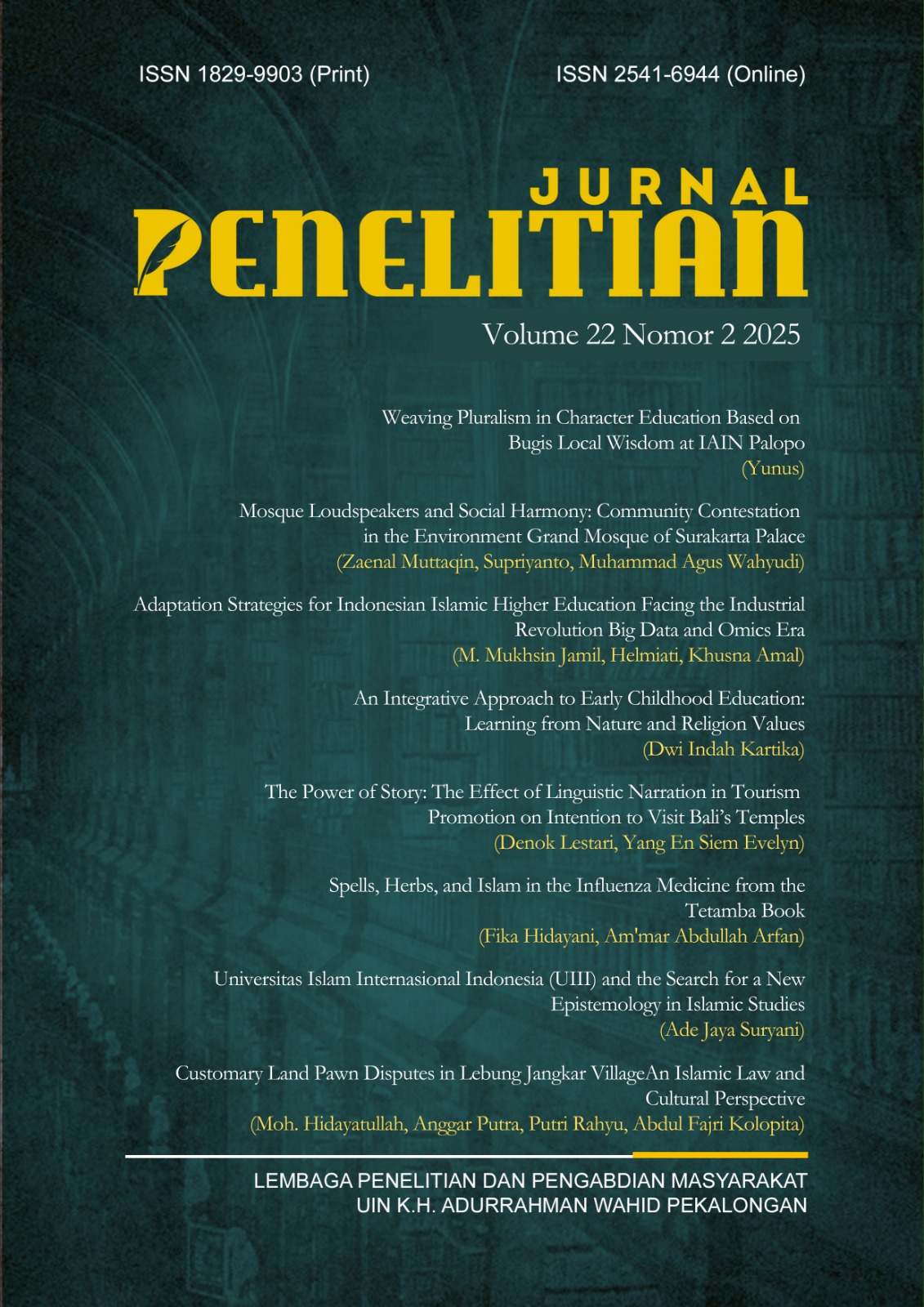
An Integrative Approach to Early Childhood Education
Learning from Nature and Religion Values
DOI:
https://doi.org/10.28918/jupe.v22i2.12286Abstract
Early childhood education is critical for building a strong foundation for children’s holistic development. Exploring the integration of nature-based and religion-based learning in Desa Petengan, Bandung, Indonesia by using the case of Yayasan Al Anbiya wal Mursalin, it addresses two questions: (1) how is the combination between learning from nature and religious values applied in early childhood education? (2) why is it important to integrate nature-based and religious-based learning early education setting? The study examines the implementation of nature-religion integrated learning in early childhood education, and its significance for children’s holistic development. A descriptive-explorative qualitative design is employed with data collected through classroom observations, interviews and documentation analysis. Findings reveal that integration of nature and religion not only enriches learning experiences but also fosters cognitive, socio-emotional, moral, and ecological awareness among children. These findings indicate that contextual learning grounded in local wisdom and spiritual values strengthens the sustainability of early childhood in rural communities. The study provides valuable implications for policy makers, educators, and researchers seeking to promote sustainable and value-based early education. Combination between learning from nature and religious values in early childhood education shows two learning domains, they are environmental (nature) and spiritual (religious). The combination is directly examined the process and practice of integration. Moreover, it answers and explores community response and impact by understanding why the model gains social legitimacy. It connects the outcome of integration (trust, satisfaction) with the value-based learning model. Model of pedagogical implementation and social validation combine natural and religious learning there.
Keywords:
References
Ärlemalm-Hagsér, (2013) Student teachers’ workplace-based learning in early childhood education: Studies in an urban and a rural setting in Sweden. Journal of Early Childhood Research, 11(3), 229–244. https://doi.org/10.1177/1476718X13487280
Bredekamp, S. (2019). Effective practices in early childhood education: Building a foundation. Pearson Higher Ed.
Bryk, A.S., & Schneider, (2002). Trust in Schools: A Core Resource for Improvement. Russel Sage Foundation.
Elliott, S., & Ärlemalm-Hagsér, E. (2019). Exploring the potential of education for sustainability in early childhood education. Springer. https://doi.org/10.1007/978-3-030-05982-0
Epstein, A. S. (2014). The intentional teacher: Choosing the best strategies for young children’s learning. National Association for the Education of Young Children (NAEYC).
Goodman, A., Joshi, H., Nasim, B., & Tyler, C. (2015). Social and emotional skills in childhood and their long-term effects on adult life: A review for the Early Intervention Foundation. UCL Institute of Education / Early Intervention Foundation. Retrieved from https://www.eif.org.uk/report/social-and-emotional-skills-in-childhood-and-their-long-term-effects-on-adult-life
Heckman, J. J. (2011). The economics of inequality: The value of early childhood education. American Educator, 35(1), 31–47.
Hornby, G., & Blackwell, I. (2018). Barriers to parental involvement in education: An update. Educational Review, 70(1), 109–119. https://doi.org/10.1080/00131911.2018.1388612
Istiqomah, N. (2018). Internalization of Islamic Values in Early Childhood Education. Jurnal Penelitian, 15(2), 221-233. https://doi.org/10.28918/jupe.v15i2.1135
Lovat, T., Toomey, R., & Clement, N. (2010). International research handbook on values education and student wellbeing. Springer. https://doi.org/10.1007/978-90-481-8675-4
Patiruhu, Makulua, Thalib, Elizar, (2023). Holistic and Integrative Learning Strategies in Early Childhood Education. Journal of Early Childhood of Development Studies, 7(4), 331-340
UNESCO. (2017). Education for sustainable development goals: Learning objectives. UNESCO Publishing. https://unesdoc.unesco.org/ark:/48223/pf0000247444
Patel, Murray, and Cowling. (2025). Supporting Young Children's Social-Emotional Well-Being Educator Perspective. Early Childhood Education Journal. 53(1), 77-92. https://doi.org/10.1007/s10643-024-01422-7.
patengan.desa.id. Data taken from https://patengan.desa.id/index.php/, on 11 October 2025, at 6.43 AM.
Elliott & Ärlemalm-Hagsér, (2019). Exploring the Potential of Education for Sustainability in Early Childhood Education. Springer.https://doi.org/10.1007/978-3-030-05982-0
Fleer, M., & van Oers, B. (2018). International perspectives on early childhood education. Springer. https://doi.org/10.1007/978-3-319-90239-9
Kartika, D. I. (2025). Penerapan metode belajar tematik maritim untuk anak usia dini di Desa Wisata Bahari Sukarame, Pandeglang. Smart Dedication: Jurnal Pengabdian Masyarakat, 2(2). https://doi.org/10.70427/smartdedication.v2i2.227
Maulida, A. (2021). Nature-Based Learning to Enhance Children's Socio-Emotional Development. Jurnal Penelitian, 18(1), 75-89. https://doi.org/10.28918/jupe.v18i1.1777
Musthafa, B., & Suherdi, D. (2021). Local culture integration in early childhood curriculum in Indonesia. Journal of Early Childhood Research and Practice, 23(1), 55–70.
Pemerintah Desa Patengang. (2024). Patengang Desa. https://patengang.desa.id
Rahmawati, R. 2019. Integrasi Pendidikan Karakter Relijius di Paud Berbasis Masyarakat. Jurnal Penelitian. 16(1), 45-60. https://doi.org/10.28918/jupe.v16i1.1457
Shonkoff, J. P., & Phillips, D. A. (Eds.). (2000). From neurons to neighborhoods: The science of early childhood development. National Academies Press. https://doi.org/10.17226/9824
Sholihah, M. (2022). Cultural and Local Wisdom Integration in Early Childhood Learning. Jurnal Penelitian, 19(1), 101-117. https://doi.org/10.28918/jupe.v19i1.1991
Setyowati, & Nurhayati, S. (2022). Environmental awareness education in rural Indonesia. Jurnal Penelitian, 17(2), 133–147. https://doi.org/10.28918/jupe.v17i2.1683
Siraj, I. (2021). Quality in early childhood education: An international review. Early Child Development and Care, 191(5), 715–729. https://doi.org/10.1080/03004430.2020.1713734
Sobel, D. (2014). Nature preschools and forest kindergartens: The handbook for outdoor learning. Redleaf Press.
Suryadi, K., & Hadisaputra, R. (2020). Community-based early childhood education: Local wisdom as a foundation for sustainability. Indonesian Journal of Early Childhood Education, 9(2), 143–156.
Wahyuni, I., Zulaeha, Z., Budiarti, B., & Nasiru, L. A. (2024). Digital innovation in Arabic language learning models for Islamic higher education. Jurnal Penelitian, 21(2), 137–151. https://doi.org/10.28918/jupe.v21i2.2279
UNESCO. (2021). Early Childhood Care and Education. UNESCO Publishing. https://unesdoc.unesco.org/ark:/48223/pf000378517
Yulindrasari and Nurzaman. (2022). Parental Involvement and Community Participation in Rural Early Childhood, 54(2), 213-229. https://doi.org/10.1007/s13158/022-00315-9.
Zamroni, H. (2023). Local Values and Character Formation in Early Childhood: A Rural Community Perspective. Jurnal Penelitian, 20(2). 155-170. https://doi.org/10.28918/jupe.v20i2.2135
Zins, J. E., Weissberg, R. P., Wang, M. C., & Walberg, H. J. (2004). Building academic success on social and emotional learning: What does the research say? Teachers College Press.
Downloads
Published
License
Copyright (c) 2025 Jurnal Penelitian

This work is licensed under a Creative Commons Attribution 4.0 International License.

This work is licensed under a Creative Commons Attribution 4.0 International License.