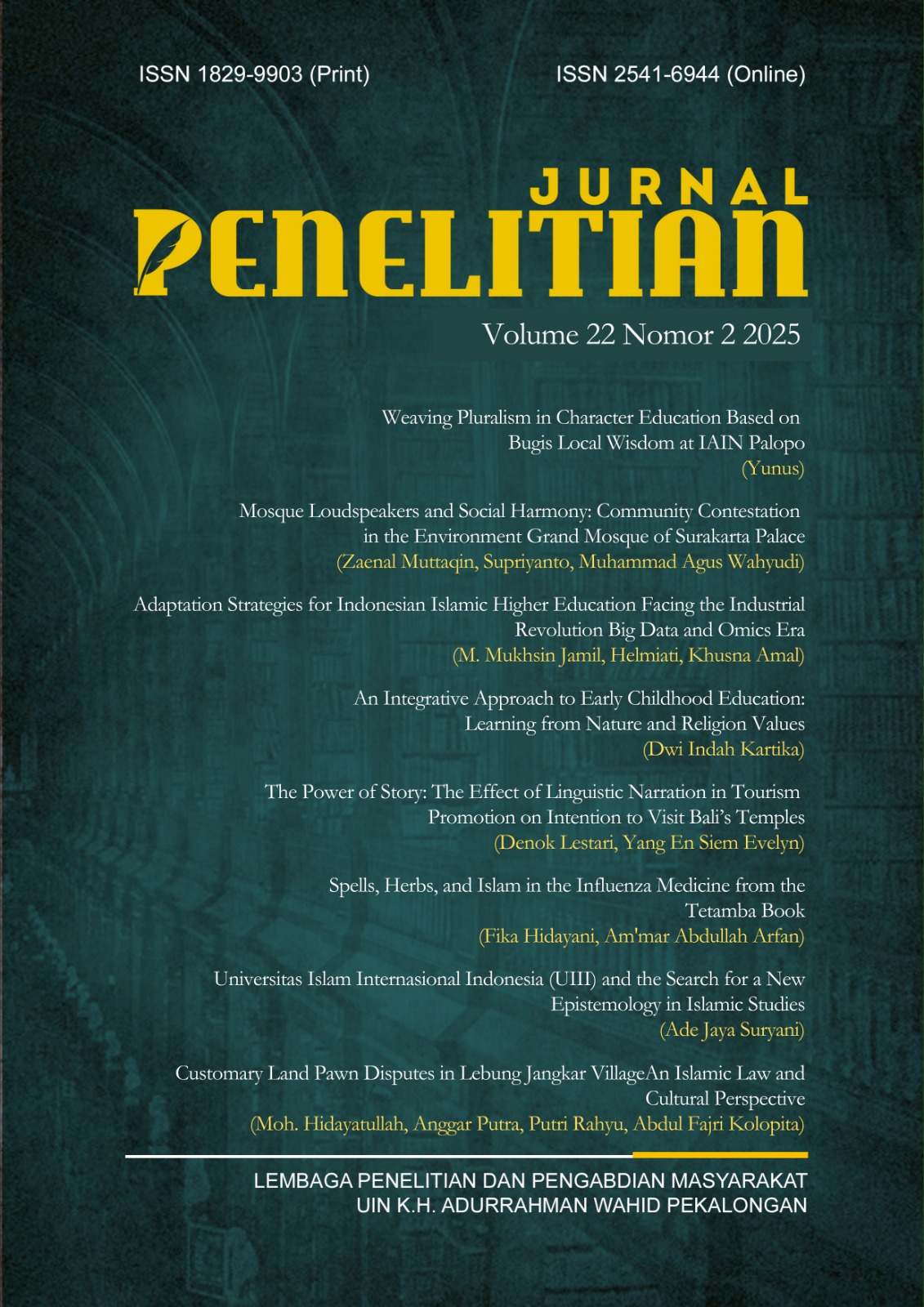
Mosque Loudspeakers and Social Harmony
Community Contestation in the Environment Grand Mosque of Surakarta Palace
DOI:
https://doi.org/10.28918/jupe.v22i2.8722Abstract
In the context of a pluralistic urban society, religious practices in public spaces often give rise to social dynamics between religious expression and shared comfort. This study examines public perceptions of the use of loudspeakers at the Great Mosque of the Surakarta Palace (Masjid Agung Kraton Surakarta) as part of Islamic preaching practices within a pluralistic public sphere. Employing a qualitative approach, data were collected through semi-structured interviews with individuals residing in the vicinity of the mosque. Informants were selected using purposive sampling, and the data were analyzed using thematic analysis. The findings reveal a diversity of perceptions influenced by respondents’ socio-religious backgrounds. The religious-conservative group views the loudspeaker as an indispensable tool for Islamic proselytization (da'wah). The moderate-pragmatic group adopts an adaptive and tolerant stance, provided that the practice does not disrupt socio-economic activities. Meanwhile, the critical-reflective group advocates for regulated use of loudspeakers to preserve collective comfort. Within the framework of Talcott Parsons’ structural functionalism, these religious practices reflect the four functional imperatives of the AGIL scheme: adaptation, goal attainment, integration, and latency. Nevertheless, potential dysfunctions may arise when symbolic religious expressions are not aligned with the heterogeneous social context. These findings underscore the necessity of fostering social dialogue and adopting moderate policies to maintain intercommunal harmony in urban-plural societies.
Keywords:
References
Aryanti. T. (2013). Breaking the Wall, Preserving the Barrier: Gender, Space, and Power in Contemporary Mosque Architecture in Yogyakarta, Indonesia. (Disertasi: University of Illinois at Urbana-Champaign). http://hdl.handle.net/2142/45570.
Ashmore, R. D., Deaux, K., McLaughlin-Volpe, T. (2004). “An organizing framework for collective identity: Articulation and significance of multidimensionality”. Psychological Bulletin, 130 (1), 80–114. https://doi.org/10.1037/0033-2909.130.1.80.
Bowen, J. R. (2012). A New Anthropology of Islam. Cambridge: Cambridge University Press.
Brown, R. J. & Zagefka, H. (2006). Choice of comparisons in intergroup settings: the role of temporal information and comparison motives. European Journal of Social Psychology, 36 (5), 649–671. https://doi.org/10.1002/ejsp.311.
Denzin, N. K., & Yvonna S. L. (2018). Handbook of Qualitative Research. 5th ed. Thousand Oaks: SAGE Publications.
Eickelman, D. F. & Jon W. A. (2003). New Media in the Muslim World: The Emerging Public Sphere. Indiana University Press.
Habermas, J. (1984). The Theory of Communicative Action. Vol. 1. Beacon Press.
Hasdar, H. (2019). Persepsi Masyarakat Terhadap Pembatasan Pengeras Suara oleh Dirjen Bimas Islam Kemenag Ri Kecamatan Sinjai Utara Kabupaten Sinjai. (Disertasi, Institut Agama Islam Muhammadiyah Sinjai).
Hassan, R. (2003). Faithlines: Muslim Conceptions of Islam and Society, Karachi: Oxford University Press.
Hefner, R. W. (2011). Shari’a Politics: Islamic Law and Society in the Modern World. Bloomington: Indiana University Press.
Mardi, M. (2024). Peran Masjid Dalam Pengembangan Sosial Dan Ekonomi Masyarakat. Journal of Economic and Islamic Research, 3 (1), 391-408. https://doi.org/10.62730/journalofeconomicandislamicresearch.v3i1.140.
Miles, Matthew B., A. Michael Huberman, dan Johnny Saldaña. 2014. Qualitative Data Analysis: A Methods Sourcebook. 3rd ed. Thousand Oaks, CA: SAGE Publications.
Millie. J. (2012). Oratorical Innovation and Audience Heterogeneity in Islamic West Java. Indonesia, 93, 123–145. https://doi.org/10.5728/indonesia.93.0123.
Muzaky, I. A. & Muslim, A. (2023). Polemik Peraturan Pengeras Suara Masjid di Indonesia: Perspektif Agama sebagai Bagian Sistem Budaya. Umbara: Indonesian Journal of Anthropology, 8 (1), 15-28. https://doi.org/10.24198/umbara.v8i1.41511.
Parsons, T. (1951). The Social System. New York: Free Press.
Postmes, T. & Branscombe, N. (2010). “Sources of social identity”. dalam T. Postmes & N. Branscombe (Eds).
Rediscovering Social Identity: Core Sources. Psychology Press.
Riyanto, W. F. (2024). Escaping Islamic Religious Noise: The Pros and Cons of the Use of Mosque Loudspeakers in Indonesia. Ulumuna, 28 (1), 81-107. https://doi.org/10.20414/ujis.v28i1.826.
Safei, A. A., & Armstrong, P. S. (2024). Mosque Management in Urban City: Bargaining Between the Sacred and the Social Challenges. Wawasan: Jurnal Ilmiah Agama Dan Sosial Budaya, 8 (1), 43-54. https://doi.org/10.15575/jw.v8i1.26049.
Salsabila, M., et. al. (2024). Kohesi Sosial Antar Jamaah Masjid Hidayatul Islam Di Desa Margamukti. Arus Jurnal Sosial Dan Humaniora, 4 (3), 1880-88. https://doi.org/10.57250/ajsh.v4i3.789.
Syarifah, F. S., & Samatan, N. (2020). Analisis Kerukunan Hidup Antar Budaya Dan Agama Melalui Studi Tentang Pengeras Suara Masjid. 2020. BroadComm, 2 (2), 25-34. https://doi.org/10.53856/bcomm.v2i2.208.
Tajfel, H., & Turner, J. C. (1979). “An integrative theory of intergroup conflict”. in W. G. Austin & S. Worchel (ed,). The social psychology of intergroup relations. Monterey, CA: Brooks/Cole.
Tajfel, H., & Turner, J. C. (1986). “The social identity theory of intergroup behaviour”. in S. Worchel & W. G. Austin (ed.). Psychology of Intergroup Relations. Chicago, IL: Nelson-Hall.
Taylor, C. (1992). Multiculturalism and The Politics of Recognition. Princeton University Press.
Thompson, S. (2022). The regulation of religion in public spaces. Politics and Religion, 16 (1), 27-44. https://doi.org/10.1017/S1755048322000372
Turner, Bryan S. (1991). Religion and Social Theory, London: SAGE Publication.
Turner, J. & Oakes, P. (1986). The significance of the social identity concept for social psychology with reference to individualism, interactionism and social influence. British Journal of Social Psychology, 25 (3), 237–252. https://doi.org/10.1111/j.2044-8309.1986.tb00732.x.
Turner, J. C. & Reynolds, K. J. (2010). “The story of social identity”. in T. Postmes & N. Branscombe (ed,). Rediscovering Social Identity: Core Sources. Psychology Press.
Yaman, A. (2024). Mosque Economic Empowerment through Sharia Microfinance Institutions. Waiheru, 10 (1), 107-14. https://doi.org/10.47655/12waiheru.v10i1.185.
Downloads
Published
License
Copyright (c) 2025 Jurnal Penelitian

This work is licensed under a Creative Commons Attribution 4.0 International License.

This work is licensed under a Creative Commons Attribution 4.0 International License.