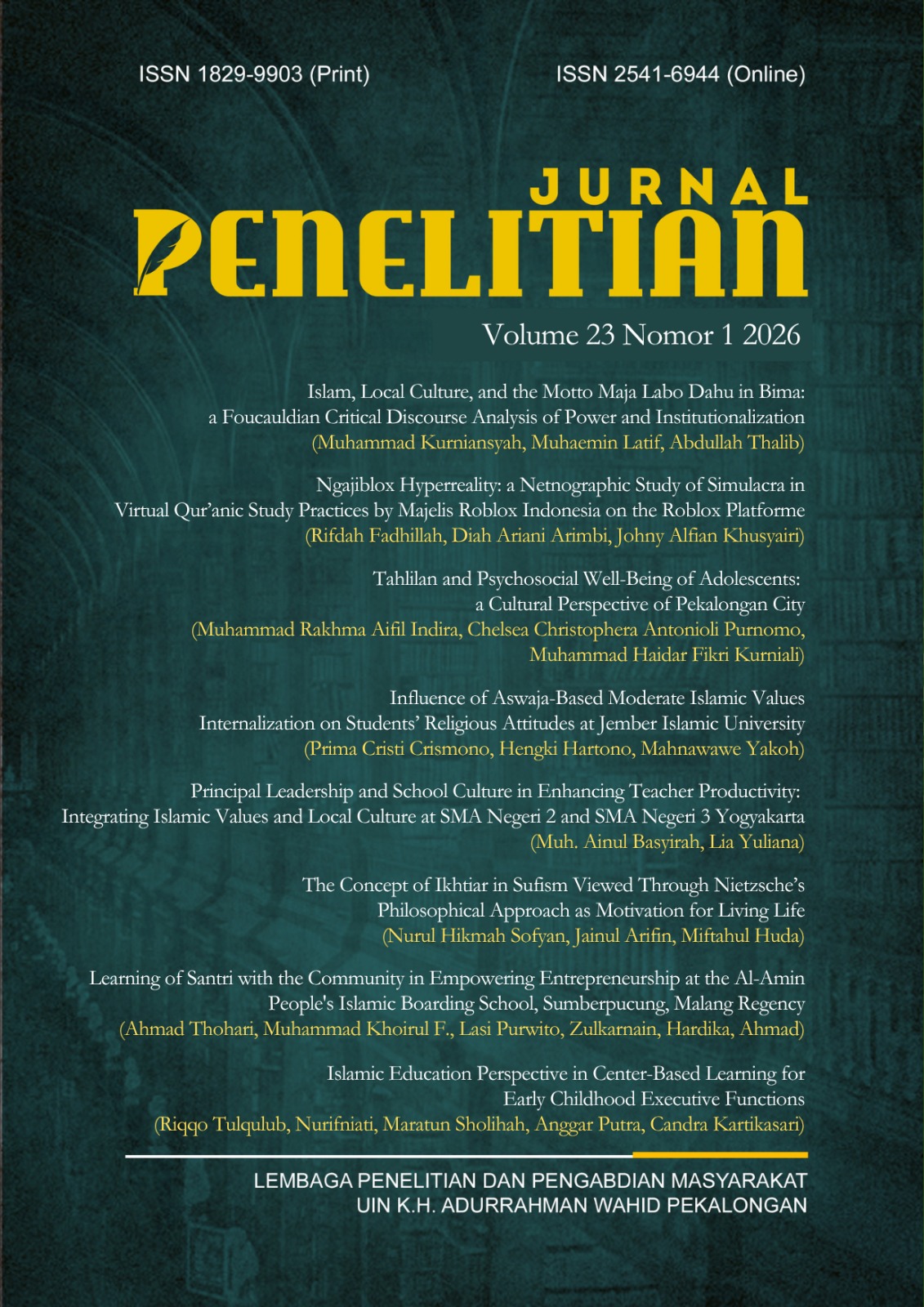
Islamic Education Perspective in Center-Based Learning for Early Childhood Executive Functions
DOI:
https://doi.org/10.28918/9k8e1t31Abstract
The development of executive functions in early childhood is a crucial foundation for later academic readiness; however, learning practices in early childhood education still tend to be teacher-centered and less contextual. This study examines the implementation of the Center-Based Learning model integrated with the traditional Bima game Mpa’a Ncimi Lombo Tembe within the perspective of Islamic education as an effort to enhance children’s executive functions. The scope of the study focuses on three core components of executive function: inhibitory control, working memory, and cognitive flexibility. The aim of this study is to determine the effectiveness of the Center-Based Learning model integrated with the traditional Bima game Mpa’a Ncimi Lombo Tembe in improving early childhood executive functions. This study employed a quantitative approach using a quasi-experimental design with a non-equivalent control group design. The participants consisted of 40 children aged 5–6 years, divided into experimental and control groups. Data were collected through structured observation and executive function assessment instruments and analyzed using independent sample t-test and paired sample t-test at a significance level of 0.05. The results revealed a significant difference between the experimental and control groups in the posttest (t = 6.32; p < 0.05), with a higher gain score in the experimental group (21.70) compared to the control group (10.45). These findings indicate that structured and contextual play-based learning effectively enhances children’s executive functions. Furthermore, the integration of Islamic educational values contributes to holistic character development.
Keywords:
References
Ali, G., Qurnia, A., & Hasibuan, R. (2024). Development of a Case Based Learning ( CBL ) Model Based on a Knowledge Management System to Improve Students ’ Critical Thinking Skills. Al-Ishlah: Jurnal Pendidikan, 16(3), 3029–3040. https://doi.org/10.35445/alishlah.v16i3.4904
Anggryani, I., Imaniar, M., Roswati, R., & Yakin, N. R. (2025). Meningkatkan Kemampuan Kognitif Anak Melalui Metode Role Play Di TK Lahila Donggo. Jurnal Pendidikan Anak Usia Dini, 3(1), 20–28. https://doi.org/10.56997/earlystage.v3i1.2039
Anggryani, I., Kartikasari, C., Tulqulub, R., Imaniar, M., Najamuddin, & Roswati, R. (2025). Integrating a STEAM-Based Learning Model with Maja Labo Dahu Local Wisdom to Enhance Creativity and Character Development in Early Childhood,” Bulletin of Science Education. Bulletin of Science Education, 5(4), 1–10.
Anshul, S., Kashif, M., Reddy, P. B. R., Ashwin, U., & Arshad, K. (2020). Erratum regarding missing Declaration of Competing Interest statements in previously published articles. Journal of Clinical Orthopaedics and Trauma, 11(6), 1177. https://doi.org/10.1016/j.jcot.2020.10.025
Banić, L., & Orehovački, T. (2024). A Comparison of Parenting Strategies in a Digital Environment: A Systematic Literature Review. Multimodal Technol. Interact., 8(4), 32. https://doi.org/10.3390/mti8040032
Budhi Santosa, E., Sukmawati, F., Juwita, R., Prihatin, R., Tri Cahyono, B., & Suparmi. (2024). The Effect of Teachers’ Level of Self-Regulated Learning and Internet Self-Efficacy on Teaching Innovation in the Constructivist Curriculum. JTP - Jurnal Teknologi Pendidikan, 26(2), 657–675. https://doi.org/10.21009/jtp.v26i2.48474
Dewi, C. A., Rahayu, S., & Dasna, I. W. (2022). Case-Based Learning ( CBL ) in Chemistry Learning : A Systematic Review. Jurnal Penelitian Pendidikan IPA, 8(4), 1926–1936. https://doi.org/10.29303/jppipa.v8i4.1971
Fauziah, M., Marmoah, S., Murwaningsih, T., & Saddhono, K. (2020). The Effect of Thinking Actively in a Social Context and Creative Problemsolving Learning Models on Divergent-Thinking Skills Viewed from Adversity Quotient. European Journal of Educational Research, 9(2), 537–568. https://doi.org/10.12973/eu-jer.9.2.537
Hakim, U., Syamsurianti, S., Zaini, S. H. Bin, & Zaini, S. H. Bin. (2025). Enhancing Student Engagement, Academic Performance, and Character through Problem- and Project-Based Learning: A Cross-National Study. International Journal of Learning Teaching and Educational Research, 24(9), 20–39. https://doi.org/10.26803/ijlter.24.9.2
Hanifah, S., Kurniati, E., & Rudiyanto. (2024). The Role of Early Childhood Education Teachers in Preparing Early Childhood Learning Readiness in the Transition Period. Jurnal Pendidikan Anak Usia Dini Undiksha, 12(3), 517–524. https://doi.org/10.23887/paud.v12i3.80623
Hardiyanti, W. D., Prayitno, Christianti, M., Rambe, A., & Ulfiyani. (2025). Coding Games to Stimulate Computational Thinking Ability in Early Childhood. Journal for Lesson and Learning Studies, 8(2), 243–256. https://doi.org/10.23887/jlls.v8i2.92569
Herreras, E. B. (2024). Comparative Study of the Development of Executive Functions in Children: Transition from the First Cycle to the Second Cycle of Early Childhood Education. Brain Sciences, 14(12), 1273. https://doi.org/10.3390/brainsci14121273
Kucab, M. D., Keown-Stoneman, C. D., Birken, C. S., Perlman, M., Parsons, J., D’Annunzio, D., Thadani, S., Allen, C. A., & Maguire, J. L. (2025). Center-Based Childcare in Early Childhood and Nutritional Risk in Later Childhood: A Prospective Cohort Study. The Journal of Nutrition, 115(12), 4530–4539. https://doi.org/10.1016/j.tjnut.2025.09.028
Liu, F., Vadivel, B., Rezvani, E., & Namaziandost, E. (2021). Using Games to Promote English as a Foreign Language Learners’ Willingness to Communicate: Potential Effects and Teachers’ Attitude in Focus. Frontiers in Psychology, 12, 762447. https://doi.org/10.3389/fpsyg.2021.762447
Mansour, N., Çevik, M., Uzun, Y., & Alotaibi, S. B. M. (2025). Exploring the impact of STEAM and connected learning on skills of digital age in primary schools. Thinking Skills and Creativity, 56, 102024. https://doi.org/10.1016/j.tsc.2025.102024
Na, C., Clarke-Midura, J., Shumway, J., Dijk, W. van, & Lee, V. R. (2024). Validating a performance assessment of computational thinking for early childhood using item response theory. Int J Child Comput Interact, 40, 100650. https://doi.org/10.1016/j.ijcci.2024.100650
Nafal, Q., Maunah, B., & Patoni, A. (2024). Hakikat Kepemimpinan Transformasional. IHSANIKA : Jurnal Pendidikan Agama Islam, 2(3), 45–58. https://doi.org/10.59841/ihsanika.v2i2.1361
Nasution, N., & Ahyansyah, A. (2024). Identifikasi Ekstrakurikuler Sekolah dalam Mendukung Fungsi Eksekutif Siswa Sekolah Dasar di Kota Bima. DIKSI: Jurnal Kajian Pendidikan Dan Sosial, 5(1), 34–38. https://doi.org/10.53299/diksi.v5i1.1107
Nasution, N., Wiraningtyas, A., Nurmaya, A., Ahyansyah, A., & Mawaddah, S. (2024). Kondisi Fungsi Eksekutif Anak Usia 7-9 Tahun Berdasarkan Pola Asuh Orang Tua: Studi di Daerah Pesisir dan Pegunungan Kota Bima. Edu Sociata ( Jurnal Pendidikan Sosiologi ), 7(2), 158–165. https://doi.org/10.33627/es.v7i2.2694
Nasution, Wiraningtyas, A., Nurmaya, A., Ahyansyah, Mawaddah, S., & Safitri, A. H. Y. I. (2024). Guidance and counseling services on parenting patterns to improve executive function of children aged 7-12 years. Edelweiss Applied Science and Technology, 8(6), 6274–6289. https://doi.org/10.55214/25768484.v8i6.3369
Nudin, B., Lukman, Sihab, W., & Aldinata, N. (2024). The Role Of Parents And Families In Children’s Education In The Digital Era. Linguanusa Social Humanities Education and Linguistic, 2(1), 9–22. https://doi.org/10.63605/ln.v2i1.35
Ocak, C., Yadav, A., & Rich, K. M. (2025). Exploring young children’s metacognition during unplugged computational thinking. International Journal of Child-Computer Interaction, 45, 100767. https://doi.org/10.1016/j.ijcci.2025.100767
Paraskevopoulou-Kollia, E.-A., Michalakopoulos, C.-A., Zygouris, N. C., & Bagos, P. G. (2025). Computational Thinking in Primary and Pre-School Children: A Systematic Review of the Literature. Multidisciplinary Digital Publishing Institute (MDPI), 15(8), 985. https://doi.org/10.3390/educsci15080985
Pratiwi, D., Rohman, Z., Mufid, & Afrianingsih, A. (2025). Inclusivity of Pre-Learning Screening for Religious and Moral Values in Early Childhood Education (PAUD). Jurnal Pendidikan Anak Usia Dini Undiksha, 13(1), 57–66. https://doi.org/10.23887/paud.v13i1.85543
Putu, N., & Dharmayanthi, I. (2022). Penerapan Model Case Based Learning ( CBL ) Mengembangkan Critical Thinking Skills Siswa Pembelajaran Geografi di SMA Negeri 1 Kuta Utara untuk dalam. Jurnal Pendidikan Geografi Undiksha, 10(3), 291–300. https://doi.org/10.23887/jjpg.v10i3.50446
Roni Irawan. (2020). Peran Masyarakat Pesisir Bima Dalam Proses Masuknya Agama Islam Di Bima Pada Abad XVI-XVII. Jurnal Pendidikan Ips, 10(2), 144–149. https://doi.org/10.37630/jpi.v10i2.399
Shih, Y.-H. (2022). Designing Culturally Responsive Education Strategies to Cultivate Young Children’s Cultural Identities: A Case Study of the Development of a Preschool Local Culture Curriculum. Children, 9(12). https://doi.org/10.3390/children9121789
Simbolon, D. H. (2022). Pengaruh Model Case Based Learning ( CBL ) Terhadap Hasil Belajar Mahasiswa. BULLET: Jurnal Multidisiplin Ilmu, 1(3), 181–184. https://journal.mediapublikasi.id/index.php/bullet %7C
Siswanto, S., Saimroh, S., Muthmainna, A., Nurhijriah, N., & Siswanto, S. (2024). The Role of Self-Confidence and Self-Awareness in Enhancing Academic Value: An SEM Analysis. International Journal of Social Learning (IJSL), 5(1), 189–201. https://doi.org/10.47134/ijsl.v5i1.310
Sugiyono. (2013). Metode Penelitian Kuantitatif, Kualitatif, dan RD. Alfabeta.
Walsh, K., L’Estrange, L., Smith, R., Burr, T., & Williams, K. E. (2024). Translating neuroscience to early childhood education: A scoping review of neuroscience-based professional learning for early childhood educators. Educational Research Review, 45, 100644. https://doi.org/10.1016/j.edurev.2024.100644
Winarni, E. W. (2021). Teori dan Praktik Penelitian Kuantitatif, Kualitatif, PTK, R&D. Bumi Aksara.
Yang, W. (2025). A three-phase professional development approach to improving robotics pedagogical knowledge and computational thinking attitude of early childhood teachers. Computers & Education, 231, 105282. https://doi.org/10.1016/j.compedu.2025.105282
Yordudom, T., Nui-Suk, C., Imjai, N., Sumiati, S., & Aujirapongpan, S. (2025). Developing open innovation competency in Gen Z entrepreneurship students: Roles of absorptive capacity, AI literacy and algorithmic thinking skills. The International Journal of Management Education, 24(1), 101326. https://doi.org/10.1016/j.ijme.2025.101326
Zhong, M., Caldwell, M. P., Cheung, S.-K., Cheung, H., & Siu, C. T.-S. (2025). Teacher-child relationships, early childhood programme quality and early learning in two-year-old toddlers. Learning and Instruction, 99, 102173. https://doi.org/10.1016/j.learninstruc.2025.102173
Downloads
Published
License
Copyright (c) 2026 Anggar Putra, Riqqo Tulqulub, Nurifniati, Maratun Sholihah, Candra Kartikasari

This work is licensed under a Creative Commons Attribution 4.0 International License.

This work is licensed under a Creative Commons Attribution 4.0 International License.