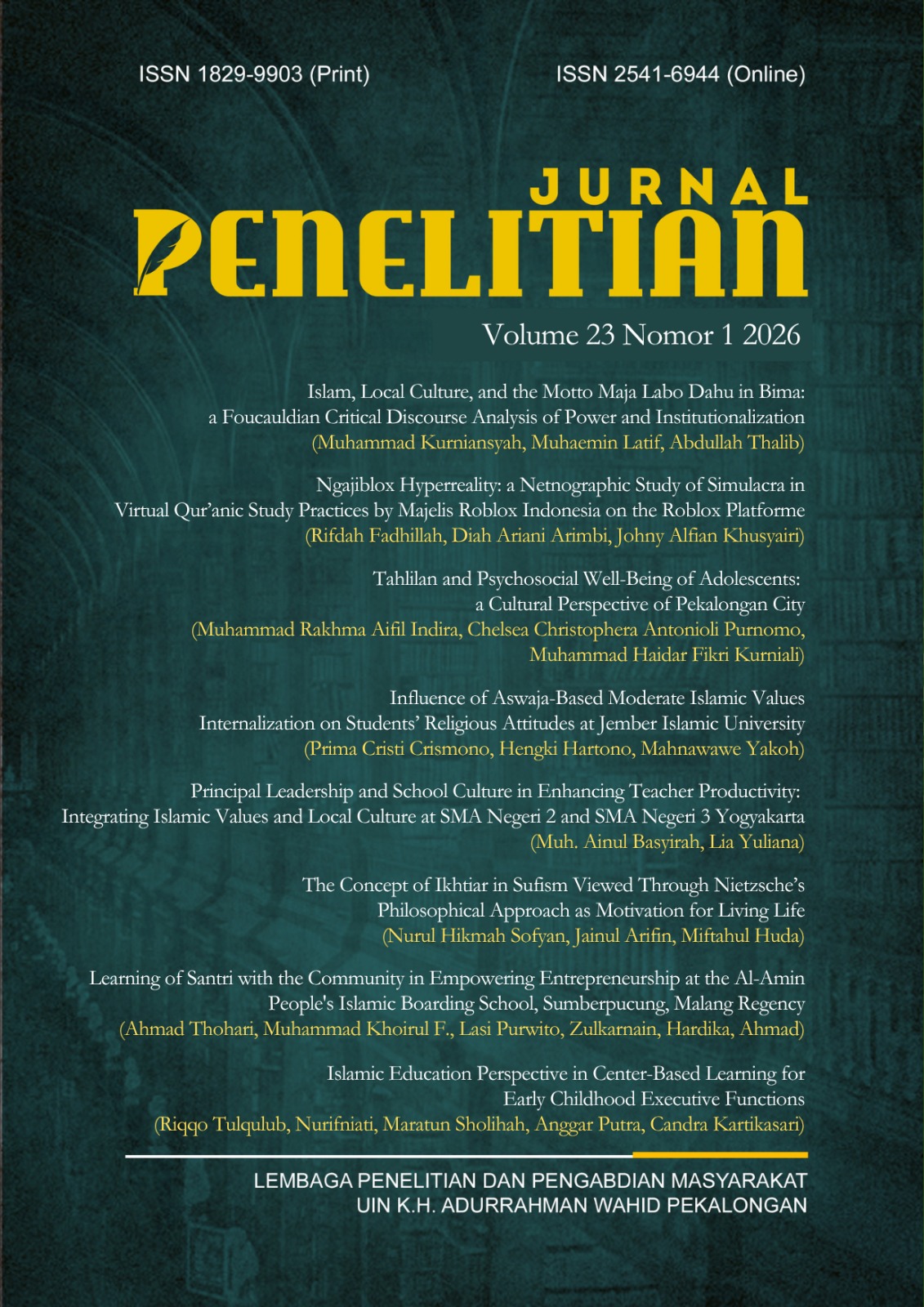
The Concept of Ikhtiar in Sufism Viewed Through Nietzsche’s Philosophical Approach as Motivation for Living Life
DOI:
https://doi.org/10.28918/bzjba067Abstract
In Sufism, there is no specific theme related to ikhtiar; if any, it is very limited and serves as a supplement to the theme of tawakal. So, people can misuse tawakal as a shield for laziness, and even the general public views Sufism as hating worldly life. Meanwhile, there is a hadith of the Prophet Muhammad commanding ikhtiar first before tawakal. This study aims to discuss the concept of ikhtiar seen through the motivation of Nietzsche's philosophical life. The research method employed is qualitative, utilizing library research and syncretic-hermeneutic to analyze Nietzsche’s philosophical concepts in relation to or unite them with the concept of ikhtiar in Sufism through the reinterpretation of texts related to everyday life. The results are, the concept of ikhtiar through Nietzsche's philosophical approach as a motivation to live life: a. Nietzsche's critique of absolute truth is linked to ikhtiar, namely, there must be a dismantling of understanding so that sustenance depends on someone’s struggle, but the final step must still be balanced with tawakal; b. Nietzsche's will to power is linked to ikhtiar, namely that someone does not know the cause of what sustenance from existence can bring him. Therefore, according to Nietzsche, someone must optimize the power to gather sustenance that is around him, but the final result must still be left to Allah (tawakal).
Keywords:
References
Adi, A. (2020). Genealogi Nietzsche: Kematian Tuhan dan Utopia Ubermensch. Widya Katambung, 11(2). https://doi.org/10.33363/wk.v11i2.548
Ahmad, A. F. S. (2005). Tasawuf; Antara Al-Ghazali dan Ibnu Taimiyah. Pustaka Al-Kautsar.
Al-Qusyairi. (1994). Risalah Sufi Al-Qusyairi. Penerbit Pustaka.
Anggraini, O., Mardliyati, S., & Purnamasari, E. (2025). Schopenhauer’s Pessimism and Nietzsche’s Optimism in Human Will: Islamic Perspective as a Middle Way. Refleksi, 25(1). https://doi.org/10.14421/ref.v25i1.6258
Arif, M. M., & Rahmawati, A. (2022). Hermeneutika Dalam Studi Islam. Tadris, 16(2). https://ejournal.iainutuban.ac.id/index.php/tadris/article/view/634
Arikhah. (2016). Reaktualisasi Pemikiran Ibn Qayyim Al-Jauziyyah dalam Pengembangan Tasawuf. At-Taqaddum, 8(1). https://journal.walisongo.ac.id/index.php/attaqaddum/article/view/1165
Astuti, L., & Bashori. (2025). Kajian Semantik Tawakkal dalam Al-Qur`an: Relevansinya terhadap Konsep Coping dan Psikologi Resiliensi. Fathir, 2(2). https://doi.org/10.71153/fathir.v2i2.283
Azra, A. (2018). Ensiklopedi Tasawuf. Penerbit Angkasa.
Dalimuthe, S. M., & Rambe, M. H. (2025). Keselarasan antara Ikhtiar dan Tawakal dalam Membentuk Mental Positif. An-Nawa, 7(1). https://doi.org/10.37758/4g8kz711
Fathkhullathif, A. I. K. (2025). Destiny and Mental Health: Reading Al Ghazali’s Tawakkal and Ibn Taymiyyah’s Ikhtiyar Through the Lens of Modern Psychology. Jurnal Pemikiran Islam, 5(2). https://doi.org/https://doi.org/10.22373/jpi.v5i2.32419
Hakim, A., Sholihah, F. M., & Anifa, N. A. (2023). Konsep Ikhtiar dalam Berobat Sesuai Ajaran Islam. Jurnal Religion, 1(4). https://doi.org/https://doi.org/10.55606/religion.v1i4.508
Hardiman, F. B. (2019). Pemikiran Modern; Dari Machiavelli sampai Nietzsche. PT. Kanisius.
Hidayatullah, A. R. (2020). Nietzsche: Kehendak untuk Berkuasa. Jurnal Kalam Dan Filsafat, 2(1). https://journal.uinjkt.ac.id/index.php/paradigma/article/view/26618
Jaelani, J. (2021). Ikhtiar dan Tawakal dalam Menghadapi Wabah Pandemi Covid-19 (Perspektif Tasawuf). Al Asma, 3(2). https://doi.org/10.24252/asma.v3i2.21071
Mokhtar, R. A. M., & Sa’ari, C. Z. (2015). Konsep Sinkretisme Menurut Perspektif Islam. Afkar, 17(1). https://ejournal.um.edu.my/index.php/afkar/article/view/5645
Munir, M. (2011). Pengaruh Filsafat Nietzsche Terhadap Perkembangan Filsafat Barat Kontemporer. Jurnal Filsafat, 21(2). https://journal.ugm.ac.id/wisdom/article/view/3113/9365
Nietzsche, F. (2002). Beyond Good and Evil; Prelude Menuju Filsafat Masa Depan. Ikon Teraliter.
Nietzsche, F. (2010). Sabda Zarathustra. Pustaka Pelajar.
Nopitasari, P. E., & Heri, M. (2021). Pemenuhan Nutrisi (The Fulfillment of Nutrition) Literatur Review. Jurnal Online Keperawatan Indonesia, 4(1). https://doi.org/10.51544/keperawatan.v4i1.1441
Pransiska, T. (2017). Meneropong Wajah Studi Islam dalam Kacamata Filsafat: Sebuah Pendekatan Alternatif. Intizar, 23(1). https://doi.org/10.19109/intizar.v23i1.1270
Robinson, D. (2002). Nietzsche dan Postmodernisme. Penerbit Jendela.
Sulaiman. (2023). Konsep Tawakal Menurut Imam Ghazali dalam Kitab Ihya Ulumuddin. Ameena Journal, 1(1). https://ejournal.ymal.or.id/index.php/aij/article/view/5
Sunardi, S. (2011). Nietzsche. LKiS.
Tammar, A., Abubakar, A., & Mahfudz, M. (2023). Relevansi Tawakal Dalam Kehidupan Sosial (Kajian Literatur Al Qur`an). Farabi, 20(2). https://doi.org/10.30603/jf.v20i2.4247
Tjahjadi, S. P. L. (2004). Petualangan Intelektual: Konfrontasi dengan Para Filsuf dari Zaman Yunani hingga Zaman Modern. Penerbit Kanisius.
Wafi, H. A., & Firdausiyah, U. W. (2022). Konsep Kebebasan Kehendak Manusia Sebagai Penentu Hidup Sosial: Studi Analisis Pemikiran Friedrich Nietzsche. Refleksi, 22(1). https://ejournal.uin-suka.ac.id/ushuluddin/ref/article/view/2201-05
Widayani, H. (2019). Maqamat (Tingkatan Spiritualitas dalam Proses Bertasawuf). El-Afkar, 8(1). https://doi.org/10.29300/jpkth.v8i1.2023
Widiadharma, N., Lasiyo, & Tjahjadi, S. (2023). Teori Kausalitas Aristotelian. Living Islam, 61. https://doi.org/10.14421/lijid.v6i1.4397
Widyawati, S., Mayasaroh, D., & Aqila, S. L. (2025). Faktor-Faktor yang Berkaitan dengan Kesehatan Mental Mahasiswa,. Jurnal ISO, 5(1). https://doi.org/10.53697/iso.v5i1.2534
Downloads
Published
License
Copyright (c) 2026 Nurul Hikmah Sofyan, Jainul Arifin, Miftahul Huda

This work is licensed under a Creative Commons Attribution 4.0 International License.

This work is licensed under a Creative Commons Attribution 4.0 International License.