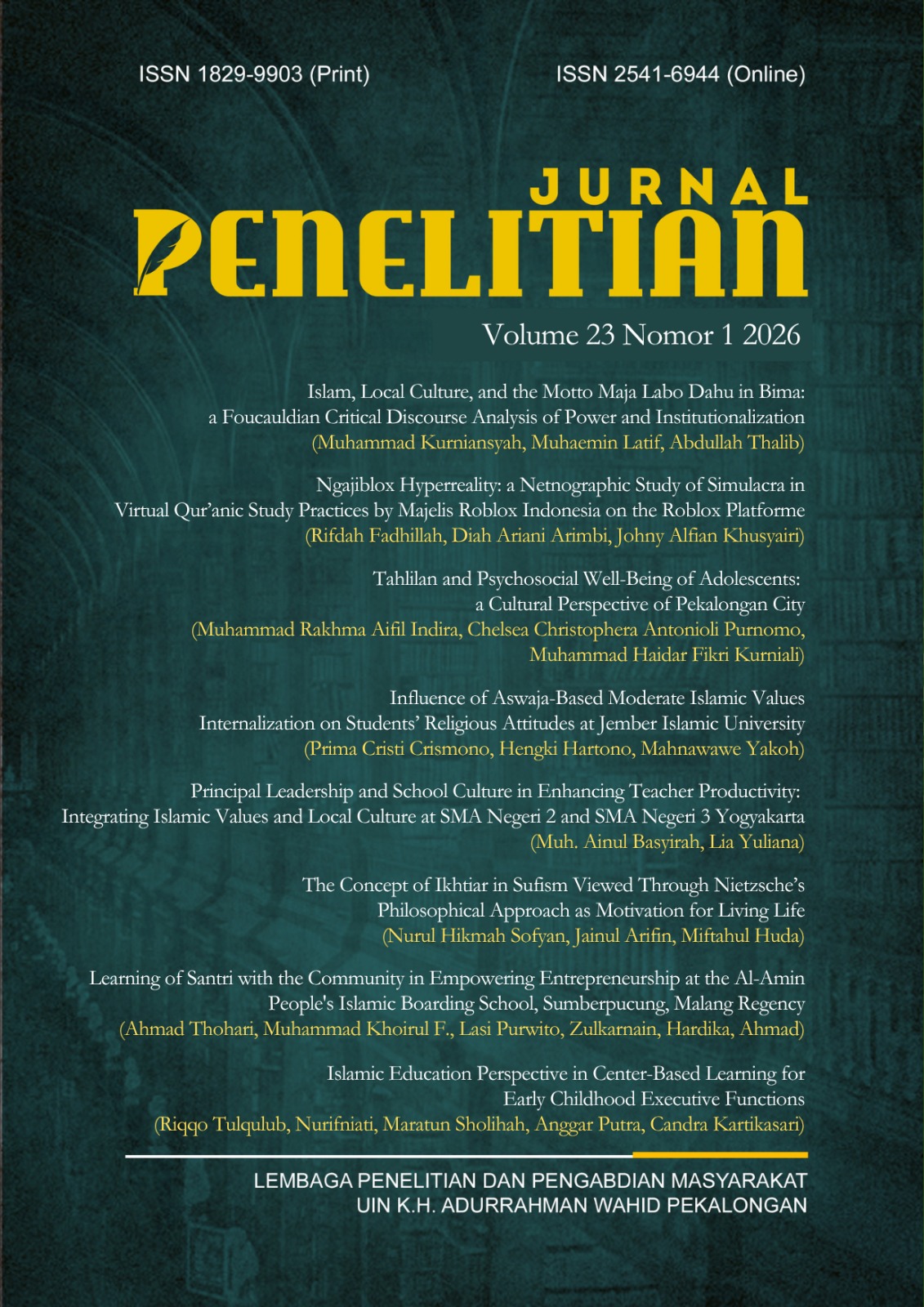
Islam, Local Culture, and the Motto Maja Labo Dahu in Bima
a Foucauldian Critical Discourse Analysis of Power and Institutionalization
DOI:
https://doi.org/10.28918/df6zhy82Abstract
This study is grounded in concerns over the transformation of local cultural values amid modernization, which may weaken their role in shaping social behavior. It examines the philosophical meaning and socio-discursive role of maja labo dahu within the Bima community of West Nusa Tenggara, Indonesia. The discussion focuses on the integration of Islam and local culture, the construction of moral discourse, and the role of power relations in sustaining social norms. This study aims to analyze (1) the philosophical values embodied in maja labo dahu, (2) its function as a dominant moral discourse from a Foucauldian perspective, and (3) the role of power relations in its institutionalization within social institutions. This research employs a qualitative approach with a critical discourse analysis framework. Data were collected through observation, interviews, and documentation, and analyzed using inductive and deductive techniques. Data validity was ensured through triangulation. The findings reveal that maja labo dahu, meaning “shame and fear,” represents a synthesis between Islamic teachings and local cultural values that forms the ethical foundation of Bima society. From a Foucauldian perspective, it functions as a dominant moral discourse reproduced through educational, religious, and governmental institutions. The study concludes that maja labo dahu is a dynamic discursive practice shaping moral subjectivity, collective identity, and social order, while reflecting the operation of power–knowledge in contemporary society.
Keywords:
References
Abdullah, A., Aksa, A., & Megawati, L. (2021). The Sultanate of Bima in the Fragments of Islamic Civilization in the Archipelago. Advances in Social Science, Education and Humanities Research, 600. https://doi.org/10.2991/assehr.k.220408.003
Agbon, G. (2024). Who speaks through the machine? Generative AI as discourse and implications for management. Critical Perspectives on Accounting, 100, 102761. https://doi.org/10.1016/j.cpa.2024.102761
Al-Islami, M. A.-A., Putra, A., & Pajarudin, P. (2024). Cultural Threads: ‘Kalembo Ade’ and its Islamic Roots in Bima. Mimbar Agama Budaya, 41(2), 187–195. https://doi.org/10.15408/mimbar.v41i2.41402
Amiruddin, A. (2019). Menggali Potensi Budaya Maja Labo Dahu Sebagai Basis Pendidikan Etika Dan Moral Di Sekolah. EL-Muhbib: Jurnal Pemikiran Dan Penelitian Pendidikan Dasar, 2(1), 69–76. https://doi.org/10.52266/el-muhbib.v2i1.238
Amrin, A., Priyono, A., Supriyanto, & Nurrahmania. (2022). Analysis of Local Wisdom in Bima Community Marriage (Study of Socio- Cultural Values). Legal Brief, 11(2), 2418–2424. https://doi.org/10.35335/legal.v11i4
Anwar Hasnun. (2020). Mengenal Orang Bima dan Kebudayaannya: Lukisan Singkat Terhadap Kepribadian dan Kepemimpinan Nggusu Upa, Nggusu Ini, Nggusu Waru, Nilai Luhur Maja Labo Dahu, dan Filsafat Hidup. CV. Bildung Nusantara.
Aziz, M. B., Agama, I., & Negeri, I. (2025). Cultural Heritage as a Driver of Educational Choices : Evaluating the Role of Bugis Values in the Selection of Islamic Private Schools in Indonesia. Nazhruna: Jurnal Pendidikan Islam, 7(3), 726–741. https://doi.org/10.31538/nzh.v7i3.110
Diana T Laurenson, A. S. (1972). The Sociology of Literature. Schocken Books.
Fahrurizki. (2020). Artifisial Parafu Hingga Hikayat Sang Bima. https://www.mbojoklopedia.com/2020/08/artifisial-parafu-hingga-hikayat-sang.html
Haris, A., & Anwar, S. (2023). Unveiling Maja Labo Dahu : a Local Wisdom in Implementing Character Values. Tadris: Jurnal Keguruan Dan Ilmu Tarbiyah, 8(2), 463–474. https://doi.org/10.24042/tadris.v8i2.18144
Haryono, D. (2017). Makna “Nggahi Rawi Pahu” dalam Tradisi Dou Mbojo. https://www.mbojoklopedia.com/2017/08/makna-nggahi-rawi-pahu-dalam-tradisi.html
Haugaard, M. (2022). Foucault and Power: A Critique and Retheorization. Critical Review, 22(3–4), 341–371. https://doi.org/10.1080/08913811.2022.2133803
Henri Chambert-Loir. (2004). Kerajaan Bima dalam sastra dan sejarah. Kepustakaan Populer Gramedia.
Henri Chambert-Loir, S. M. R. S. (2012). Bo’ Sangajikai: Catatan Kerajaan Bima. Ecole Francaise D’extreme-Orient, Yayasan Pustaka Obor.
Hilmy, M., Yussof, B., Universiti, K., Ugama, P., & Begawan, S. (2019). Building Children ’s Character: Ethnographic Study of Maja Labo Dahu Culture at Bima Community. Jurnal Iqra’ : Kajian Ilmu Pendidikan, 4(2), 182–201. https://doi.org/10.25217/ji.v4i2.582
Idrus, A. M., Hasan, H., Asti, M. J., Taudiyah, N. T., & Halim, P. (2022). Philosophy of Tashrī‘ Review on Internalization Maja Labo Dahu in The Legal System of The Sultanate of Bima. Al-Daulah Jurnal Hukum Dan Perundangan Islam, 12(1), 108–128. https://doi.org/10.15642/ad.2022.12.1.108-128
Jarrah, M., Musmar, O., & Al-Quran, G. (2025). Mobilizing Faith: religious inscriptions, vernacular identity, and urban belonging in Jordan. Social Identities, 1–26. https://doi.org/10.1080/13504630.2025.2553906
Jumriati, Arifuddin, & Tajibu, K. (2024). Previous studies have generally examined Maja Labo Dahu from anthropological, cultural, and educational perspectives, emphasizing its moral and religious dimensions as a source of character building. TASAMUH, 22(2), 211–224. https://doi.org/10.20414/tasamuh.v22i2.11504
Malingi, A. (2016). Syiar Islam dalam Upacara Adat Hanta Ua Pua di Tanah Bima Nusa Tenggara Barat. Jurnal Lektur Keagamaan, 14(1), 29–53. https://doi.org/10.31291/jlk.v14i1.471
Malingi, A. (2022). Bima Herritage : Jejak Islam Di Tanah Bima. El-Sufi Publishing. https://doi.org/http://dx.doi.org/10.58258/jime.v3i1.104
Nasution, Wiraningtyas, A., Nurmaya, A., Ahyansyah, Mawaddah, S., & Safitri, A. H. Y. I. (2024). Guidance and counseling services on parenting patterns to improve executive function of children aged 7-12 years. Edelweiss Applied Science and Technology, 8(6), 6274–6289. https://doi.org/10.55214/25768484.v8i6.3369
Nisa’u, F. I. (2025). Symbolic Power and the Discursive Construction of Obedience: Media Representations of Kiai–Santri Relations in the Context of Bida’ah Serie. FIKRI: Jurnal Kajian Agama Sosial Dan Budaya, 10(1), 328–341. https://doi.org/10.25217/jf.v10i1.6252
Nurnazmi, N., & Maksum, A. (2023). Upacara Hanta Ua Pua Untuk Memperingati Masuknya Islam Di Dana Mbojo. Peradaban Journal of Religion and Society, 2(2), 176–195. https://doi.org/10.59001/pjrs.v2i2.50
Nurrahmania, Fahruddin, Azmin, N., & Putra, A. (2025). The Role Of Local Wisdom Of Dana Mbojo In Climate Change Mitigation: Analysis Of The Parafu System And Pamali Practices. Journal of Humanities and Social Studies, 9(2), 1571–1575. https://doi.org/10.33751/jhss.v9i2.12603
Poorghorban, Y. (2023). On Michel Foucault : Power / Knowledge , Discourse , and Subjectivity. OKARA: Jurnal Bahasa Dan Sastra (November, 17(2), 318–328.
Rasyid, A., Lubis, R. F., & Saleh, I. (2024). Contestation of Customary Law and Islamic Law in Inheritance Distribution: A Sociology of Islamic Law Perspective. Al-Ahkam, 34(2), 419–448. https://doi.org/10.21580/ahkam.2024.34.2.20843
Raúl, N., & Velásquez, P. (2025). Rethinking Power and Human Management Practices : A Foucauldian and Psychopolitical Perspective. Nusantara Journal of Behavioral and Social Science., 4(1), 23–34. https://doi.org/10.47679/njbss.202575
Sahrain, M., & Irawan, L. A. (2019). Kalembo Ade As an Instrument of Resolving Conflict Among Mbojo Community: a Study on Speech Act. Journal of Languages and Language Teaching, 6(2), 116. https://doi.org/10.33394/jollt.v6i2.1263
Salam, A. (2025). Karakter maja labo dahu dalam perspektif pendidikan islam di bima. Fitrah: Jurnal Studi Pendidikan, 13(2), 98–106.
Siti Maryam R. Salahuddin. (2015). Naskah Hukum Adat Tanah Bima Dalam Perspektif Hukum Islam. Samparaja Bima Kerja Sama dengan Insan Madani Publishing || Alamtara Institute.
Siti Maryam R. Salahuddin. (2021). Aksara Bima: Peradaban Lokal yang Sempat Hilang. Yayasan Museum Samparaja Bima.
Supratikno, A. (2022). International Journal of Multicultural and Multireligious Understanding Reinforcing Indonesian National Identity Based on Inclusiveness of Pancasila as a Way to Deal with the Identity Politics in Indonesia. International Journal of Multicultural and Multireligious Understanding, 9(6), 407–417. https://doi.org/10.18415/ijmmu.v9i6.3809
Umar, U., Ghufron, A., & Wuryandani, W. (2025). Integrating Maja Labo Dahu culture in Islamic education: a module for character development in elementary students. Journal of Education and Learning (EduLearn), 19(2), 711–723. https://doi.org/10.11591/edulearn.v19i2.21801
Waliyudin, W., Suyatno, S., Indarti, T., & Annisah, A. (2023). Actualization of “ Maja Labo Dahu ” Cultural Values in installing Students Character Education. Proceedings of the 4th International Conference on Linguistics and Culture (ICLC-4 2023), 839. https://doi.org/10.2991/978-2-38476-251-4
Zuriatin, Nurhasanah, Junaidin, & Nurlaila. (2025). The Reconstruction of Local Wisdom as Socio-Political Ethics: A Conceptual Inquiry into the Philosophy of Maja Labo Dahu in Bima Society. Jurnal Ilmu Sosial Dan Pendidikan, 6(3), 474–480. https://doi.org/10.54543/syntaximperatif.v6i3.712
Downloads
Published
License
Copyright (c) 2026 Muhammad Kurniansyah, Muhaemin Latif, Abdullah Thalib

This work is licensed under a Creative Commons Attribution 4.0 International License.

This work is licensed under a Creative Commons Attribution 4.0 International License.