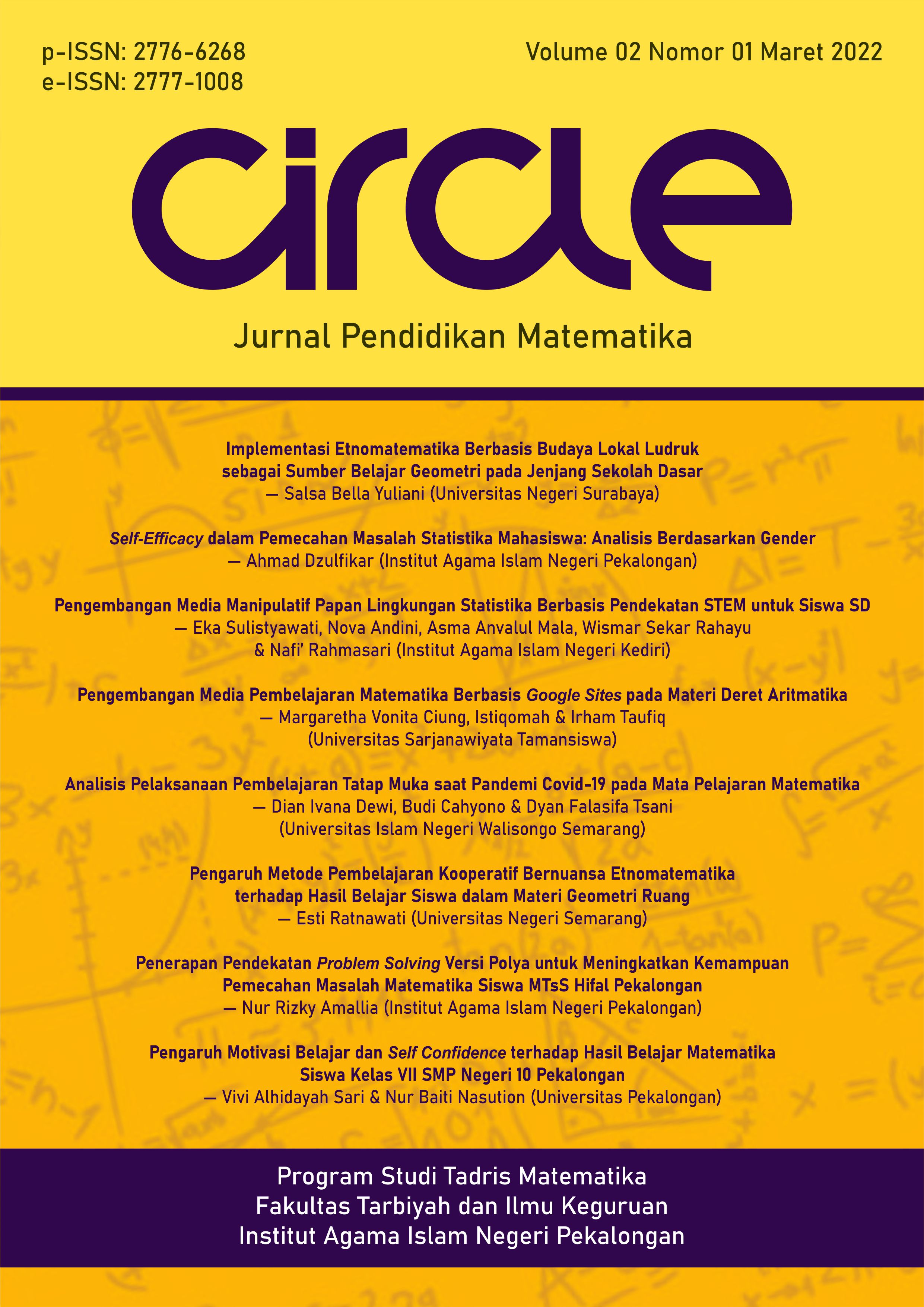
Self-Efficacy dalam Pemecahan Masalah Statistika Mahasiswa: Analisis Berdasarkan Gender
DOI:
https://doi.org/10.28918/circle.v2i01.5139Abstract
Self-efficacy is an interesting study for researchers because it has been successfully to explain and predict various individual domains in the various academic settings. The results of previous studies show that self-efficacy has a positive impact on a person's statistics performance. However, the results of previous studies showed inconsistent results regarding the contribution of gender to a person's statistics self-efficacy. Therefore, this study analyzed the level of college students’ statistics self-efficacy and the contribution of gender to their self-efficacy in statistical problem solving. In this research, a quantitative descriptive study was conducted using a survey method. The sample in this study was 167 college students who will take the statistical problem solving test at a public university in Central Java which were selected by simple random sampling. The statistics self-efficacy scale that has been tested is valid and reliable as an instrument in this study. This study found that in general the students’ self-efficacy in statistical problem solving, both overall and in terms of dimensions was at a moderate level. Another finding is that there is no difference in students’ self-efficacy in statistical problem solving based on gender. Future research is expected to examine the level of student self-efficacy based on other variables, such as previous knowledge, age, education level, and others.
Keywords:
References
Downloads
Published
License
Copyright (c) 2022 Ahmad Dzulfikar

This work is licensed under a Creative Commons Attribution-ShareAlike 4.0 International License.