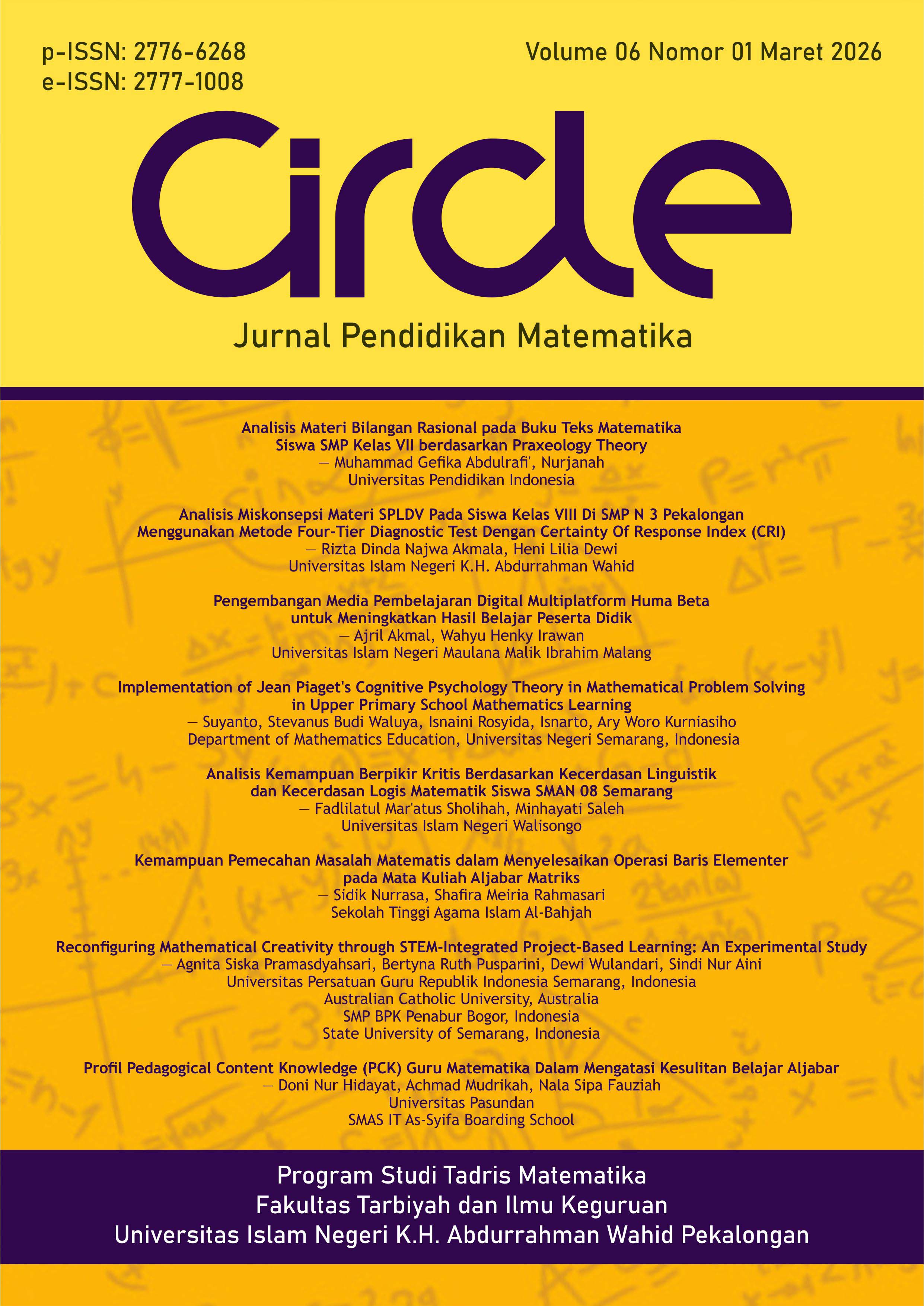
Piaget's Cognitive Theory in Upper Primary School Students' Mathematical Problem Solving: A Literature Review
DOI:
https://doi.org/10.28918/circle.v6i1.2605Abstract
Mathematical problem-solving ability are one of the key competencies in mathematics education and a major requirement of the global curriculum. Mathematical problem-solving ability are one of the key competencies in mathematics education and a major requirement of the global curriculum. This study aims to systematically examine the implementation of Jean Piaget's cognitive development theory in mathematical problem solving in upper primary school mathematics learning. The method used was a literature review of articles published between 2020 and 2025 through the Google Scholar, Scopus, and ScienceDirect databases. The search and selection process was carried out through stages of identification, screening, and feasibility assessment based on predetermined inclusion and exclusion criteria, resulting in 19 articles that were analysed using descriptive qualitative methods. The synthesis results show four main findings. First, the characteristics of the concrete operational stage are an important foundation in designing mathematics problem-solving learning. Secondly, the processes of assimilation and accommodation in Piaget's theory play a role in helping students construct conceptual understanding through the use of concrete and semi-concrete representations. Third, innovative learning approaches such as Problem-Based Learning and the use of manipulatives are effective in developing students' problem-solving strategies. Fourth, the implementation of Piaget's theory had a positive impact on learning engagement, logical thinking skills, and the quality of mathematics learning. The main contribution of this study is to present a conceptual synthesis that integrates Piaget's stages of cognitive development with mathematical problem-solving processes, as well as emphasising the importance of aligning learning designs with the cognitive characteristics of upper primary school students. These findings provide a theoretical basis for the development of more contextual, exploratory, and student-centred mathematics learning.
Keywords:
References
Agustyaningrum, N., Pradanti, P., & Yuliana, Y. (2022). Teori perkembangan Piaget dan Vygotsky : Bagaimana implikasinya dalam pembelajaran matematika sekolah dasar? Jurnal Absis: Jurnal Pendidikan Matematika Dan Matematika, 5(1), 568–582. https://doi.org/10.30606/absis.v5i1.1440
Anggraita, R. L., Masruroh, U., Listiyani, L., Widyasari, C., & Ernawati, E. (2024). Implementasi teori perkembangan kognitif Jean Piaget dalam pembelajaran matematika di sekolah dasar. Jurnal Pengembangan Dan Penelitian Pendidikan, 06(3), 67–76.
Anjoon, A., & Paul, P. K. (2024). In search of learning problems of students in context of psychology : An analysis of Vygotsky’s social development theory. SSRJournalof Arts, Humanities and Social Sciences (SSRJAHSS), 1(2), 95–101.
Fahma, M. A., & Purwaningrum, J. P. (2021). Teori Piaget dalam pembelajaran matematika. MUST: Journal of Mathematics Education, Science and Technology, 6(1), 31–42. https://doi.org/10.30651/must.v6i1.6966
Fauziah, R. R., & Safari, Y. (2025). Penerapan belajar matematika pada siswa SD dengan teori perkembangan Jean Piaget. Karimah Tauhid, 4(2), 1222–1230.
Herold-Blasius, R. (2024). The role of strategy keys in enhancing heuristics and self-regulation in mathematical problem-solving : A qualitative , explorative , and type-building study with primary school students. Investigations in Mathematics Learning, 1–20. https://doi.org/10.1080/19477503.2024.2430135
Jannah, A., Usriyah, L., & Mu’alimin, M. (2020). Implikasi teori psikologi perkembangan Jean Piaget untuk peserta didik sekolah dasar pada pembelajaran matematika. AKSELERASI: Jurnal Pendidikan Guru MI, 1(2), 156–166.
Kaitera, S., & Harmoinen, S. (2022). Developing mathematical problem-solving skills in primary school by using visual representations on heuristics. Lumat, 10(2), 111–146. https://doi.org/10.31129/LUMAT.10.2.1696
Maiyah, I. N., Pratiwi, Y. N., Oktavia, L., Saputra, D. B., & Utami, R. (2023). Implemantasi Teori Piaget Menggunakan Puzzle Pada Materi Pecahan Kelas V Sekolah Dasar. Jurnal Pengabdian Indonesia, 1(1), 32–37. https://doi.org/10.47134/jpi.v1i1.2088
Mcleod, S. (2024). Piaget’s theory and stages of cognitive development. Simply Psychology. https://doi.org/10.5281/zenodo.15241970
Midgett, C. W., & Eddins, S. K. (2001). NCTM’s Principles and Standards for School Mathematics: Implications for Administrators. NASSP Bulletin, 85(623), 35–42. https://doi.org/10.1177/019263650108562305
Omar, M. S. R., Raiyan, A. S. H., Shanaa, H. A. A., & Aboushi, M. “Mohammad J. (2024). The effectiveness of mathematical modeling in developing problem solving skills and eelf-efficacy in mathematics among sixth grade in Palestine. Pakistan Journal of Life and Social Sciences, 22(2), 7793–7808. https://doi.org/10.57239/PJLSS-2024-22.2.00587
Ozkale, A., & Aprea, C. (2023). Designing mathematical tasks to enhance financial literacy among children in grades 1–8. International Journal of Mathematical Education in Science and Technology, 54(3), 433–450. https://doi.org/10.1080/0020739X.2022.2157342
Pehkonen, E., Naveri, L., & Laine, A. (2023). On teaching problem solving in school mathematics. CEPS Journal, 3(4), 9–23. https://doi.org/10.25656/01
Putri, S. R., Fitriana, L., & Kusmayadi, T. A. (2024). Students ’ thinking process in solving Pythagoras problems : Piaget ’ s theory in adversity quotient. Journal of Educational Management and Instruction, 4(2), 295–306. https://doi.org/10.22515/jemin.v4i2.9692
Susanti, V. D., Krisdiana, I., & Adamura, F. (2020). Students’ mathematical critical thinking reviewed from self-regulated learning. Journal of Physics: Conference Series, 1613(1), 012008. https://doi.org/10.1088/1742-6596/1613/1/012008
Suyanto, S. (2023). Analisis pengaruh tingkat kecemasan dan konsistensi belajar terhadap prestasi belajar matematika siswa kelas X SMA Islam Sinar Cendekia Kota Tangerang. Journal on Education, 5(4), 17823–17834.
Umar Sa’ad, T., Adamu, A., & M. Sadiq, A. (2014). The causes of poor performance in mathematics among public senior secondary school students in Azare Metropolis of Bauchi State, Nigeria. IOSR Journal of Research & Method in Education (IOSRJRME), 4(6), 32–40. https://doi.org/10.9790/7388-04633240
Zhou, M., & Brown, D. (2015). Educational learning theories: (2nd Edition). In Education Open Textbooks. https://oer.galileo.usg.edu/education-textbooks/1
Downloads
Published
License
Copyright (c) 2026 Suyanto Suyanto, Stevanus Budi Waluya, Isnaini Rosyida, Isnarto Isnarto, Ary Woro Kurniasih

This work is licensed under a Creative Commons Attribution-ShareAlike 4.0 International License.