

| ..:: ADDITIONAL MENU ::.. |
| Editorial Team |
| Reviewer |
| Publication Ethics |
| Focus and Scope |
| Author Guideline |
| Peer Review Process |
| Template |
| Publication Fee |
| Copyright Notice |
| Open Access Policy |



The Asian Journal of Law and Humanity (AJLH) Volume 6, Number 1, 2026, presents various studies that examine the dynamics of the relationship between law, humanity, and social justice in the context of Indonesian society. This edition specifically highlights issues of family law, legal pluralism, group protection, and social practices that develop in the lives of vulnerable communities.
This issue presents a collection of contemporary legal studies addressing strategic governance, social protection, inclusive democracy, Islamic family law, public rights, and the relationship between law and humanity. The six articles demonstrate that law is not merely a normative instrument but also closely connected to social, political, institutional, and humanitarian realities.
The first article examines the strategic governance of health services in Pekalongan Regency, focusing on social security protection for underprivileged communities through a socio-legal approach. It highlights the relationship between government policies, access to healthcare, and the fulfillment of citizens’ social rights.
The second article discusses lifetime pensions for parliamentarians from a socio-legal and humanitarian perspective. The study critically examines the policy by considering principles of justice, fairness, public welfare, and the broader public interest.
The third article explores inclusive democracy and the political rights of people with intellectual disabilities in Indonesia. It emphasizes the importance of ensuring equal political rights and democratic participation for vulnerable groups as an essential component of the rule of law and democratic governance.
The fourth article examines the Jujuran tradition in Banjar marriages through symbolic deconstruction and Islamic law analysis. The study highlights the interaction between local traditions, social meanings, and Islamic legal principles in marriage practices.
The fifth article focuses on health-service governance and social security for underprivileged communities in Pekalongan Regency. It contributes to the broader discussion of social policy, public service accessibility, and the state's responsibility to fulfill fundamental social rights.
The sixth article addresses the disharmony between police discretion and the right to demonstrate. Through a socio-legal and humanitarian perspective, the study examines the balance between police authority to maintain public order and the protection of the freedom of peaceful expression and assembly.
Overall, this issue provides a multidimensional perspective on contemporary legal problems. By bringing together socio-legal, Islamic legal, political, governance, and humanitarian approaches, the articles contribute to academic discussions on justice, human rights, democracy, public governance, and the protection of vulnerable groups. This issue is expected to provide valuable insights for scholars, legal practitioners, policymakers, and researchers interested in the development of law and its role in addressing complex social challenges.
The Asian Journal of Law and Humanity (AJLH) Volume 5, Number 2, 2025, presents various studies that examine the dynamics of the relationship between law, humanity, and social justice in the context of Indonesian society. This edition specifically highlights issues of family law, legal pluralism, group protection, and social practices that develop in the lives of vulnerable communities.
The first article examines the rights and obligations of husbands towards wives with mental disorders through a socio-legal approach based on gender justice in Jenggot Village, Pekalongan. This study provides an important perspective on how law, social values, and principles of gender justice interact to guarantee the rights of women in vulnerable situations.
The second article examines legal pluralism in the Tuesday Wage wedding tradition in the Donowangun community using the perspective of *'urf* in Islamic law. This research demonstrates how state law, Islamic law, and customary norms intertwine in shaping social practices that exist and develop in the community.
This article examines the granting of rights and obligations to husbands and wives in a fishing family. Through an empirical approach, this article uncovers the socio-economic challenges that affect family relationships and the implementation of rights and obligations within households in coastal communities.
Furthermore, the fourth article examines advocacy for the iddah (waiting period) for vulnerable women through the role of the Pemalang Justice Perisai Legal Aid Institute. This study highlights the importance of access to justice, the law, and the protection of women's rights after divorce as part of efforts to achieve substantive justice.
Overall, this edition demonstrates how law operates within complex and diverse social realities. The various articles presented not only enhance the body of legal and humanitarian scholarship but also offer critical reflections on efforts to achieve justice, protect human rights, and empower vulnerable groups within communities. AJLH Volume 5 Number 2 of 2025 is expected to be a beneficial academic contribution for researchers, legal practitioners, policymakers, and the wider community concerned with legal and humanitarian issues.
The Asian Journal of Law and Humanity (AJLH) Volume 5, Number 1, 2025, presents six articles exploring various strategic issues at the intersection of law, justice, human rights, and humanity in the Indonesian context. This edition presents critical studies that not only examine the development of positive law but also examine how law interacts with social and cultural values, and the rights of vulnerable groups in society.
The first article examines aspects of justice and ethics in mining policy, particularly regarding the inconsistency in the regulations regarding the granting of mining concessions to religious organizations. This study offers a critical reflection on the direction of natural resource policy and its implications for the principles of social justice and good governance.
The second article examines legal policies regarding the recognition of indigenous peoples' rights in the Draft Law on Indigenous Peoples. This research highlights the urgency of strengthening legal protection for indigenous peoples as part of recognizing diversity, cultural identity, and the constitutional rights of citizens.
The third article examines the practice of voting through the Noken System in Papua, placing the perspective of customary justice and human dignity as the analytical framework. This study demonstrates how local democracy and the values of indigenous wisdom can be understood within the framework of political rights and legal pluralism.
Next, the fourth article discusses the constitutionality of legal protection for people with mental disorders in Indonesia. It examines the extent to which constitutional guarantees and national regulations are able to provide effective protection for the rights of groups vulnerable to discrimination and marginalization.
The fifth article examines the relationship between informal debt and gender-based violence through the practice of forced transactional marriage in Central Java. This research demonstrates how economic factors can intertwine with gender power relations and produce forms of social vulnerability that require legal and public policy attention.
Concluding, the sixth article explores the legal arguments of gender activists against the rejection of criminal sanctions for perpetrators of domestic rape, as reflected in the 2015 Indonesian Ulema Council (MUI) Fatwa. This study enriches the discourse on the protection of victims of sexual violence, women's rights, and legal developments with a gender justice perspective.
Overall, AJLH Volume 5 Number 1 of 2025 affirms its commitment as an academic space that encourages critical dialogue on law and humanity. The articles in this edition offer multidisciplinary perspectives on contemporary issues related to social justice, human rights, indigenous peoples, natural resource governance, democracy, and the protection of vulnerable groups. It is hoped that this publication will make a significant contribution to the development of legal science and serve as a reference for academics, practitioners, policymakers, and the wider public.
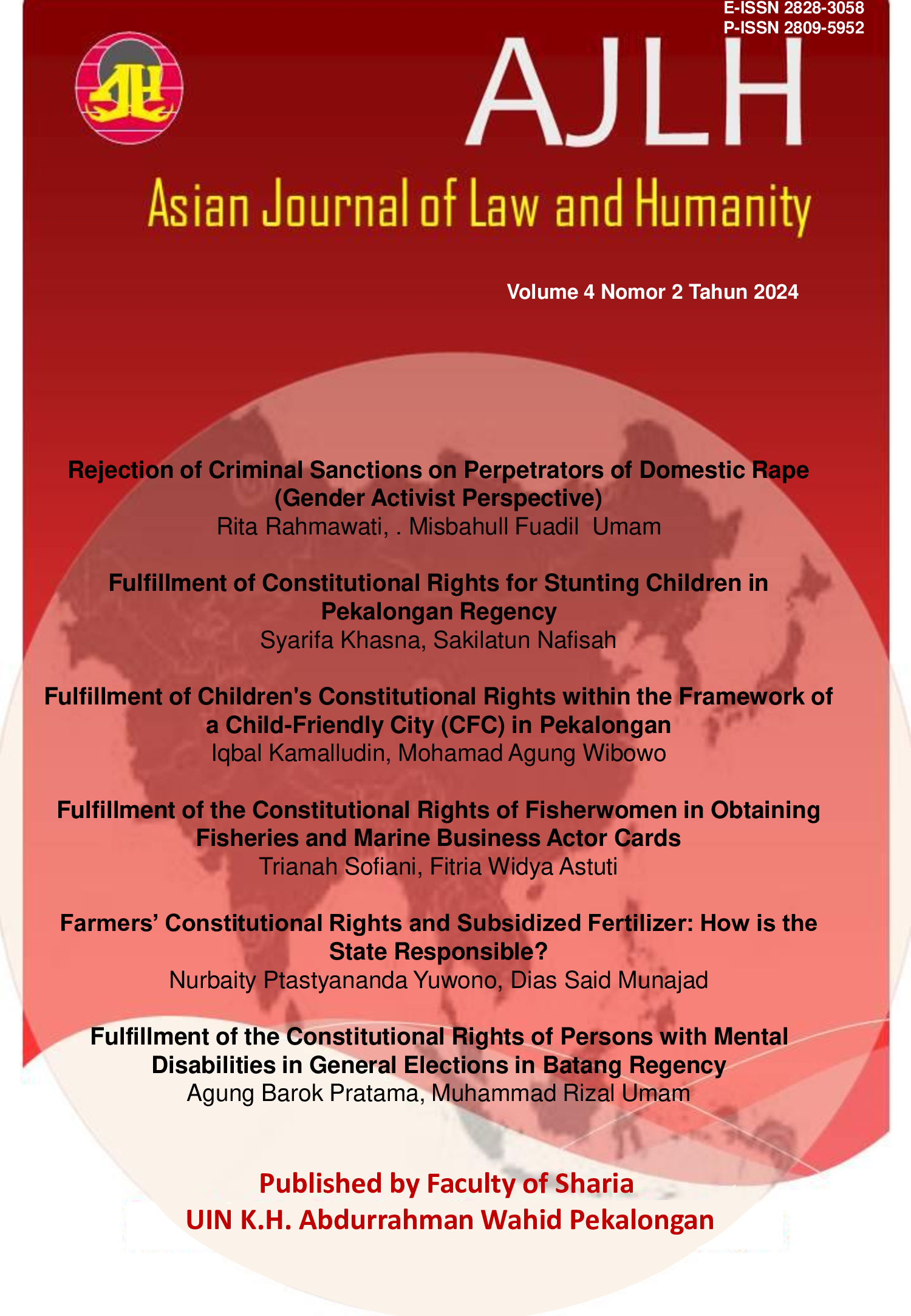
**Edition Description**
The Asian Journal of Law and Humanity (AJLH) Volume 4, Number 2, 2024, addresses the overarching theme of fulfilling citizens' constitutional rights, particularly those of vulnerable groups who often face various obstacles in obtaining equal protection and services. This edition presents six articles highlighting the implementation of constitutional rights in various sectors of life, from politics and health to child protection and women's empowerment, to the welfare of farmers and fishermen.
The first article examines the rejection of criminal sanctions for perpetrators of domestic rape from the perspective of gender activists. This study critiques various views that have the potential to weaken the protection of victims of sexual violence in the domestic sphere and emphasizes the importance of a legal approach oriented toward gender justice and human rights.
The second article examines the fulfillment of the constitutional rights of persons with mental disabilities in the general elections in Batang Regency. This research highlights the challenges and efforts made to ensure inclusive political participation as part of the constitutionally guaranteed rights of citizens.
The third article highlights the fulfillment of the constitutional rights of stunted children in Pekalongan Regency. This study confirms that stunting is not solely a health issue but is also closely related to the state's responsibility to guarantee children's rights to optimal growth and development.
Next, the fourth article discusses the fulfillment of children's constitutional rights within the Child-Friendly City (KLA) framework in Pekalongan City. This research evaluates the implementation of policies aimed at creating a safe, inclusive, and supportive environment for the growth and development of children as the nation's next generation.
The fifth article addresses the issue of fulfilling the constitutional rights of fisherwomen to obtain a Marine and Fisheries Business Actor Card. This study demonstrates the importance of state recognition of women's role in the fisheries sector and the need for equal access to various facilities and economic empowerment programs.
The final article discusses farmers' constitutional rights regarding access to subsidized fertilizer and the state's responsibility to ensure its availability. This article examines the relationship between subsidy policies, food security, and the protection of the economic rights of communities dependent on the agricultural sector for their livelihoods.
Overall, AJLH Volume 4 Number 2 of 2024 demonstrates that the fulfillment of constitutional rights is not only related to normative legal aspects but also requires the presence of the state in ensuring social justice for all citizens. Various articles in this edition offer critical perspectives on how law and public policy can serve as instruments for protecting, empowering, and advancing the rights of vulnerable groups. Through these studies, this edition is expected to contribute to the development of legal science, the formulation of more inclusive policies, and the strengthening of humanitarian values and justice in national life.
The Asian Journal of Law and Humanity (AJLH), Volume 4, Number 2, 2024, addresses the overarching theme of fulfilling citizens' constitutional rights, particularly those of vulnerable groups who often face various obstacles in obtaining equal protection and services. This edition presents six articles highlighting the implementation of constitutional rights in various sectors of life, from politics and health to child protection and women's empowerment to the welfare of farmers and fishermen.
The first article examines the rejection of criminal sanctions for perpetrators of domestic rape from the perspective of gender activists. This study critiques various perspectives that have the potential to weaken the protection of victims of sexual violence in the domestic sphere and emphasizes the importance of a legal approach oriented toward gender justice and human rights.
The second article examines the fulfillment of the constitutional rights of persons with mental disabilities in the general elections in Batang Regency. This research highlights both the challenges and efforts made to ensure inclusive political participation as part of the constitutionally guaranteed rights of citizens.
The third article highlights the fulfillment of the constitutional rights of stunted children in Pekalongan Regency. This study emphasizes that stunting is not only a health issue but is also closely related to the state's responsibility to guarantee children's right to optimal growth and development.
Next, the fourth article discusses the fulfillment of children's constitutional rights within the Child-Friendly City (KLA) framework in Pekalongan City. This research evaluates the implementation of policies aimed at creating a safe, inclusive environment that supports the growth and development of children as the nation's next generation.
The fifth article addresses the issue of fulfilling the constitutional rights of fisherwomen to obtain Marine and Fisheries Business Actor Cards. This study demonstrates the importance of state recognition of women's role in the fisheries sector and the need for equal access to various facilities and economic empowerment programs.
The final article discusses farmers' constitutional rights regarding access to subsidized fertilizer and the state's responsibility to ensure its availability. This article examines the relationship between subsidy policies, food security, and the protection of the economic rights of communities dependent on the agricultural sector for their livelihoods.
Overall, AJLH Volume 4 Number 2 of 2024 demonstrates that the fulfillment of constitutional rights is not only related to normative legal aspects but also requires the presence of the state in ensuring social justice for all citizens. The various articles in this edition offer critical perspectives on how law and public policy can function as instruments for the protection, empowerment, and advancement of the rights of vulnerable groups. Through these studies, this edition is expected to contribute to the development of legal science, the formulation of more inclusive policies, and the strengthening of humanitarian values and justice in the life of the nation and state.