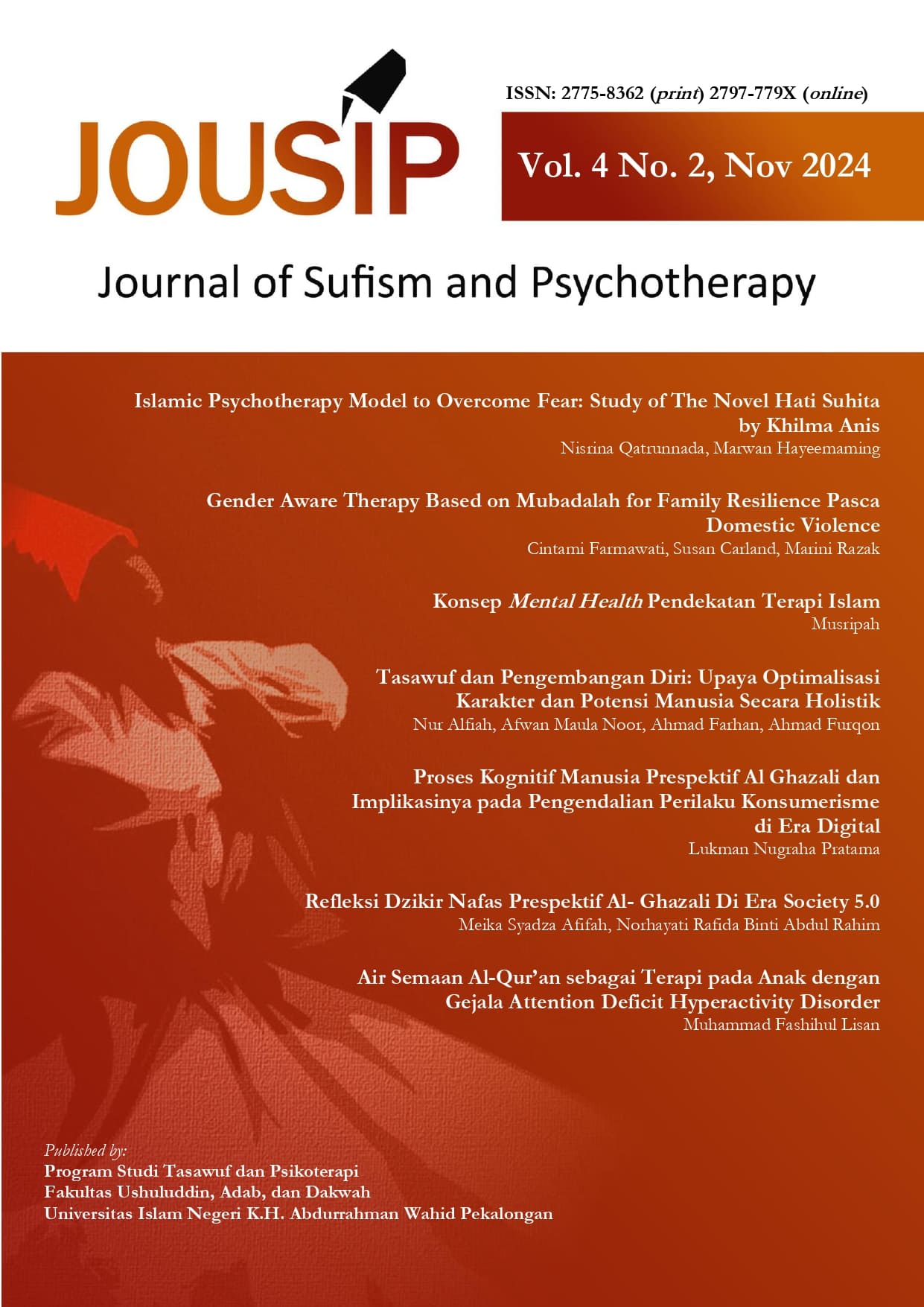
Refleksi Zikir Nafas Perspektif Al-Ghazali di Era Society 5.0
DOI:
https://doi.org/10.28918/jousip.v4i2.9799Abstract
Modern life today has the potential to make people lose the meaning of life because of the various demands of life that continue to develop rapidly. One effort to rediscover the meaning of life for a Muslim is to remember God again by doing dhikr. Breath dhikr is one of the spiritual practices that emphasizes the regulation and awareness of breathing in order to get closer to Allah SWT. According to Al-Ghazali, this dhikr is not just a repetition of words or sentences, but involves a deep appreciation of the greatness of Allah, which should be absorbed into every inhalation and exhalation. This study aims to see the relevance of breath dhikr in the lives of modern society today. This study uses a qualitative descriptive approach through library research whose data sources are obtained from books, notes, literature which in the writing system can be used to study or research an object. The results of this study indicate that with breath dhikr, a person can achieve inner peace and protect the heart from worldly thoughts. The practice of breath dhikr is in line with the needs of today's humans for mindfulness and meditation as a means of achieving balance between the material and spiritual worlds. In addition to providing peace of mind, breathing dhikr can also improve focus, productivity, and quality of life holistically. Thus, Al-Ghazali's teachings on breathing dhikr still have strong relevance as a method of spiritual and mental development in facing the challenges of modern life.
Keywords:
References
Abdurrahman. (2007). Tasawuf Kontemporer antara Teks dan Konteks. Gema Insani.
Al-A’la Islami, Huyu. (2016). Konsep Tazkiyatun Nfas Dalam Kitab Ihya Ulumudin Karya Imam Al- Ghazali. Institut Agama Islam Negeri Salatiga.
Ainur Rofiq, & Sutopo. (2023). Tafakur Dan Dzikir Dalam Mencapai Ketenangan Hidup. Conseils : Jurnal Bimbingan Dan Konseling Islam, 3(1), 1–12. https://doi.org/10.55352/bki.v3i1.170
Al-Ghazali. (2003). Ringkasan Ihya Ulumudin. Gita Media.
Ardiansyah, M. (2012). Dan Psikoreligius Terhadap Tingkat Stress Pasien Pasca Perawatan Di Ruang Icu-Iccu. 43.
Beno, J., Silen, A. ., & Yanti, M. (2022). Zikir Prespektif Al- Quran (Studi Surah Al-Baqoroh). In Braz Dent J. (Vol. 33, Issue 1).
Hubbi, M. S. A. (2019). konsep dzikir menurut al- ghazali dalam konsep budha. h. 58.
Ismail, Ilyas. (2008). Esiklopedia Tasawuf Jilid 3. Angkasa.
Kaliongga, A., Iriani, A., & Mawardi, M. (2023). Reintegrasi dan Kontekstualisasi Kearifan Lokal Sintuwu Maroso: Upaya Menjawab Tantangan Pendidikan di Era Revolusi Industri 4.0 Menuju Society 5.0. Scholaria: Jurnal Pendidikan Dan Kebudayaan, 2, 117–127. https://doi.org/10.24246/j.js.2023.v13.i2.p117-127
Khotijah, S., & Khotijah, S. (2024). Pergulatan Sufi Melawan Tirani : Ratib Samman Sebagai Gerakan Kultural dan Perlawanan pada Abad 19 Keywords : Sufi struggle , Ratib Samman , 19th Century Cultural movement. 7(1), 15–22.
Kurniati, Z. (2018). Zikir sebagai terapi penyembuhan gangguan jiwa dalam perspektif Imam Al-Ghazali (Doctoral dissertation, UIN Raden Intan Lampung).
Mahmudi, I. (2019). Urgensi Perilaku Keagamaan Pada Era Society 5.0. Prosiding Seminar Nasional Bimbingan Dan Konseling, Vol. 3(No. 1), 8. http://prosiding.unipma.ac.id/index.php/SNBK/article/view/1371
Moleong, (1990). Metode Penelitian Kualitatif. Rineka Cipta.
Nastiti, F., & Abdu, A. (2020). Kajian: Kesiapan Pendidikan Indonesia Menghadapi Era Society 5.0. Edcomtech Jurnal Kajian Teknologi Pendidikan, 5(1), 61–66. https://doi.org/10.17977/um039v5i12020p061
Purwanto, Setyo. (2012). Buku Zikir Nafas. Pustaka Hidayah.
Qomarudin. (2002). Zikir Sufi Menghampiri Ilahi Lewat Tasawuf. Serambi.
Riwayat, A., & Al-Ghazali, H. (2023). Bab Ii Biografi Al-Ghazali. 14–24. https://repo.iain-tulungagung.ac.id/13848/5/BAB II.pdf
Rosyad, R. (2021). Pengantar Psikologi Agama dalam Konteks Terapi. http://digilib.uinsgd.ac.id/46118/
Soleha, U., Diniati, R., & Sofiani, I. K. (2024). Membangun Pendidikan Berbasis Etika: Perspektif Al-Ghazali. HEMAT: Journal of Humanities Education Management Accounting and Transportation, 1(2), 791–798. https://doi.org/10.57235/hemat.v1i2.2829
Sukadiyanto, S. (2010). Stress Dan Cara Menguranginya. Jurnal Cakrawala Pendidikan, 1(1), 55–66. https://doi.org/10.21831/cp.v1i1.218
Syafudin, Nur. (2018). Konsep Tazkiyatun Nafs Prespektif Al-Ghzali Dalam Pendiikan Ahkalak. Institut Agama Islam Negeri Metro.
Yusuf, R. N., & Nurleli. (2018). Hubungan Status Gizi Dengan Kejadian Tb Paru. Jurnal Kesehatan Saintika Meditory Jurnal Kesehatan Saintika Meditory, 1(1), 35–44.
Zahri, Mustafa. (1993). Kunci Memahami Ilmu Tasawuf. Bina Ilmu.
Downloads
Published
Article Statistics
Issue
Section
License
Copyright (c) 2024 Meika Syadza Afifah, Norhayati Rafida Binti Abdul Rahim

This work is licensed under a Creative Commons Attribution-ShareAlike 4.0 International License.