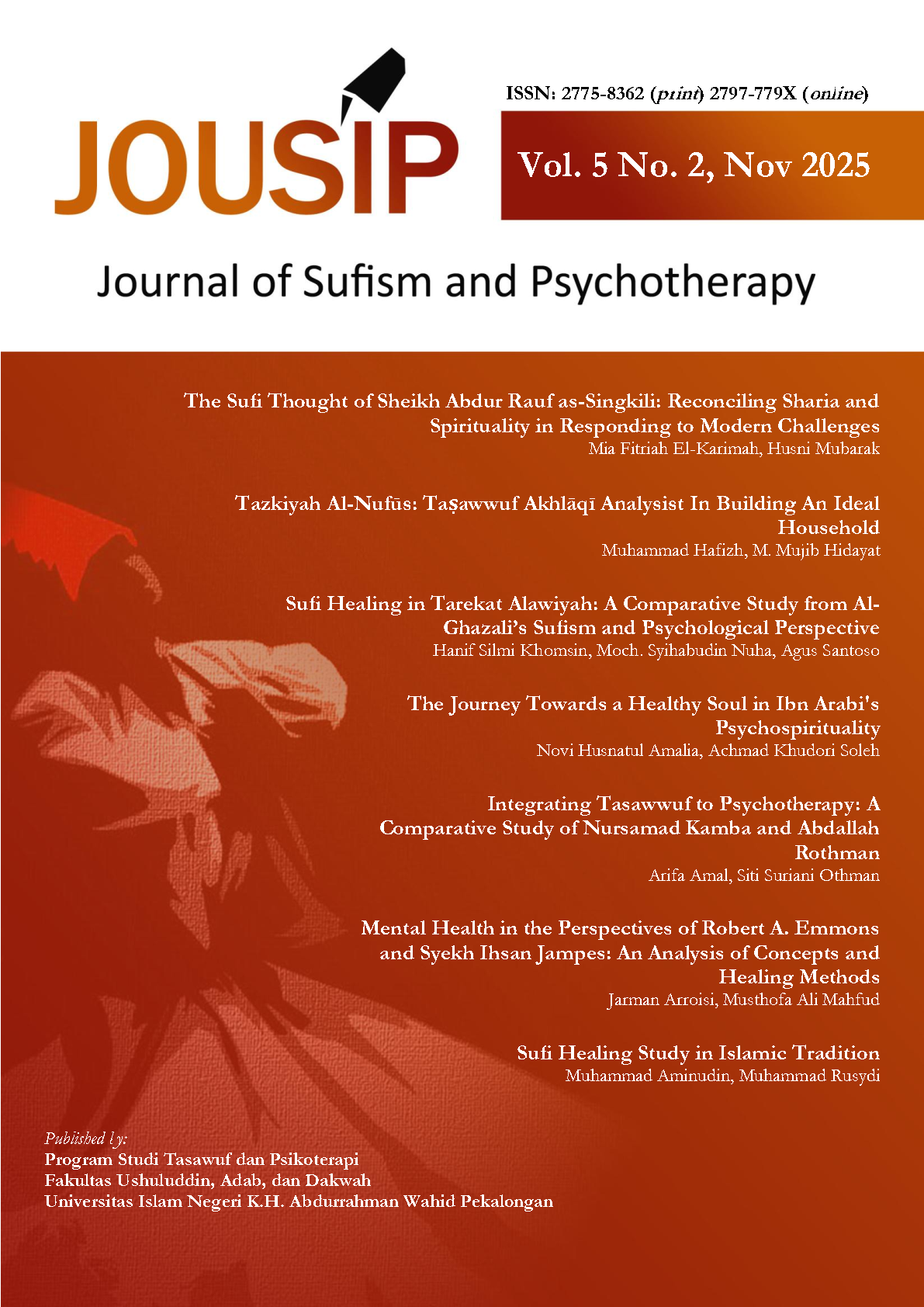
Sufi Healing in Tarekat Alawiyah
A Comparative Study from Al-Ghazali’s Sufism and Psychological Perspective
DOI:
https://doi.org/10.28918/jousip.v5i2.11966Abstract
Happiness is the goal of life that everyone desires. Happy people can be careful in their decision-making, actions, and efforts to achieve happiness itself. Tarekat is a spiritual organization with specific methods as a form of practicing Sufism teachings that have a healing dimension. The Sufi healing dimension in this tarekat focuses on healing the soul so that Sufi practitioners can improve their mental well-being through the teachings of zuhud, tawakal, khauf, and mahabbah. The purpose of this study is to examine the dimension of Sufi healing in the teachings of the Alawiyah Order based on Al-Ghazali's Sufi perspective. This study uses a literature review approach by collecting various literature through searches based on relevant discussions in research, ranging from books to articles; literature processing; filtering; combining and drawing relevant conclusions. This research shows that conceptually produces a psychological concept that connects the basic principles of the teachings of the Alawiyah Tarekat and the framework of Al-Ghazali's Sufism with the path of Sufi healing in the modern era. Modern psychological and scientific concepts that have been developed include preventing distorted thinking that causes stress, righteous deeds driven by increased productivity and happiness, motivation for self-improvement and repentance, generating positive energy, and being able to make wise decisions through self-awareness.
Keywords:
References
Abidin, Z., & Sirojuddin, A. (2024). Developing Spiritual Intelligence Through The Internalization of Sufistic Values: Learning From Pesantren Education. Tafkir: Interdisciplinary Journal of Islamic Education, 5(2), 331–343. https://doi.org/10.31538/tijie.v5i2.783
Ahmad, K. B., & Huda, D. M. S. (2023). The Role of Reading the Al-Quran on Peace of Mind. FOCUS, 4(1), 39–44. https://doi.org/10.26593/focus.v4i1.6487
al-Jauziyah, I. Q. (1999). Madarij as-Sālikīn (Pendakian Menuju Allah) penjabaran Kongkrit Iyyāka Na’budu wa Iyyāka Nasta’īn. Pustaka al-Kautsar.
Alaudin, F. (2023). Peran Tarekat Alawiyyah dalam Menghadapi Krisis Spiritual di Kalangan Masyarakat Modern. Jurnal Penelitian Ilmu Ushuluddin, 3(1), 1–20. https://doi.org/10.15575/jpiu.17583
Alfain, S. N. I., Soleh, A. K., & Yamani, M. R. (2023). The Role of Patience in Coping Mental Problems: A Quranic Perspective. Tribakti: Jurnal Pemikiran Keislaman, 34(2), 195–212. https://doi.org/10.33367/tribakti.v34i2.3633
Al-Ghazali, A. H. M. (2021). Mukhtasar Ihya’ ’Ulum al-Din (Al-Tab’ah Al-Thaniyah). Dar al-Kutub al-Ilmiyah.
Al-Simth, Z. bin I. (2017). Al-Manhaj Al-Sawi Sharh Usul Tariqat Al-Sadah Al Ba’alawi (Al-Tab’ah Al-Thaniyah, Vol. 1). Dar Al-Fath Li Al-Dirasat wa Al-Nashr.
Amalia, L. N., & Saifuddin, A. (2022). Tawakal and Academic Stress in Assignment Completion of University Students. Gadjah Mada Journal of Psychology (GamaJoP), 8(2), 203. https://doi.org/10.22146/gamajop.75621
Amin, S. J., & Astuti, A. R. T. (2022). The Business of Followers: Study of The Khalwatiyah Samman Congregation in Kulo. Dinasti International Journal of Education Management And Social Science, 3(2), 257–276. https://doi.org/10.31933/dijemss.v3i2.1070
Aminullah Poya & Habiburrahman Rizapoor. (2023). Al-Ghazali’s Theory of Real Knowledge: An Exploration of Knowledge Integration in Islamic Epistemology through Contemporary Perspectives. International Journal Of Humanities Education and Social Sciences (IJHESS), 3(2). https://doi.org/10.55227/ijhess.v3i2.627
Amy, N., Adam, S., & Wijoyo, S. (2020). The Concept of Akhlaqul Karimahas A Basic Principle of Character Building in West Nusa Tenggara Indonesia. PalArch’s Journal of Archaeology of Egypt / Egyptology, 17(6).
Antika, M. W., Wijaya, & Handiki, Y. R. P. (2024). Self Healing Dalam Tasawuf Perspektif Imam Al-Ghazali Dalam Kitab Minhajul Abidin. Jurnal Kajian Islam Dan Sosial Keagamaan, 1(4), 383–389. https://jurnal.ittc.web.id/index.php/jkis/article/view/1100
Artika, L., Rabbani, M. Y., Nafis, M. R. R., Siregar, N., & Gusnanda, I. (2023). Biografi Tokoh Tasawuf Al-Ghazali. Jurnal Kajian Penelitian Pendidikan Dan Kebudayaan, 1(2), 29–55. https://jurnal.aksaraglobal.co.id/index.php/jkppk/article/view/108
Bagheri, S., Sharifi Rigi, Z., Paran, M., Ghaemmaghami, P., Hadian Shirazi, Z., & Ghobadimoghaddam, R. (2025). Impact of spiritual care program on self-efficacy and burden in mothers of children with leukemia. BMC Psychology, 13(1), 583. https://doi.org/10.1186/s40359-025-02908-5
Bang, A. K. (2003). Sufis and Scholars of the Sea: Family Networks in East Africa, 1860–1925. Routledge.
Bożek, A., Nowak, P. F., & Blukacz, M. (2020). The Relationship Between Spirituality, Health-Related Behavior, and Psychological Well-Being. Frontiers in Psychology, 11, 1997. https://doi.org/10.3389/fpsyg.2020.01997
Cetinkaya, M., & Billings, J. (2023). Systematic review of the relationship between Islamic-Sufi spirituality and practice and mental well-being. Mental Health, Religion & Culture, 26(10), 1065–1080. https://doi.org/10.1080/13674676.2023.2256265
Defriono, I., Zaini, S. K., Nawal, A. F., & Hidayat, A. M. (2023). Zuhd and Minimalism in a Consumerist Society: Exploring Al-Ghazali and Fumio Sasaki’s Thoughts. Peradaban Journal Religion and Society, 2(2). https://doi.org/10.59001/pjrs.%20v2i2.92
Fakhruddin, A., Suryadi, A., Hakam, K. A., & Nurdin, E. S. (2018). The Development of Learning Content of Islamic Religious Education (IRE) Courses on Environmental Conservation in Higher Education. IOP Conference Series: Earth and Environmental Science, 145, 012125. https://doi.org/10.1088/1755-1315/145/1/012125
Farid, F. (2024). The Concept of Religious Experience by Rudolf Otto: A Phenomenological Approach. Jurnal Filsafat, 34(2), 235. https://doi.org/10.22146/jf.92141
Fasya, A. ‘Aunillah. (2022). Konsep Tasawuf Menurut Imam Al-Ghazali. JOUSIP: Journal of Sufism and Psychotherapy, 2(2), 153–166. https://doi.org/10.28918/jousip.v2i2.6723
Fernández-Palleiro, P., Rivera-Baltanás, T., Rodrigues-Amorim, D., Fernández-Gil, S., Del Carmen Vallejo-Curto, M., Álvarez-Ariza, M., López, M., Rodriguez-Jamardo, C., Luis Benavente, J., De Las Heras, E., Manuel Olivares, J., & Spuch, C. (2020). Brainwaves Oscillations as a Potential Biomarker for Major Depression Disorder Risk. Clinical EEG and Neuroscience, 51(1), 3–9. https://doi.org/10.1177/1550059419876807
Fitriani, H., & Abdullah, Z. (2021). Relevansi Konsep Neurosains Spiritual Taufiq Pasiak terhadap Psikoterapi Sufistik. JOUSIP: Journal of Sufism and Psychotherapy, 1(2), 141–160. https://doi.org/10.28918/jousip.v1i2.4458
Głaz, S. (2023). Religious Experience as a Predictor of the Meaning in Life and Life Satisfaction in the Lives of Polish Women after a Stillbirth. Journal of Religion and Health, 62(2), 839–858. https://doi.org/10.1007/s10943-022-01698-z
Hafidz, H. U. bin. (2022). Ringkasan Ihya’ Ulumiddin Tentang Membersihkan Penyakit-penyakit Hati. Noura Books.
Hamisu, S., & Kumo, A. A. (2024). Upliftment of Spirituality and Its Impacts on The Life of Muslim. International Journal of Emerging Issues in Islamic Studies, 4(1), 41–53. https://doi.org/10.31098/ijeiis.v4i1.2386
Hanafi, M., Rahmatillah, A., Wiyono, N., & Mirawati, D. K. (2024). The effect of listening to Holy Quran recitation on stress among healthy adults: A non-blinded randomized controlled trial. Universa Medicina, 43(1), 61–68. https://doi.org/10.18051/UnivMed.2024.v43.61-68
Hardy, S. A., Nelson, J. M., Frandsen, S. B., Cazzell, A. R., & Goodman, M. A. (2022). Adolescent Religious Motivation: A Self-Determination Theory Approach. The International Journal for the Psychology of Religion, 32(1), 16–30. https://doi.org/10.1080/10508619.2020.1844968
Harlianty, R. A., Wilantika, R., Mukhlis, H., & Madila, L. (2022). The Role of Gratitude as a Moderator of the Relationship Between the Feeling of Sincerity (Narimo ing Pandum) and Psychological Well-Being Among the First Year University Students. Psychological Studies, 67(4), 560–567. https://doi.org/10.1007/s12646-022-00671-w
Haryanto, S., & Muslih, M. (2024). Integration of Sufism and Transpersonal Psychology. International Journal of Religion, 5(5), 1041–1047. https://doi.org/10.61707/gwf1q264
Hidayat, A., Azhar, M., Purnomo, H., Nugroho, S., Napitupulu, L., & Yusdanis, I. (2024). Predictors of Patience in Islamic Psychology: An Evidence from Indonesia. Islamic Guidance and Counseling Journal, 7(1). https://doi.org/10.25217/0020247447400
Husna, I., & Khodijah. (2024). Dimensi Spiritual dalam Psikoterapi:Dampak Praktik Sufi terhadap Kecemasan dan Depresi. DA’WA: Jurnal Bimbingan Penyuluhan & Konseling Islam, 4(1). https://doi.org/10.36420/bbxxm152
Jalili, I., & Ulfa, F. (2023). An Analysis of Al-Ghazali’s Thought on Happiness Through His Book: The Alchemy of Happiness. Psikis : Jurnal Psikologi Islami, 9(1), 30–39. https://doi.org/10.19109/psikis.v9i1.16263
James FW. (2018). Stupidity and Mental Illness: Normal and Abnormal (Normal Human Behavior as Maladaptive). International Journal of Public Health & Safety, 3(1).
Jarman Arroisi, Zarkasyi, H. F., Iwan Aminur Rokhman, & Fahrudin Mukhlis. (2023). Pursuit of Spiritual Happiness: Abu Hamid al-Ghazali on The Theory of Human Nature. Progresiva : Jurnal Pemikiran Dan Pendidikan Islam, 12(02), 291–306. https://doi.org/10.22219/progresiva.v12i02.29265
Kholifah, U. N., Dinata, K. I., & Al-Saffar, A. H. (2022). The Convergence of Tasawuf and Psychology in the Thought of Ibn Sina: A Literature Study. International Conference on Tradition and Religious Studies, 2(1).
Koycu, E., & Hidir, E. (2023). Ikhlas and Sincerity According to Verses and Hadiths. SCIENTIFIC WORK International Scientific Journal, 12(11), 8–18.
Mahpol, S., S.H.S, O., Aziz, T. M. F. T. A., Wahid, N. A., E, R., M.S., O., S.M.H, S. O., M.S, A., & Adam, F. (2018). The Implementation of Takhalli Value in Arabic Grammar according to Al-Qushayri in Na?w al-Qulub al-Kabir. International Journal of Academic Research in Business and Social Sciences, 7(12), Pages 558-564. https://doi.org/10.6007/IJARBSS/v7-i12/3637
Moeez, Z., Haider, D. M. F., & Tahseen, D. S. (2022). The Qur’ānic Terminologies “Fear” AND “Grief”; THEIR Exegetical, Mystical AND Psychological Interpretations. Journal of Positive School Psychology, 6(12).
Muhammad Ilham, Darraz, M. A., & Fatimah, A. (2024). Concepts of self-control and zuhud in character education: A perspective of stoicism and sufism. At Turots: Jurnal Pendidikan Islam, 6(1), 110–119. https://doi.org/10.51468/jpi.v6i1.668
Mukti, A., Drajat, A., & Mourssi Hassan Kahwash, M. A. (2021). Moral Education According to Ibn Miskawayh and Al-Ghazali. Jurnal Tarbiyah, 28(1), 56. https://doi.org/10.30829/tar.v28i1.972
Munir. (2018). Ajaran Tarekat Alawiyah Palembang dan Urgensinya dalam Konteks Kehidupan Kontemporer. Teosofi: Jurnal Tasawuf Dan Pemikiran Islam, 8(1). https://doi.org/10.15642/teosofi.2018.8.1.1-30
Mursalin, M. (2024). Pendekatan Tasawuf Dan Psikoterapi Perspektif Islam. CONS-IEDU, 4(1), 77–90. https://doi.org/10.51192/cons.v4i1.813
Mutohharoh, A. (2022). Self Healing: Terapi atau Rekreasi? JOUSIP: Journal Of Sufism and Psychotherapy, 2(1).
Naufanita, H. (2023). A Preliminary Quranic Review of Consciousness. Journal of Strategic and Global Studies, 6(1).
Novel bin Muhammad Alaydrus, H. (2018). Jalan Lurus Anak Cucu Nabi Thariqah Alawiyah. Taman Ilmu.
Nurzaman, M. R., Solahudin, D., & Fajar, D. A. (2024). The Concept of Tazkiyatunnafs in the Book of Ihya ’Ulumuddin and Its Implications in Sufistic Counseling. Syifa Al-Qulub: Jurnal Studi Psikoterapi Sufistik, 8(2). https://doi.org/10.15575/saq
Pratama, L. N. (2024). Proses Kognitif Manusia Prespektif Al Ghazali Dan Implikasinya Pada Pengendalian Perilaku Konsumenisme Di Era Digital. JOUSIP: Journal of Sufism and Psychotherapy, 4(2), 201–218. https://doi.org/10.28918/jousip.v4i2.9121
Rahman, F. N. (2014). Spiritual Healing and Sufi Practices. Nova Journal of Sufism and Spirituality, 2(1).
Rahmawati. (2014). Tarekat Dan Perkembanganya. Al-Munzir, 7(1). https://ejournal.iainkendari.ac.id/index.php/al-munzir/article/view/271/261
Rangkuti, M. R. (2022). Ajaran Tarekat Alawiyah Dan Kontribusi Habib Abdullah Alawi Al-Haddad. Bunayya: Jurnal Pendidikan Guru Madrasah Ibtidaiyah, 3(3), 248–261. https://jurnal.stit-al-ittihadiyahlabura.ac.id/index.php/bunayya/article/view/236
Ridho, A., Khatibi, A., Azam, F., Tham, J., Yusuf, E., & Alam, S. (2019). Maintaining the Value of Human Diversity through Implementing Thariqah Alawiyah. International Journal of Innovation, 7(4).
Rohmah, G. N. (2021). The Role of Tarekat in Awakening the Spirit of Nationalism (Study of the Thought and Movement of Habib Luthfi bin Yahya). JOUSIP: Journal of Sufism and Psychotherapy, 1(2), 127–140. https://doi.org/10.28918/jousip.v1i2.4831
Saepudin, A. (2020). Gerakan Sosial Keagamaan Thariqah ‘Alawiyyin. Tsaqofah: Jurnal Agama Dan Budaya, 18(1).
Soleh, A. K., Rahmawati, E. S., Camila, H. G. S., & Furqona, H. T. (2023). The Truth on Al-Ghazali Perspective. International Journal of Innovative Research in Multidisciplinary Education, 02(09). https://doi.org/10.58806/ijirme.2023.v2i9n10
Sumarti, H., Tasyakuranti, A. N., Zulfikah, P., & Edison, R. E. (2024). The Influence of Istighfar Dhikr on Brain Wave Activity: An EEG-Based Study on Anxiety Management. Multidisciplinary Science Journal, 6(11), 2024236. https://doi.org/10.31893/multiscience.2024236
Surur, A. M., Anfa’u, M., rosi, F., & Rohmain, M. A. F. (2024). Memudarnya Otoritas Keagamaan? (Polemik Nasab Habaib di Kalangan Pondok Pesantren Al-Nahdliyin. Asy-Syari`ah: Jurnal Hukum Islam, 10(1), 101–128. https://doi.org/10.55210/assyariah.v10i1.%201542ps
Thanh, B. X. (2023). Aristotle’s philosophy about happiness is the function of valuing human life. Aufklärung: Journal of Philosoph, 10(1), 53–64. https://doi.org/10.18012/arf.v10i1.67088
Tsarwah, V. A., Putri, R. A., Agusvina, N. N., Syahirah, V. G., & Ramadhan, M. A. I. (2024). The Effectiveness of Tawakkal Therapy in Reducing Future Anxiety in Students. Proceeding Conference on Psychology and Behavioral Sciences, 3(1).
Uddin, F., & Irshad, E. (2022). Sufism, Religiosity, Life Satisfaction, Hope and Optimism: A Comparative Study of the Disciples and Non-Disciples. International Journal of Psychological and Behavioural Research (IJPBR), 2(1), 1–18. https://doi.org/10.37605/ijpbr.v2i1.11
Wahid, A. A., Aziz, A., & Lestari, P. (2024). Tasawuf Di Era Modern: Tasawuf Sebagai Psikoterapi. BEST Journal (Biology Education, Sains and Technology), 7(2), 169–175. https://doi.org/10.30743/best.v7i2.9654
Walter, Y., & Koenig, T. (2023). The Induction of Religious Experiences and Temporal Lobe Activation: Neuronal Source Localization Using EEG Inverse Solutions. Psych, 5(4), 1191–1206. https://doi.org/10.3390/psych5040079
Yurnalis, S. A. F. H., Putri, E. W., & Arrasyid, A. (2022). Urban Sufism from Exclusiveness to Inclusiveness: A Metaphysical Perspective. Teosofia: Indonesian Journal of Islamic Mysticism, 11(2), 183–202. https://doi.org/10.21580/tos.v11i2.14522
Zahir, F. R., & Qoronfleh, M. W. (2025). Traditional Islamic spiritual meditative practices: Powerful psychotherapies for mental wellbeing. Frontiers in Psychology, 16, 1538865. https://doi.org/10.3389/fpsyg.2025.1538865
Zhang, K., Shi, J., Wang, F., & Ferrari, M. (2023). Wisdom: Meaning, structure, types, arguments, and future concerns. Current Psychology, 42(18), 15030–15051. https://doi.org/10.1007/s12144-022-02816-6
Downloads
Published
Article Statistics
Issue
Section
License
Copyright (c) 2025 Hanif Silmi Khomsin, Moch. Syihabudin Nuha, Agus Santoso

This work is licensed under a Creative Commons Attribution-ShareAlike 4.0 International License.