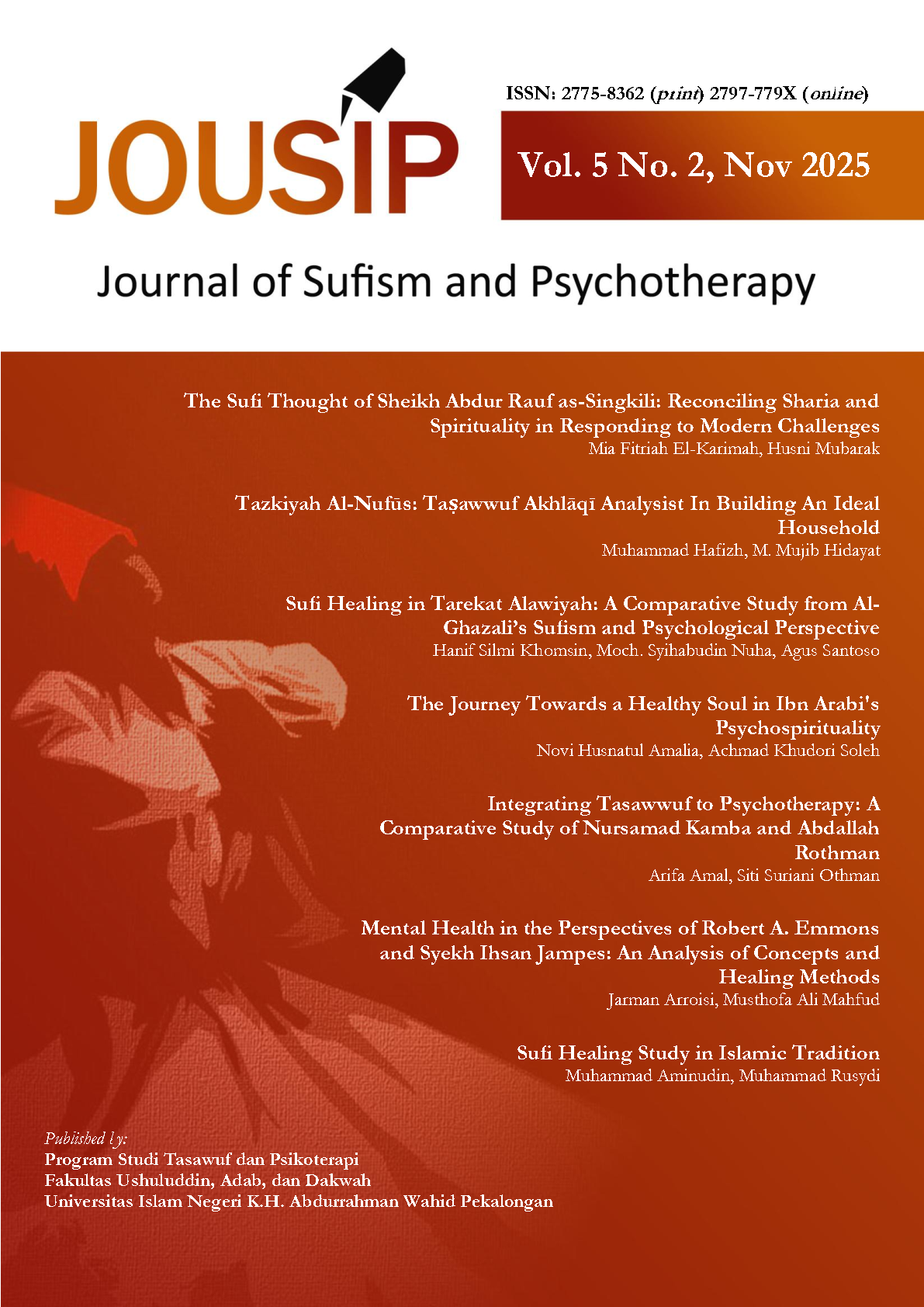
Sufi Healing Study in Islamic Tradition
DOI:
https://doi.org/10.28918/jousip.v5i2.11901Abstract
This study examines Sufi healing in Islamic tradition as a psycho-spiritual healing system rooted in the teachings of the Prophet Muhammad ﷺ, the practices of the Companions, and the intellectual–spiritual development of classical Sufism. The research aims to explain the concepts, historical foundations, principles, methods, and contemporary relevance of Sufi healing for modern individuals who experience stress, anxiety, and meaning crises. Using a descriptive qualitative method through library research, this study analyzes classical Sufi texts, works of Islamic medicine, scholarly journals, and contemporary books, supported by hermeneutic analysis and source triangulation. The findings reveal that Sufi healing originated from prophetic practices such as ruqyah, supplication, and balanced living, and was later systematized by figures such as Ibn Sina, al-Razi, and al-Ghazali into a holistic healing paradigm that views humans as a unity of body, soul, and spirit. Its core principles include bodily–spiritual balance, tazkiyat al-nafs, remembrance (dhikr) as spiritual energy therapy, supplication and ruqyah, as well as meditation and contemplation (tafakkur). These principles manifest in practical methods such as dhikr jahr and khafi, sama’, qawwali, herbal remedies, and spiritual energy transfer practiced within various Sufi orders, including Mevlevi, Chishti, Qadiriyya, Naqshbandiyya, Sammaniyya, and Alawiyya. In the modern era, Sufi healing contributes significantly to Islamic psychotherapy, Islamic mindfulness, and holistic medicine by offering a comprehensive model that integrates medical, psychological, and theological dimensions, fostering inner tranquility, mental well-being, and spiritual closeness to Allah.
References
Abdullah, S. (2014). Pemikiran Islam. Baitul Hikmah Press.
Aini, F. N. (2024). Sama’ sebagai meditasi dalam Tarekat Maulawiyah untuk mencapai Ma’rifat. Tesis, Digilib UIN Sunan Ampel Surabaya.
Alfian, A., Muh. Imran Herikusuma, Khairul Nisah, & Sulfiana Hasir. (2018). Tazkiyatun Nafs: Penyucian Jiwa dalam Tasawuf.
Al-Ghazali, A. H. M. (2011). Ihyā’ ’Ulūm al-Dīn. Dar Al-Minhaj.
Al-Hujwiri, A. H. A. (2015). Kasyful Mahjub (Buku Daras Tasawuf Tertua). MIZAN.
Aristianto, Y. (t.t.). Kamus Inggris-Indonesia. www.KamusBahasaInggris.com
Bahri, T. K., & Jannah, N. (2024). The concept of mindfulness in Islam. Journal of Islamic, Social, Economics and Development. https://www.researchgate.net/publication/381880284_The_concept_of_mindfulness_in_islam?
Bakar, A., & Prayogo, I. (2023). Urang Banjar dan Tarekat Sammaniyah di Banua Urang: Sebuah Penelusuran Awal di Serdang Bedagai, Sumatera Utara. Hikmah, 20(2), 345–359.
Bakri, S. (2019). Sufi Healing: Integrasi Tasawuf dan Psikologi dalam Penyembuhan Psikis dan Fisik. PT. Raja Grapindo Persada.
Birhasani, B. (2017). Metode Tarekat Qadiriyah Naqsyabandiyah dalam Penyembuhan Korban Adiksi Narkoba di Kota Banjarmasin Asuhan Drs. K.H. Syakerani Naseri. Tesis, Pascasarjana UIN Antasari.
Fakhry, M. (2004). A History of Islami Philosofy. Columbia University Press.
Farmawati, C. (2021). Penguatan Iman Pecandu Narkoba Melalui Psikoterapi Islam Berbasis Tradisi Sufisme. Al-Qalb: Jurnal Psikologi Islam, 12(2), 133-148.
Farmawati, C., Wiroko, E. P., & Sharip, H. (2022). Javanese indigenous healing for physical and mental health. JOUSIP: Journal of Sufism and Psychotherapy, 2(1), 17-32.
Gordon, J. S. (1982). Holistic Medicine: Advances and Shortcomings. HOLISTIC MEDICINE. https://pmc.ncbi.nlm.nih.gov/articles/PMC1273970/
Halima, S. B. (t.t.). Ruqyah Book.
Hawwa, S. S. (1998). Mensucikan Jiwa (Konsep Tazkiyatun Nafs Terpadu) Imam Al-Gazhali. Robbani Press.
Khalid, T. (2021). Semantics of Qawwali: Poetry, Perception, and Cultural Consumption. Journal of Development and Social Sciences, 2(IV).
Khoiriyah, S. (2023). Ruqyah Sebagai Metode Sufi Healing. Al Qalam: Jurnal Ilmiah Keagamaan dan Kemasyarakatan, 16(6), 2507.
Khomsin, H. S., Nuha, M. S., & Santoso, A. (2025). Sufi Healing in TarekatAlawiyah: A Comparative Study from Al-Ghazali’s Sufism and Psychological Perspective. 5(2).
Moinuddin, S. G. (2017). Penyembuhan Cara Sufi. Narasi.
Musobiqoh, N. (2022). Healing dan Self Healing. Artikel DJKN. https://www.djkn.kemenkeu.go.id/artikel/baca/15289/Healing-dan-Self-Healing.html
Nasution, H. (1986). Islam Ditinjau dari Berbagai Aspeknya. UI Press.
Nasution, H. (2014). Falsafat dan Mistisime dalam Islam. Bulan Bintang.
Rahmi, H. A., Shofiah, V., & Rajab, K. (2025). Kesehatan Mental dan Psikoterapi: Perspektif Psikologi Islam. 8(1).
Samad, D. (2016). Konseling Sufistik. IAIN Imam Bonjol.
Sholihin, Dr. M. (2022). Ilmu Tasawuf. CV Pustaka Setia.
Siddiqy, ’Alauddin. (t.t.). Buku Saku Ruqyah. Jam’iyyah Ruqyah Aswaja.
Sina, I. (2024). Kitab Penyembuhan Ilahi. Yayasan Al-Ma’aarij Darmaji.
Sulaiman. (2018). Tindakan Sosial Kh. Muhammad Bakhiet Dalam Kontekstualisasi Dan Transformasi Ajaran Tasawuf. Jurnal SMaRT Studi Masyarakat, Religi dan Tradisi, 04.
Syukur, M. A. (2012). Terapi dalam Literatur Tasawuf. Jurnal Penelitian Sosial Keagamaan, 20.
Thobasy, U. N. (2012). At-Tafakkur fi Al-Kawn wa Al-Insan wa Al-Qur’an (Penerjemah: Bakhruddin Fannani). Erkam.
Tohir, R., Husni, M., & Erawati, D. (2022). Prosesi Ritual Batatamba Pada Masyarakat Banjar Di Kelurahan Pegatan Kabupaten Katingan Provinsi Kalimantan Tengah. Al-Banjari : Jurnal Ilmiah Ilmu-Ilmu Keislaman, 21(2).
Downloads
Published
Article Statistics
Issue
Section
License
Copyright (c) 2025 Muhammad Aminudin, Muhammad Rusydi

This work is licensed under a Creative Commons Attribution-ShareAlike 4.0 International License.