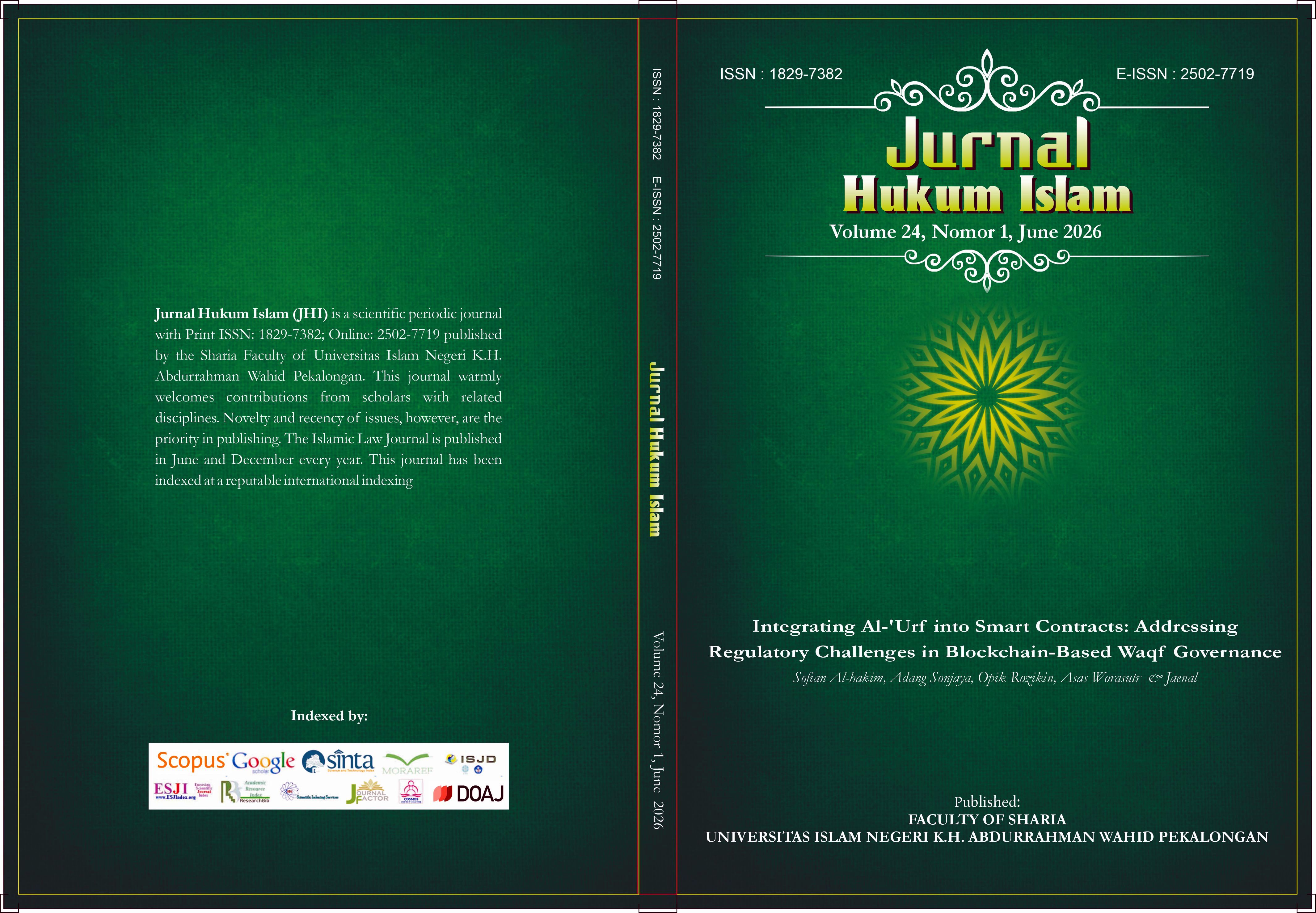
Integrating Al-‘Urf into Smart Contracts: Addressing Regulatory Challenges in Blockchain-Based Waqf Governance
DOI:
https://doi.org/10.28918/jhi.v24i1.02Abstract
The integration of blockchain technology into waqf system opens opportunities for transforming digital waqf governance by increasing transparency, efficiency, and accountability. Despite the potential, its implementation still faces Sharia compliance issues and regulatory challenges. Therefore, this study aims to examine the feasibility of implementing smart contracts, identify the regulatory challenges of smart contracts in blockchain-based waqf governance, and propose integrating Al-‘Urf as a model to support adaptive and sustainable governance. The study procedures were carried out using a normative juridical method with a statutory and conceptual approach. Legal materials, such as regulations, fiqh documents, fatwas, literature, and whitepapers on blockchain-based waqf, were then analyzed. The results showed that smart contracts had the technical potential to strengthen the transparency and efficiency of waqf management. However, its effectiveness depended on protocol security, code quality, and verification mechanisms to ensure compliance with the principles of justice ('adl), the prohibition of gharar, and usury. Regulatory challenges were primarily from the lack of regulations on the status of digital assets, the validity of blockchain-based contracts, and the dispute-resolution mechanism for digital waqf, creating legal uncertainty. Al-‘Urf integration through taqnin and siyasah syar‘iyyah could form the basis for developing more adaptive and sustainable digital waqf regulations. These results are expected to contribute to the development of a digital waqf governance model based on 4 components, including normative foundation, governance architecture, sustainable investment, and policy coherence. The model integrates Sharia principles, blockchain governance, and adaptive regulation as a new paradigm in the digital economy era.
Keywords:
References
Almakhour, Mouhamad, Layth Sliman, Abed Ellatif Samhat, and Abdelhamid Mellouk. "Verification of smart contracts: A survey." Pervasive and Mobile Computing 67 (2020): 101227. https://doi.org/10.1016/j.pmcj.2020.101227
Almakhour, Mouhamad, Layth Sliman, Abed Ellatif Samhat, and Abdelhamid Mellouk. "A formal verification approach for composite smart contracts security using FSM." Journal of King Saud University-Computer and Information Sciences 35, no. 1 (2023): 70-86.https://doi.org/10.1016/j.jksuci.2022.08.029
Abdulloh, Muhammad, Athi’ Hidayati, Moh. N Qomar, and Abdurrohman Kasdi. “Land Waqf Practices Based on Local Wisdom of Tribes in Dosay Village, Papua.” Inferensi Jurnal Penelitian Sosial Keagamaan 16, no. 2 (2023): 241–56. https://doi.org/10.18326/infsl3.v16i2.241-256.
Abikan, Abdulqadir Ibrahim, and Abdullahi Saliu Ishola. "Waqf development in Nigeria: Issues and challenges." Waqf Development and Innovation, Routledge. (2021): 238-255. https://doi.org/10.4324/9781003158073
Al-Hakim, S, A Sonjaya, S Adityawati, A Z Rahmayanti, and O Rozikin. “Mosque-Based Economic Transformation: Ecosystem Model Analysis Using ANP.” International Journal of Sustainable Development and Planning 20, no. 2 (2025): 623–33. https://doi.org/10.18280/ijsdp.200213.
Alhejaili, Mohammad. “Harmonising Derivatives with Shari’ah: Ethical Practices and Regulatory Insights.” International Journal of Islamic and Middle Eastern Finance and Management, 2025. https://doi.org/10.1108/IMEFM-03-2024-0163.
Anwar, Intan Fatimah, Syarifah Bahiyah Rahayu, Yuslina Yusoff, Noor Faizah Mohd Lajin, and Atika Atan. “The Sustainability of Cash Waqf Using Blockchain Technology: A Conceptual Study.” International Journal of Trends In Accounting Research 5, no. 2 (2024): 70–82.
Atiyah, Ghassan Adhab, Nazura Abdul Manap, Ahmed Ismael Ibrahim, and Abdur Rahman. “Legitimacy of Smart Contracts from the Perspective of Islamic Law: A Case Study of Blockchain Transactions.” Al-Istinbath: Jurnal Hukum Islam 9, no. 1 (2024): 155–92. https://doi.org/10.29240/jhi.v9i1.8726.
Choeri, Imron. “Optimalisasi Undang-Undang Nomor 41 Tahun 2004 Tentang Wakaf Di Kabupaten Jepara.” El-Usrah Jurnal Hukum Keluarga 5, no. 1 (2022): 23. https://doi.org/10.22373/ujhk.v5i1.12221.
Choirunnisak, Choirunnisak, and Azka Amalia Jihad. “Optimalisasi Inovasi Wakaf Di Indonesia Era Digital Dalam Menjawab Tantangan Dan Peluang.” Jurnal I-Philanthropy a Research Journal on Management of Zakat and Waqf 4, no. 2 (2024): 117–28. https://doi.org/10.19109/iphi.v4i2.25847.
Dinata, I Kadek Dwiki Trisna, I Ketut Kasta Arya Wijaya, and Ni Made Puspa Sutari Ujianti. “Legal Regulations on the Use of Blockchain Technology in Indonesia.” International Journal of Social Science and Human Research 08, no. 02 (2025). https://doi.org/10.47191/ijsshr/v8-i2-41.
Haniffah, Noor Leena, Mohammed Sharaf Shaiban, and Pervaiz Ahmed. “Development and Validation of a Performance Measurement System Based on Islamic Principles.” Heliyon 9, no. 5 (2023). https://doi.org/10.1016/j.heliyon.2023.e16095.
Hapsari, Meri I, Mohamed Asmy Mohd Thas Thaker, Mustafa O Mohammed, and Jarita Duasa. “A Qualitative Investigation Into Crowdfunding Framework as a Source of Financing for Waqf Land Development.” Journal of Islamic Accounting and Business Research 13, no. 3 (2021): 425–43. https://doi.org/10.1108/jiabr-10-2020-0311.
Hassan, Rusni, Noor Mahinar Abu Bakar, and Noor Haini Akmal Abu Bakar. "A review on governance and best practices in waqf management for sustainable development in selected Malaysian states and other countries." (2022).https://doi.org/10.1108/978-1-80071-625-420210009
Hewa, Tharaka, Mika Ylianttila, and Madhusanka Liyanage. “Survey on Blockchain Based Smart Contracts: Applications, Opportunities and Challenges.” Journal of Network and Computer Applications 177 (2021): 102857. https://doi.org/10.1016/j.jnca.2020.102857.
Huda, Miftahul, Lia Noviana, and Lukman Santoso. “Pengembangan Tata Kelola Wakaf Berbasis Korporasi Di Asia Tenggara/Development the Governance of Corporate-Based Waqf in South East Asia.” De Jure Jurnal Hukum Dan Syar Iah 12, no. 2 (2020): 120–39. https://doi.org/10.18860/j-fsh.v12i2.3908.
Iskandar, Azwar, Bayu Taufiq Possumah, Khaerul Aqbar, and Akhmad Hanafi Dain Yunta. “Islamic Philanthropy and Poverty Reduction in Indonesia: The Role of Integrated Islamic Social and Commercial Finance Institutions.” AL-IHKAM: Jurnal Hukum & Pranata Sosial 16, no. 2 (December 2021): 274–301. https://doi.org/10.19105/al-lhkam.v16i2.5026.
Ismail, Nurizal, and Siti Aisyah. “Islamic Social Finance: A Bibliometric Analysis.” Global Review of Islamic Economics and Business 9, no. 2 (March 2022): 019–028. https://doi.org/10.14421/grieb.2021.092-02.
Kasdi, Abdurrohman, Abdul Karim, Umma Farida, and Miftahul Huda. “The Development of Waqf in the Middle East and Its Role in Pioneering Contemporary Islamic Civilization: A Historical Approach.” Journal of Islamic Thought and Civilization 12, no. 1 (2022): 186–98. https://doi.org/10.32350/jitc.121.10.
Kaharuddin, Kaharuddin, Asep Saepudin Jahar, and Arta Amaliah Nur Afifah. "Integrating blockchain technology into waqf governance: Enhancing transparency and accountability in Sharia finance for achieving SDGs." In Towards Resilient Societies: The Synergy of Religion, Education, Health, Science, and Technology, pp. 501-506. CRC Press, 2026.
Laldin, Mohamad Akram, Sharifah Zubaidah Syed Abdul-Kader, and Fares Djafri. "Waqf development in Malaysia." In Waqf Development and Innovation, pp. 207-225. Routledge, 2021. https://doi.org/10.4324/9781003158073
Mubarok,Nafi, Suqiyah Musafa'ah, and Yoga Irama. "Epistemological Transformation of'Urf in the DSN-MUI Fatwa on E-Commerce: A Maqaṣid al-Shari'ah Based Analysis." Al-Manahij: Jurnal Kajian Hukum Islam 19, no. 2 (2025): 167.https://doi.org/10.24090/mnh.v19i2.13145
Moosavi, Nazanin, Hamed Taherdoost, Nachaat Mohamed, Mitra Madanchian, Yousef Farhaoui, and Inam Ullah Khan. "Blockchain technology, structure, and applications: a survey." Procedia Computer Science 237 (2024): 645-658.https://doi.org/10.1016/j.procs.2024.05.150
Masse, Rahman A, and Andi Aderus. “The Model Investment Management of Cash Waqf.” Diktum Jurnal Syariah Dan Hukum 20, no. 2 (2022): 204–27. https://doi.org/10.35905/diktum.v20i2.3327.
Megat, Puteri Aina, Fahd Al-Shaghdari, Besar Bin Ngah, and Sami Samir Abdelfattah. “Assessing the Predictive Benefits of Waqftech Smart Contracts on Corporate Waqf Crowdfunding among Malaysian Enterprises.” Journal of Islamic Marketing 15, no. 5 (2024): 1303–25. https://doi.org/10.1108/JIMA-08-2023-0262.
Mohaiyadin, Norlaila Mazura Hj, Aini Aman, Mohd Rizal Palil, and Suzana Muhamad Said. "Addressing accountability and transparency challenges in waqf management using blockchain technology." Journal of Islamic Monetary Economics and Finance 8 (2022): 53-80.https://doi.org/10.21098/jimf.v8i0.1413
Mujahidin, Muhammad Imran, Nasrullah Bin Sapa, Fasiha Fasiha, Sitti Aisya, and Trimulato Trimulato. "Challenge of Waqf to the Social and Economic Welfare of Muslim Communities: A Comparative Analysis Between Countries." Jurnal Ilmiah Mizani: Wacana Hukum, Ekonomi Dan Keagamaan 12, no. 1 (2025): 168-184. http://dx.doi.org/10.29300/mzn.v12i1.7765
Mustagfiroh, Siti, and Nadya Nafiisah Khoirina. "Legal and Regulatory Challenges in the Implementation of Blockchain-Based Waqf in Indonesia." WiShEL: Walisongo Journal of Sharia Economic Law 1, no. 1 (2025).https://doi.org/10.21580/wishel.2025.1.1.29407
Ningrum, Fatima Retno, A Sonjaya, S Puryandani, and D A Rahim. “Sharia Compliance Dalam Pelaksanaan Eksekusi Jaminan Gadai Rahn.” Jurnal Asy-Syari’ah 25, no. 1 (2023). https://doi.org/10.15575/as.v25i1.28809.
Putra, Haris M, Hisam Ahyani, Nanang Naisabur, Muharir Muharir, and Chikal A P Naisabur. “Reconstruction of the Practice of Siyasa Syar’iyyah During the Islamic Empire’s Relevance to the Practice of Sharia Financing CWLS Retail in Indonesia.” Al-Istinbath Jurnal Hukum Islam 8, no. 2 November (2023): 347. https://doi.org/10.29240/jhi.v8i2.8057.
Qu Meixun, Xin Huang, Xu Chen, Yi Wang, Xiaofeng Ma, and Dawei Liu. "Formal verification of smart contracts from the perspective of concurrency." In International Conference on Smart Blockchain. Cham: Springer International Publishing, 2018, 32-43. https://doi.org/10.1007/978-3-030-05764-0_4
Raimi, Lukman, Ibrahim Adeniyi Abdur-Rauf, and Basirat Olaide Raimi. “Interdependence of Halal Entrepreneurship and Islamic Finance for Creating a Strong Halal Ecosystem.” Journal of Islamic Marketing 16, no. 3 (2025): 929–54. https://doi.org/10.1108/JIMA-05-2023-0162.
Saidu, Oluwaseun S, Murat Çızakça, and Rodney Wilson. “Harmonization Is the Only ‘Game’ in Town; Actualizing the Functionality of Vital Islamic Financial Institutions: A Case of Waqfs in Nigeria.” Jurnal Syariah 29, no. 2 (2021): 175–94. https://doi.org/10.22452/js.vol29no2.1.
Sukmana, Raditya. "Critical assessment of Islamic endowment funds (Waqf) literature: lesson for government and future directions." Heliyon 6, no. 10 (2020).e05074. https://doi.org/10.1016/j.heliyon.2020.e05074
Shulthoni, Muhammad, and Norma Md Saad. “Waqf Fundraising Management: A Conceptual Comparison between Traditional and Modern Methods in the Waqf Institutions.” Indonesian Journal of Islam and Muslim Societies 8, no. 1 (2018): 57–86.
Sofiani, Trianah, Shofian bin Ahmad, Bunga Desyana Pratami, and Heris Suhendar. “Mosques as Catalysts for Islamic Financial Inclusion: Evidence from Branchless Banking Implementations.” Asy-Syari’ah 27, no. 2 (2025): 143–70. https://doi.org/10.15575/as.v27i2.48309.
Sonafist, H Y, Yasni Efyanti, Ramlah Ramlah, Ali Hamzah, and Faizin Faizin. “Ibn Al-Muqaffa’s Proposal for Taqnin and Its Synchronization With Islamic Law Codification in Indonesia.” Samarah Jurnal Hukum Keluarga Dan Hukum Islam 4, no. 2 (2020): 504. https://doi.org/10.22373/sjhk.v4i2.7864.
Sonjaya, Adang, Ragimun, Edwin Basmar, Tuti Ermawati, Anggi Putri Kurniadi, Helena Dasilva, Kanetasya Sabilla, et al. “How the Integration of Payment Systems Through QRIS Accelerates Economic and Financial Cooperation in the ASEAN Region.” International Journal of Sustainable Development and Planning 20, no. 3 (March 2025). https://doi.org/10.18280/ijsdp.200305.
Sahban, Zainuddin Zainuddin, and Wahida Wahida. "Between Innovation and Prohibition: A Contextualised Islamic Legal Analysis of Cryptocurrency Compliance with Shariʿah Principles in the Indonesian Context." Jurnal Ilmiah Mizani: Wacana Hukum, Ekonomi Dan Keagamaan 13, no. 1 (2026): 151-168. http://dx.doi.org/10.29300/mzn.v13i1.10673
Setiawan, Agus, and M. Sholeh Nurjaman. "Application of blockchain and smart-contract on waqf asset management: is it necessary?." EL DINAR: Jurnal Keuangan dan Perbankan Syariah 10, no. 2 (2022): 85-101.https://doi.org/10.18860/ed.v10i2.15529
Santoso, Bedjo, and Moch Zulfa. "Blockchain Model to Support Waqf Management." In International Conference on Intelligent Networking and Collaborative Systems, pp. 328-338. Cham: Springer International Publishing, 2022.https://doi.org/10.1007/978-3-031-14627-5_33
Singh, Amritraj, Reza M. Parizi, Qi Zhang, Kim-Kwang Raymond Choo, and Ali Dehghantanha. "Blockchain smart contracts formalization: Approaches and challenges to address vulnerabilities." Computers & Security 88 (2020): 101654.https://doi.org/10.1016/j.cose.2019.101654
Ummah, Hilma Rohmatul, Adang Sonjaya, and Jujun Jamaludin. “Sharia Fintech: Crowdfunding as MSMEs Financing.” Al-Muamalat: Jurnal Ekonomi Syariah 11, no. 1 (2024): 115–36. https://doi.org/10.15575/am.v11i1.28808.
Wijaya, Muhammad Widyarta, Irfan Ramis, Nurwinsyah Rohmaningtyas, and M. Lathoif Ghozali. "Blockchain-Based Waqf and Maslahah Mursalah: A Sharia Analysis in Light of MUI Fatwas." El-kahfi| Journal of Islamic Economics 6, no. 02 (2025): 363-380.
Yani, Achmad. “Reconstruction of the Waqf Pledge as a Juridical Acronym for Expert Waqf Dispute Resolution.” Management of Zakat and Waqf Journal (Mazawa) 5, no. 1 (2023): 105–21. https://doi.org/10.15642/mzw.2023.5.1.105-121.
Yusgiantoro, Inka, Putra Pamungkas, and Irwan Trinugroho. “The Sustainability and Performance of Bank Wakaf Mikro: Waqf-Based Microfinance in Indonesia.” International Journal of Islamic and Middle Eastern Finance and Management 17, no. 1 (2023): 86–101. https://doi.org/10.1108/imefm-06-2022-0233.
Zheng, Zibin, Shaoan Xie, Hong-Ning Dai, Weili Chen, Xiangping Chen, Jian Weng, and Muhammad Imran. "An overview on smart contracts: Challenges, advances and platforms." Future Generation Computer Systems 105 (2020): 475-491.https://doi.org/10.1016/j.future.2019.12.019
Downloads
Published
Article Statistics
Issue
Section
License
Copyright (c) 2026 Jurnal Hukum Islam

This work is licensed under a Creative Commons Attribution-ShareAlike 4.0 International License.
Jurnal Hukum Islam use a variety of waivers and licenses that are specifically designed for and appropriate for the treatment of data:
- Open Data Commons Attribution License, http://www.opendatacommons.org/licenses/by/1.0/(default)
- Creative Commons CC-Zero Waiver, http://creativecommons.org/publicdomain/zero/1.0/
- Open Data Commons Public Domain Dedication and License, http://www.opendatacommons.org/licenses/pddl/1-0/
Other data publishing licenses may be allowed as exceptions (subject to approval by the editor on a case-by-case basis) and should be justified with a written statement from the author, which will be published with the article.