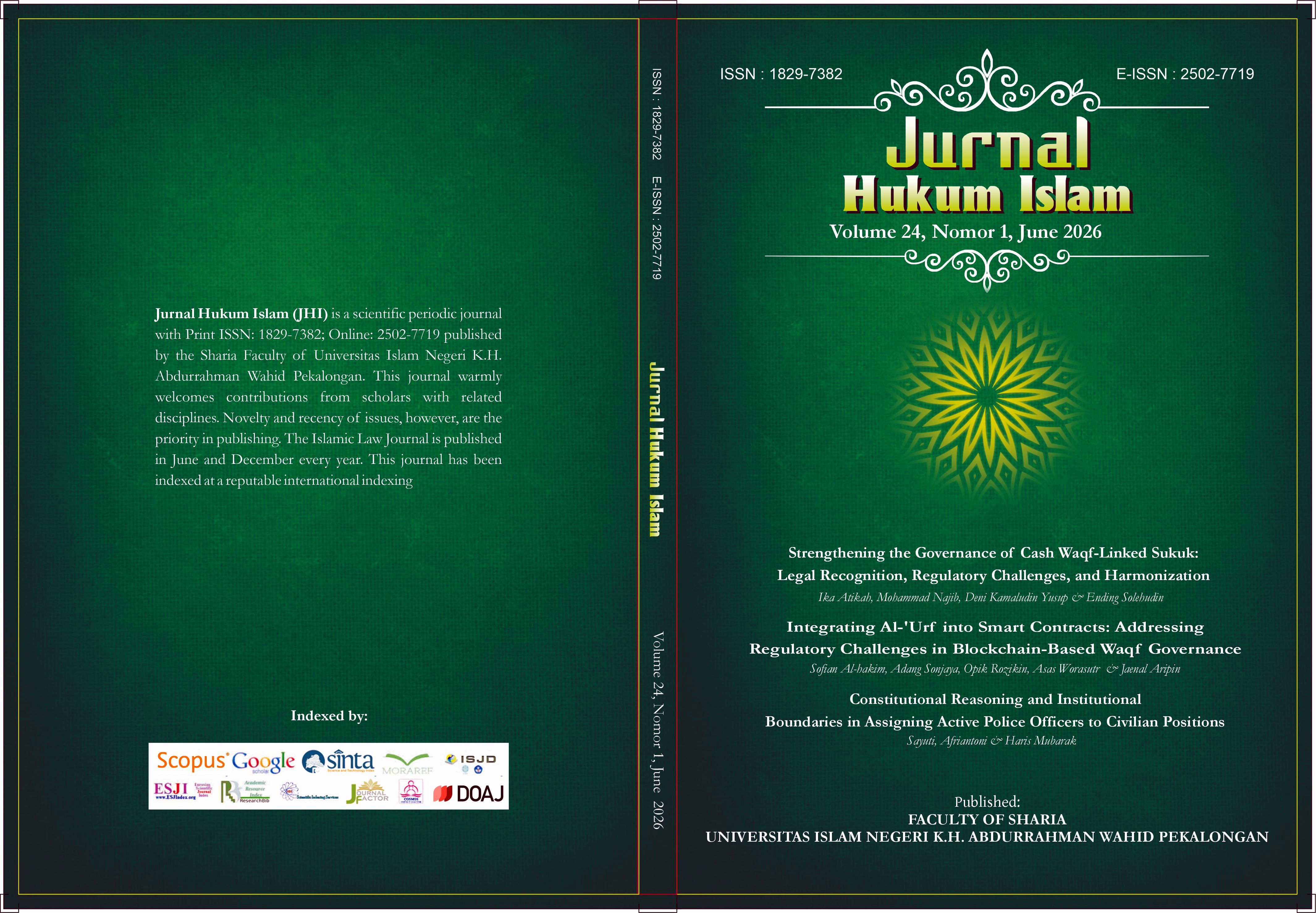
Constitutional Reasoning and Institutional Boundaries in Assigning Active Police Officers to Civilian Positions
DOI:
https://doi.org/10.28918/jhi.v24i1.03Abstract
The increasing placement of active police officers in civilian positions raises serious constitutional issues related to civilian supremacy, the neutrality of law enforcement institutions, and government accountability. Although the Constitutional Court of the Republic of Indonesia has prohibited this practice through its rulings, the constitutional reasoning and the clarity of institutional boundaries between police and civilian government functions have not been thoroughly analyzed. This study analyzes the constitutional reasoning and authority of the Constitutional Court in determining the limits of the involvement of active police officers in civilian positions, as well as its implications for the principle of separation of powers, democratic governance, and the shift in the Court's role from a negative legislator to a constitutional policy-maker. Using a normative juridical method with a statutory, conceptual, and case approach, this study finds that the Constitutional Court has adopted a substantive approach by positioning the issue of security forces as a constitutional problem through Decision Number 114/PUU-XXIII/2025. This decision has structural implications in the form of strengthening checks and balances mechanisms, increasing accountability, and preventing the politicization of security institutions. The decision also indicates a shift in the role of the Constitutional Court towards a constitutional policy-maker that contributes to the formation of public policy directions and the affirmation of state institutional boundaries. Thus, a new conception has emerged that the Constitutional Court has positioned itself as an institutional boundary-maker within the framework of constitutional governance, which emphasizes its active role in determining the boundaries of authority between state institutions.
Keywords:
References
Aditya, Nicholas Ryan, and Nawir Arsyad Akbar. “Mabes Polri Sebut Ada 300 Polisi Aktif Yang Duduki Jabatan Sipil.” Kompas.com, 2025. http://nasional.kompas.com/read/2025/11/17/20314541/mabes-polri-sebut-ada-300-polisi-aktif-yang-duduki-jabatan-sipil.
Adnyani, Ni Ketut Sari, Made Sugi Hartono, Ni Putu Ega Parwati, and Sergio Salles. “The Constitutional Law in Contemporary Times: Comparison of India and Indonesia.” Jurnal Suara Hukum 6, no. 2 (2025): 385–412. https://doi.org/10.26740/jsh.v6n2.p385-412.
Altavilla, Cristian. “The Role of Constitutional Courts in Intergovernmental Conflict Resolution: The Argentine Case.” Constitutional Review 11, no. 1 (2025): 1–27. https://doi.org/10.31078/consrev1111.
Baihaki, Muhammad Reza. “Assessment of Elements of Abuse of Authority (Detournement De Pouvoir) Based on the Decision of the Constitutional Court.” Jurnal Konstitusi 20, no. 1 (2023): 103–7. https://doi.org/10.31078/jk2016.
Banerjee, Vasabjit, and Sean P Webeck. “Civil–Military Relations: Through a Perilous Lens.” Armed Forces & Society 50, no. 1 (2024): 3–24. https://doi.org/10.1177/0095327x221108198.
Barak, Aharon, and Sari Bashi. Purposive Interpretation in Law. Princeton University Press, 2005. http://www.jstor.org/stable/j.ctt7pg5z.
Barak, Aharon, and Doron Kalir. “Proportionality: Constitutional Rights and Their Limitations.” American Journal of Comparative Law, Cambridge studies in constitutional law, 69, no. 1 (2012): 168–172. https://doi.org/https://doi.org/10.1093/ajcl/avaa022.
Bayley, David H. “Police Reform: Who Done It?” Policing and Society 18, no. 1 (2008): 7–17. https://doi.org/10.1080/10439460701718518.
Bevir, Mark. Governance: A Very Short Introduction. OUP Oxford, 2012.
Bomhoff, Jacco. “Proportionality Balancing and Global Governance: A Comparative and Global Approach.” The American Journal of Comparative Law 69, no. 1 (2021): 168–72. https://doi.org/10.1093/ajcl/avaa022.
Carothers, Thomas, and Benjamin Press. Understanding and Responding to Global Democratic Backsliding. Washington DC: Carnegie Endowment for International Peace, 2019.
Castillo-Ortiz, Pablo. “The Dilemmas of Constitutional Courts and the Case for a New Design of Kelsenian Institutions.” Law and Philosophy 39, no. 6 (2020): 617–55. https://doi.org/10.1007/s10982-020-09378-3.
Constitutional Court of the Republic of Indonesia. Decision Number 11/PUU-XXIII/2025 (2025).
———. Decision Number 114/PUU-XXIII/2025 (2025).
Croissant, Aurel, and David Kuehn. “Patterns of Civilian Control of the Military in East Asia’s New Democracies.” Journal of East Asian Studies 9, no. 2 (2009): 187–217. https://doi.org/10.1017/s1598240800002988.
Daly, Paul. “Introduction.” Apex Courts and the Common Law, 2019, 1–22. https://doi.org/10.3138/9781487530167-002.
Dixon, Rosalind. “Constitutional Drafting and Distrust.” International Journal of Constitutional Law 13, no. 4 (2015): 819–46. https://doi.org/10.1093/icon/mov068.
Djuyandi, Yusa, Shanty Kartika Dewi, Luis Fiska Rahayu, and Mohd Sufiean Hassan. “Civil-Military Relations in Indonesia: Promoting a Professional Military Character from the New Order Era to the Reform Era.” Otoritas : Jurnal Ilmu Pemerintahan 15, no. 3 (2025): 510–26. https://doi.org/10.26618/4d2j0r15.
Elliott, Mark, and Jason Varuhas. Administrative Law: Text and Materials. Oxford: Oxford University Press, 2020.
Firmanto, Kiki. “The Binding Effect of Constitutional Court Decisions on Police Regulations (An Analysis of Constitutional Court Decision No. 114/PUU-XXIII/2025).” IBLAM LAW REVIEW 6, no. 1 (2026): 1–9. https://doi.org/10.52249/ilr.v6i1.658.
Ginsburg, Tom, and Aziz Z Huq. How to Save a Constitutional Democracy. Chicago: University of Chicago Press, 2018. https://doi.org/10.7208/9780226564418
Harun, Harun. "New development: The Indonesian police—reform in an oligarchic democracy." Public Money & Management (2026): 1-6.https://doi.org/10.1080/09540962.2026.2614323
Habernal, Ivan, Daniel Faber, Nicola Recchia, Sebastian Bretthauer, Iryna Gurevych, Indra genannt Döhmann, and Christoph Burchard. “Mining Legal Arguments in Court Decisions.” Artificial Intelligence and Law 32, no. 3 (2024): 1–38. https://doi.org/10.1007/s10506-023-09361-y.
Hartati, Sri, and Rubiyanto. “Implications of Judicial Review of Law No. 3 of 2025 on the Principle of Separation of Powers.” Collaborative Journal of Science 8, no. 10 (2025): 6511–19. https://doi.org/https://doi.org/10.56338/jks.v8i10.8943.
Hasani, Ismail, Halili, and Ikhsan Yosarie. “Police Transformation within Constitutional Democracy Design: Evidence from Indonesia.” Jurnal Civics: Media Kajian Kewarganegaraan 23, no. 1 (2026): 331–46. https://doi.org/10.21831/jc.v23i1.96514.
Huda, Ni’matul. “Problematika Substantif Perppu Nomor 1 Tahun 2013 Tentang Mahkamah Konstitusi.” Jurnal Konstitusi 10, no. 4 (2016): 557. https://doi.org/10.31078/jk1041.
Huq, Aziz Z, and Tom Ginsburg. “How to Lose a Constitutional Democracy.” UCLA Law Review 65 (2017): 1–78. https://doi.org/http://dx.doi.org/10.2139/ssrn.2901776.
Hutchinson, Terry. Researching and Writing in Law. Pyrmont: Thomson Reuters, 2018.
Komárek, Jan. “National Constitutional Courts in the European Constitutional Democracy: A Rejoinder.” International Journal of Constitutional Law 15, no. 3 (2017): 815–25. https://doi.org/10.1093/icon/mox052.
Laksmana, Evan A. “Reshuffling the Deck? Military Corporatism, Promotional Logjams and Post-Authoritarian Civil-Military Relations in Indonesia.” Journal of Contemporary Asia 49, no. 5 (2019): 806–36. https://doi.org/10.1080/00472336.2019.1613556.
Mahmud, Marzuki Peter. Penelitian Hukum. Jakarta: Kencana Prenada Media Group, 2021.
Mietzner, Marcus. “Fighting Illiberalism with Illiberalism: Islamist Populism and Democratic Deconsolidation in Indonesia.” Pacific Affairs 91, no. 2 (2018): 261–82. https://doi.org/10.5509/2018912261.
Mochtar, Zainal Arifin. “Guarding Democracy: Judicial Activism in the Indonesian Constitutional Court Decisions in Regional Head Electoral Disputes.” Constitutional Review 11, no. 1 (2025): 36–62. https://doi.org/10.31078/consrev1112.
Muntingh, Lukas, Andrew Faull, Jean Redpath, and Kristen Petersen. “Democratic Policing: A Conceptual Framework.” Law, Democracy and Development 25 (2021). https://doi.org/10.17159/2077-4907/2021/ldd.v25.5.
Ng, Jefferson, and Yudha Kurniawan. “The Parliament and Cooperative Oversight of the Indonesian Armed Forces: Why Civil–Military Relations in Indonesia Is Stable but Still in Transition.” Armed Forces & Society 50, no. 3 (2024): 683–709. https://doi.org/10.1177/0095327x221137281.
Omara, Andy. “The Indonesian Constitutional Court and the Democratic Institutions in Judicial Review.” Constitutional Review 3, no. 2 (2018): 189–207. https://doi.org/10.31078/consrev323.
Palguna, I Dewa Gede, and Bisariyadi Bisariyadi. “The Power of Constitutional Court to Settle Disputes on Local Election Results.” Jurnal Konstitusi 20, no. 1 (2023): 1–18. https://doi.org/10.31078/jk2011.
Perdana, Muhammad Anugerah, and Mochamad Adli Wafi. “Pemaknaan Mahkamah Konstitusi Terhadap Batasan Open Legal Policy Beserta Kompleksitasnya.” Veritas et Justitia 11, no. 2 (2026): 251–70. https://doi.org/10.25123/vej.v11i2.9287.
Putra, Antoni. “Implications of Conditional Inconstitutional Decisions in The Constitutional Court Decision.” Jurnal Konstitusi 20, no. 1 (2023): 58–77. https://doi.org/10.31078/jk2014.
Ristawati, Rosa, and Radian Salman. “The Role of The Indonesian Constitutional Court in Preventing Social Conflict in A Diverse Society.” Constitutional Review 9, no. 2 (2023): 332–57. https://doi.org/10.31078/consrev925.
Roznai, Yaniv, Rosalind Dixon, and David E Landau. “Judicial Reform or Abusive Constitutionalism in Israel.” Israel Law Review 56, no. 3 (2023): 292–304. https://doi.org/10.1017/s0021223723000171.
Scheppele, Kim Lane. “Autocratic Legalism.” The University of Chicago Law Review 85, no. 2 (2018): 545–84. https://www.jstor.org/stable/26455917.
Sunarjo, Anwar, and Riswadi Riswadi. “Legal Uncertainty for Police Members in the Limits of Positions Outside the Police.” Journal of World Science 3, no. 12 (2024): 1587–96. https://doi.org/10.58344/jws.v3i12.1243.
Sundariwati, Ni Luh Dewi. “Judicial Activism: Between Protecting Constitutional Supremacy or Transitioning to Juristocracy.” Jurnal Konstitusi 21, no. 3 (2024): 444–45. https://doi.org/https://doi.org/10.31078/jk2135.
Susanti, Bivitri. “The Rise of Judicial Power in Indonesia.” Asian Journal of Comparative Law 15, no. 2 (2020): 255–276. https://doi.org/https://doi.org/10.1017/asjcl.2020.23.
Taş, Hakkı. “Populism and Civil–Military Relations.” Democratization 31, no. 1 (2024): 70–89. https://doi.org/10.1080/13510347.2023.2255976.
Tushnet, Mark. Advanced Introduction to Comparative Constitutional Law. Cheltenham: Edward Elgar, 2019.
Ulrich, Marybeth P. “Civil-Military Relations Norms and Democracy: What Every Citizen Should Know.” In Reconsidering American Civil-Military Relations, edited by Lionel Beehner, Risa Brooks, and Daniel Maurer, 41–62. Oxford: Oxford University Press, 2021.
Downloads
Published
Article Statistics
Issue
Section
License
Copyright (c) 2026 Jurnal Hukum Islam

This work is licensed under a Creative Commons Attribution-ShareAlike 4.0 International License.
Jurnal Hukum Islam use a variety of waivers and licenses that are specifically designed for and appropriate for the treatment of data:
- Open Data Commons Attribution License, http://www.opendatacommons.org/licenses/by/1.0/(default)
- Creative Commons CC-Zero Waiver, http://creativecommons.org/publicdomain/zero/1.0/
- Open Data Commons Public Domain Dedication and License, http://www.opendatacommons.org/licenses/pddl/1-0/
Other data publishing licenses may be allowed as exceptions (subject to approval by the editor on a case-by-case basis) and should be justified with a written statement from the author, which will be published with the article.