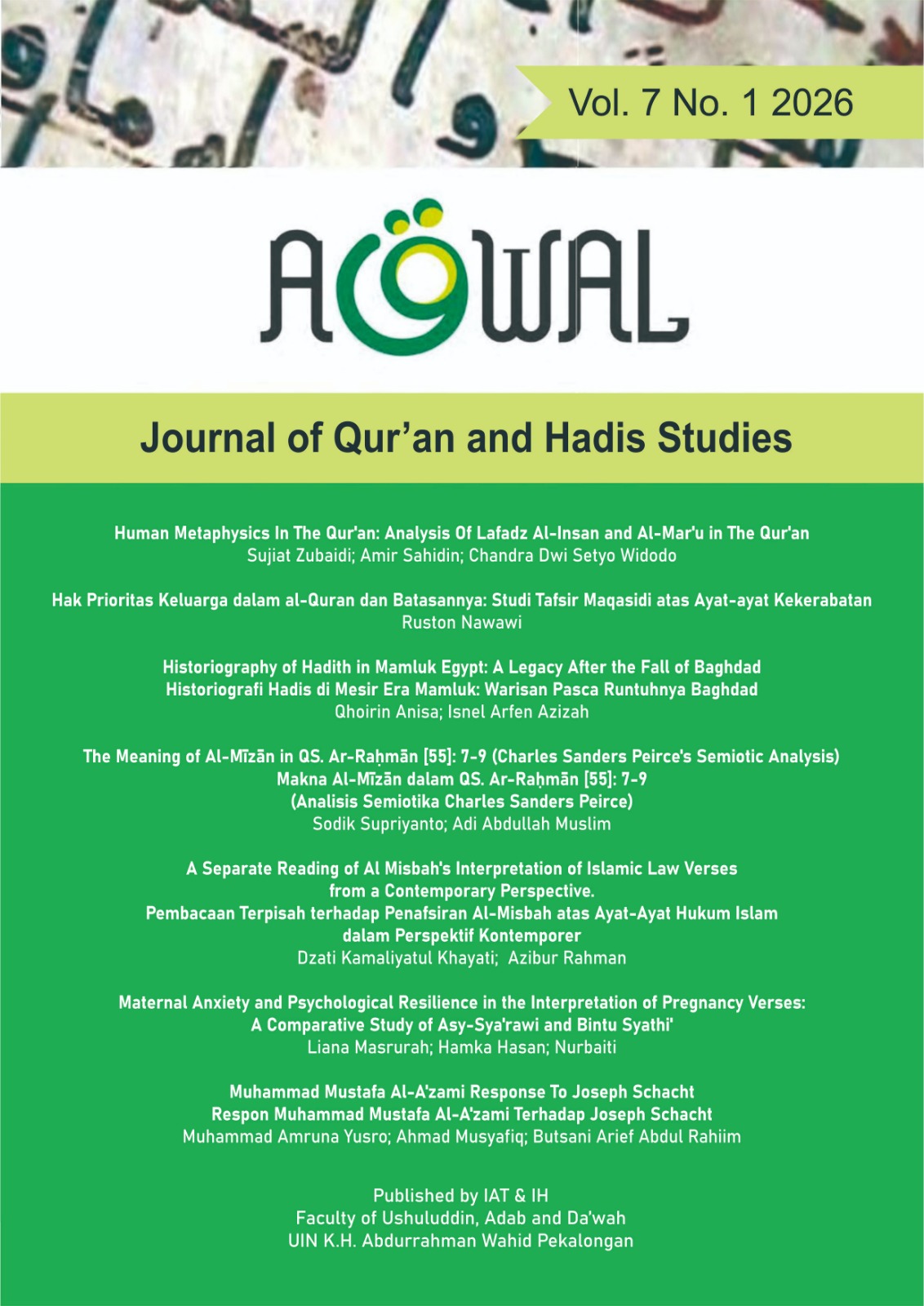
Human Metaphysics In The Qur'an: Analysis Of Lafadz Al-Insan and Al-Mar'u in The Qur'an
DOI:
https://doi.org/10.28918/pfebeg64Abstract
Background and Objectives: The study of human beings occupies a central position in Qur’anic discourse, as humans are portrayed as God’s most perfect creation in both physical and metaphysical dimensions. The Qur’an employs various terms to refer to humans, among which al-insan and al-mar’u are particularly significant due to their distinctive yet complementary meanings. Method: This study aims to analyse the meanings of al-insan and al-mar’u in the Qur’an, identify the differences between the two terms, and formulate the concept of human metaphysics reflected through them. This research employs a qualitative library research approach, using the Qur’an as the primary source, supported by classical and contemporary tafsir literature and relevant scholarly works. Data were analysed through content analysis by examining, describing, comparing, and synthesising relevant Qur’anic verses and interpretations.
Main Results: The findings show that al-insan is generally used to describe humans in relation to their privileges, existential status, negative tendencies, and the process of creation. Contributions: This research contributes to enriching the study of interpretation on the aspect of the meaning of words in the Qur'an as well as the disclosure of metaphysical concepts contained in the Qur'an. Conclusions: This study concludes that al-mar’u refers to morally responsible individuals, particularly adults who possess the capacity to act independently and bear social responsibilities. Furthermore, the two terms collectively represent two inseparable dimensions of human metaphysics in the Qur’an: humans as khalifatullah (God’s vicegerents on earth) and as ‘abdullah (servants of God).
Keywords: Al-Insan, Al-Mar'u, Human, Metaphysics.
Keywords:
References
Abdullah, B. (2018). Konsep Manusia Dalam Islam (Studi Terhadap Eksistensi Manusia). Wahana inovasi, 7(2).
Abdullah, D. (2007). Konsep Menusia Dalam Al-Qur’an (Telaah Kritis tentang Makna dan Eksistensi). Ad-Daulah, 6(2).
Al-Ashfahani, A.-H. bin M. (1412). Al-Mufradat fi Gharib Al-Qur’an. Dar al-Qalam.
Al-Baidhawi, N. (1428). Anwar al-Tanzil wa Asrar al-Ta’wil. Dar Ihya’ al-Turats al-’Araby.
Al-Bukhari, M. bin I. (1422). Shahih al-Bukhari. Dar Thauqi al-Najah.
Al-Naisaburi, M. bin H. (n.d). Shahih Muslim. Dar Ihya’ al-Turats al-’Araby.
Al-Suyuthi, J., & Al-Mahalli, J. (n.d.). Tafsir Jalalaini. Al-Hidayah.
Al-Wahidi, A. H. A. (1994). Al-Wasith fi Al-Qur’an al-Majid. Dar al-Kutub al-Ilmiyyah.
Al-Zubaidi, M. bin M. (n.d.). Taj al-‘Arus min Jawahir al-Qamus. Dar al-Hidayat.
Amin, M. (2021). Manusia dalam pandangan islam. Al Urwatul Wutsqa, 1(2), 64–85.
Arifin, S. (1996). Spiritualisasi Islam dan Peradaban Masa Depan. Sipress.
Azzuhriyyah, I. S., & Khudori Sholeh, A. (2023). Konsep Manusia Sebagai Al-Basyar Dalam Al-Qur’an. Qolamuna: Jurnal Studi Islam, 8(2).
Basyir, A. A. (1994). Refleksi Atas Persoalan Keislaman (Vol. 2). Mizan.
Binti Al-Syati’, A. (1999). Manusia dalam Perspektif al-Qur’an, terj. Ali Zawawi. Pustaka Firdaus.
Graiguer, C. (2021). Al-Insan wa Al-Mar’u Fi Al-Qur’an Aw Baina Al-Mahiyah al-Mitafiziqiyah wa Al-Syakhs Al-Akhlaqi. Journal of Islamic Ethics Brill, 5. http://dx.doi.org/10.1163/24685542-12340055
Hamzah Amir. (2020). Metode Penelitian Kepustakaan. Literasi Nusantara.
Hawa, S. (1989). Al-Asas fi al-Tafsir. Dar al-Salam.
Hidayat, R. (2017). Konsep Manusia dalam Al-Qur’an. Almufida, 2(2), 120.
Ibn Ishaq, I. (1405). Gharib al-Hadis (Vol. 2). Jami’ah ’Ulum Al-Qur’an.
Ibn Manzur, J. (1414). Lisan al-‘Arab. Dar Shadir.
Ibn Zakariyah, A. bi F. (1972). Mu’jam Maqayis al-Lughat (Vol. 5). Musthafa al-Bab al-Halibi wa Syarikah.
Islamiyah, I. (2020). Manusia Dalam Perspektif Al-Qur’an (Studi Terminilogi Al-Basyar, Al-Insan dan An-Nas). Rusydiah: Jurnal Pemikiran Islam, 1(1).
Isra, M. F., Hidayat, S., & Jinan, M. (2023). Analysis Of Al Insan Verses In The Study Of Tafsir And Its Application In The Formulation Of Islamic Education Objectives. Tadrib, 9(1). https://jurnal.radenfatah.ac.id/index.php/Tadrib/article/view/13644
Jalal, A. F. (1988). Min Ushulil Tarbawiyah Islamiyah. Diponegoro.
Kenneth M. Sayre. (1969). Plato’s Analytic Method. University of Chicago Press.
Langgulung, H. (1988). Asas-asas Pendidikan Islam. Pustaka Al-Husna.
Lohaiy, L. (1984). Manusia Makhluk Paradoksal. Gramedia.
Lubis, N. A. F. (1993). Mewujudkan Pribadi Muslim (Insan Kamil); Suatu Kajian Epistemologis, Dalam Aktualisasi Pemikiran Islam. Widyasarana.
Ma’arif, S. (1985). Al-Qur‟an Realitas Sosial dan Limbo Sejarah; Sebuah Refleksi. Pustaka.
Mahyuddin, A. (1983). Tema-Tema Pokok Alquran. Pustaka.
Mestika Zed. (2004). Metode Penelitian Kepustakaan. Yayasan Obor Indonesia.
Muhlasin, M. (2019). Konsep Manusia Dalam Perspektif Al-Qur’an. Idaratuna: Jurnal Kajian Manajemen Dakwah, 1(2).
Munawwir, A. W. (1997). Al-Munawwir Kamus Arab Indonesia. Pustaka Progresif.
Nasution, M. Y. (2002). Manusia menurut Al Ghazali. Rajawali Pres.
Nurdin, R. (2017). Manusia Dalam Sorotan Al-Qur’an (Suatu Tinjauan Tafsir Maudhui). Tahkim, 155–171. https://doi.org/10.33477/thk.v9i1.96
Nurmadiah, N. (2019). Manusia dan Agama (Konsep Manusia dan Agama dalam Al-Qur’an). Pendais, 1.
Pransiska, T. (2017). Konsepsi Fitrah Manusia Dalam Perspektif Islam dan Implikasinya dalam Pendidikan Islam Kontemporer. Jurnal Ilmiah Didaktika, 17(1), 1. https://doi.org/10.22373/jid.v17i1.1586
Safitri, L., Nuskhi, M., Muatip, K., Purwaningsih, H., & Setiana, L. (2018). The Relationship between Human Being and Animal: The Study of the Concepts of Khalifah and the Animals in the Quran. Kemenristek Dikti, 20(32), 211–215.
Salim, Abd. M. (1994). Fiqhi Siyasah, Konsepsi Kekuasaan Politik Dalam Alquran. Raja Grapindo Persada.
Shihab, M. Q. (1996). Wawasan Alquran, Tafsir Maudhuiy Atas Berbagai Persoalan Umat. Mizan.
Shihab, M. Q. (2012). Tafsir Al-Mishbah, Pesan, Kesan dan Keserasian Al-Quran. Lentera Hati.
Soemanto, W. (1990). Psikologi Pendidikan, Landasan Kerja Pemimpin Pendidikan. Rineka Cipta.
Suntoro, A. F., & Sahidin, A. (2021). The Concept of ’Aqal in the Al-Qur’an. Tasfiyah: Jurnal Pemikiran Islam, 5(2), 245–266. http://dx.doi.org/10.21111/tasfiyah.v5i2.6312
Sustikasasi, S. (2021). Konsep Tentang Manusia Dalam Al-Qur’an dan Implementasinya Pada pendidikan Islam. IndraTech, 2(2).
Syafe’i, I. (2012a). Hakikat Manusia Menurut Islam. Psympathic: Jurnal Ilmiah Psikologi, 2.
Syafe’i, I. (2012b). Hakikat Manusia Menurut Islam. Psympathic, Jurnal Ilmiah Psikologi, 2(105).
Tabroni, T., & Arifin, S. (1994). Islam Pluralisme Budaya dan Politik, Refleksi Teologi untuk Aksi dalam Keberagamaan dan Pendidikan. Sipress.
Umar, N. (2001). Argumen Kesetaraan Gender. Paramadina.
Wahid, A., & Ismail Firdaus, H. (2022). Hakikat Manusia Dalam Al-Qur’an: Kajian Tafsir Tematik. Jurnal: Kewarganegaraan, 6(2).
Downloads
Published
License
Copyright (c) 2026 Sujiat Zubaidi, Amir Sahidin, Chandra Dwi Setyo Widodo

This work is licensed under a Creative Commons Attribution-ShareAlike 4.0 International License.
Aqwal: Journal of Quran and Hadies Studies is licensed under a Creative Commons Attribution-ShareAlike 4.0 International License.
An author who publishes in Aqwal: Journal of Quran and Hadies Studies agrees to the following terms:
- Author retains the copyright and grants the journal the right of first publication of the work simultaneously licensed under the Creative Commons Attribution-ShareAlike 4.0 License that allows others to share the work with an acknowledgment of the work's authorship and initial publication in this journal
- Author is able to enter into separate, additional contractual arrangements for the non-exclusive distribution of the journal’s published version of the work (e.g., post it to an institutional repository or publish it in a book) with the acknowledgment of its initial publication in this journal.
- Author is permitted and encouraged to post his/her work online (e.g., in institutional repositories or on their website) prior to and during the submission process, as it can lead to productive exchanges, as well as earlier and greater citation of the published work (See The Effect of Open Access).
Read more about the Creative Commons Attribution-ShareAlike 4.0 License here https://creativecommons.org/licenses/by-sa/4.0/.