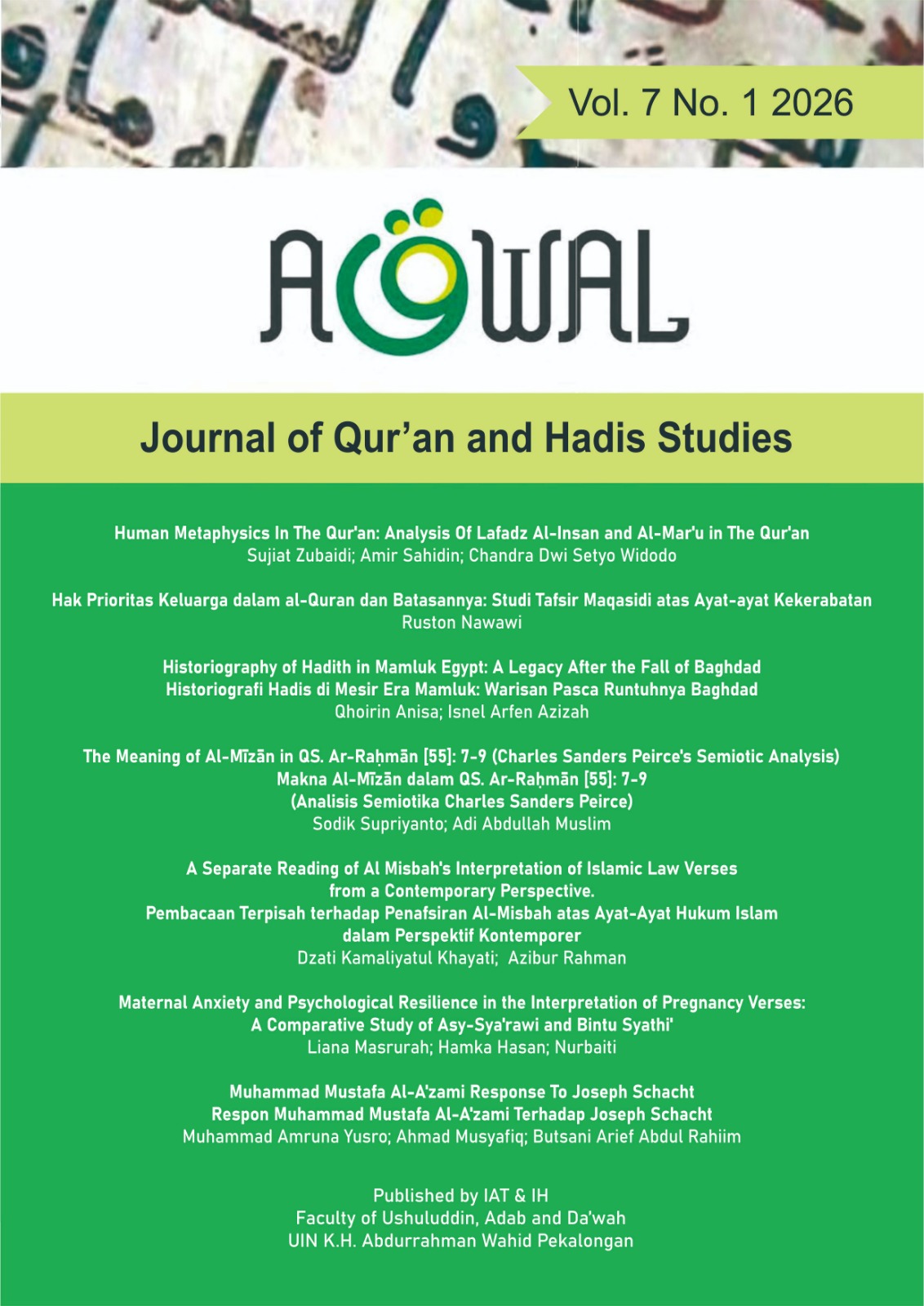
Muhammad Mustafa Al-A’zami Response to Joseph Schacht
DOI:
https://doi.org/10.28918/5xnkj590Abstract
Background and Objectives: The debate over the authenticity of hadith has become one of the central issues in modern hadith studies, particularly following the emergence of Joseph Schacht’s historical-critical approach, which argues that most hadith traditions were formulated as legal constructs after the time of the Prophet Muhammad. This perspective has prompted various responses from Muslim scholars, among whom Muhammad Mustafa al-A‘zami stands out for reexamining Schacht’s assumptions through philological and historical investigations. This study aims to analyze al-A‘zami’s scholarly response to Schacht’s criticism, identify the epistemological and methodological differences between the two scholars, and examine the relevance of their debate to contemporary hadith studies.
Method: The research employs a qualitative approach using library research methods. Primary sources consist of Joseph Schacht’s The Origins of Muhammadan Jurisprudence and Muhammad Mustafa al-A‘zami’s Studies in Early Hadith Literature, while secondary data are drawn from books, peer-reviewed journal articles, and related academic studies. Data were analyzed through qualitative content analysis and comparative analysis.
Main Results: The findings indicate that Schacht’s argument is grounded in a historical reconstruction of Islamic legal development based on the historical-critical method, whereas al-A‘zami develops his argument through philological analysis of early manuscripts, documentary evidence of hadith writing, and the science of isnād (chain of transmission). The evidence presented by al-A‘zami poses a significant challenge to Schacht’s generalization regarding the late documentation of hadith. Nevertheless, this study also demonstrates that the existence of early manuscripts does not, by itself, resolve all questions concerning hadith authenticity, particularly those related to transmission continuity, textual variation, and the complexities of oral transmission. Therefore, the debate over hadith authenticity should be understood as an evolving academic discourse rather than a settled issue.
Contributions: This study contributes to contemporary hadith scholarship by offering a more dialogical reading of the relationship between historical-critical methodology and the traditional science of hadith, thereby opening new possibilities for methodological integration in the study of Islamic traditions.
Conclusions: This study concludes that Joseph Schacht's criticism of the authenticity of hadith needs to be accurately re-examined within the context of the historical-critical approach he uses. Al-A'zami's response to maintaining the authenticity of hadith by presenting evidence and providing significant challenges to Schacht's generalizations regarding the delay in hadith documentation, particularly regarding the existence of ṣaḥīfah and the tradition of writing hadith in early Islam, is crucial.
Keywords: Hadith, Joseph Schacht, Muhammad Mustafa al-A'zami, authenticity, orientalist criticism.
Keywords:
References
Ab Rahim, N. M. Z., Abd Razzak, M. @ M., & Ali Nuar, J. H. (2025). Skeptisisme Orientalis terhadap Hadis: Analisis Kritis Pemikiran Goldziher dan Schacht: Orientalist Scepticism Towards Hadith: A Critical Analysis of the Thoughts of Goldziher and Schacht. Al-Irsyad: Journal of Islamic and Contemporary Issues, 10(2), 1576–1591. https://doi.org/10.53840/alirsyad.v10i2.548
Abdul Kadir, M. N. B., Zakaria, M. H., & Mohd Fadzil, A. F. (2023). Three Levels in the Interaction with Mutasyabihat Text in the Quran and Hadith. International Journal of Academic Research in Progressive Education and Development, 12(2), Pages 471-477. https://doi.org/10.6007/IJARPED/v12-i2/16355
Abdul Muhyi. (2024). Hadis-Hadis Toleransi Beragama dalam Perspektif Kitab Shahih Bukhari dan Shahih Muslim. Tabsyir: Jurnal Dakwah Dan Sosial Humaniora, 5(4), 88–104. https://doi.org/10.59059/tabsyir.v5i4.1597
Al-Maududi, A., Prasetyo, B., & Arisy, H. (2025). Historiography of Hadith Writing during the Era of the Companions and the Tabi’in. El-Sunnah: Jurnal Kajian Hadis Dan Integrasi Ilmu, 6(1), 54–71. https://doi.org/10.19109/elsunnah.v6i1.26508
Aly Mahmudi, M. (2021). Studi Pemikiran MM. Adzami Ahli Hadist Melawan Orientalis. Al Furqan: Jurnal Ilmu Al Quran Dan Tafsir, 4(1), 98–115. https://doi.org/10.58518/alfurqon.v4i1.693
Amdah, N. S. (2022). Mustafa Azami’s Contribution in Rebutting Orientalist Views about The Writing of Hadith. Nabawi: Journal of Hadith Studies, 2(2). https://doi.org/10.55987/njhs.v2i2.50
Amin, K. (2005). The Reliability of the Traditional Science of Hadith: A Critical Reconsideration. Al-Jami’ah: Journal of Islamic Studies, 43(2), 255. https://doi.org/10.14421/ajis.2005.432.255-281
Annisa Az Zahra, Gina Sabila, Khulda Azizah, Noor Khalisah, Muhammad Anshari, & Anwar Hafidzi. (2024). Joseph Schacht and the Early Concept of Islamic Law Formation: A Study of Orientalist Perspectives. Interdisciplinary Explorations in Research Journal, 2(3), 1934–1949. https://doi.org/10.62976/ierj.v2i3.827
Azhar, T. (2024). Hadith Isnad Study In The Discovery Of Islamic Law (Critique of the Thoughts of Goldziher and Schacht). Eduvest - Journal of Universal Studies, 4(5), 4169–4183. https://doi.org/10.59188/eduvest.v4i5.1292
Duderija, A. (2009). Evolution in the Canonical Sunni Hadith Body of Literature and the Concept of an Authentic Hadith During the Formative Period of Islamic ought as Based on Recent Western Scholarship. Arab Law Quarterly, 23(4), 389–415. https://doi.org/10.1163/157302509X467371
Gülteki̇N, H. (2020). TARİHİ TENKİT METODUNDA İSNÂD SİSTEMİNİN YERİ VE MÜNEKKİDLERİN TENKİDLERİNDEKİ ÇELİŞKİ VE FARKLILIKLAR. Journal of International Social Research, 13(69), 337–353. https://doi.org/10.17719/jisr.2020.3962
Hehmeyer, I., & Khan, A. (2007). Islam’s forgotten contributions to medical science. Canadian Medical Association Journal, 176(10), 1467–1468. https://doi.org/10.1503/cmaj.061464
Masuwd, M. A. (2025). Hadith, Law, And Orientalism: A Critical Study of Joseph Schacht’s Theoretical Contributions. Ad-Dawl : Jurnal Islamic Studies, 1(1), 10–24. https://doi.org/10.61590/jis.v1i1.208
Mutaqin, R. S., & Muazar, D. S. (2022). Kritik Epistemologis Ignaz Goldziher Dan Joseph Schacht Terhadap Kitab Al-Muwattha’ Imam Malik. Al-Dzikra: Jurnal Studi Ilmu al-Qur’an Dan al-Hadits, 16(1), 105–126. https://doi.org/10.24042/al-dzikra.v16i1.9908
Nasir, M. A., Zulfahmi Alwi, & Siti Aisyah Kara. (2024). Fuat Sezgin’s Thoughts on Hadith Criticism: Revisiting Ignaz Goldziher’s Views on Doubts about the Authenticity of Hadith. AL QUDS : Jurnal Studi Alquran Dan Hadis, 8(3), 505–516. https://doi.org/10.29240/alquds.v8i3.8807
Paizin, H. B. (2023). TELA’AH PEMIKIRAN HADITS JOSEP SCHACHT DALAM BUKU THE ORIGIN OF MUHAMMAD JURISPRUDENCE, DAN AN INTRODUCTION TO ISLAMIC LAW. Jurnal Studi Hadis Nusantara, 5(2), 116. https://doi.org/10.24235/jshn.v5i2.16690
Putri, G. N., Meylani, H., & Agustina, I. (2022). Kritik Hadis Menurut Pemikiran G.H.A Juynboll dan Joseph Schacht. Integritas Terbuka: Peace and Interfaith Studies, 1(1), 59–70. https://doi.org/10.59029/int.v1i1.3
Qhoirin, Q. (2025). A Critical Examination of Hadith Authenticity through the Theory of Projecting Back: An Analytical Study of Joseph Schacht’s Viewpoint. El-Sunnah: Jurnal Kajian Hadis Dan Integrasi Ilmu, 6(1), 108–123. https://doi.org/10.19109/elsunnah.v6i1.26269
Rahman, A., Hakim, L., & Khoirul Anwar, M. (2024). MM Azami’s Contribution to Countering Hadith Skepticism and Its Influence in Indonesia. Diroyah : Jurnal Studi Ilmu Hadis, 8(2), 303–315. https://doi.org/10.15575/diroyah.v8i2.35248
Riady, F., & Karim, A. (2025). Otoritas Kufah Asy-Sya‘bī dan Konstruksi Sanad: Kritik terhadap Pendekatan Joseph Schacht dalam Studi Hadis Tabi‘in. Al-Qudwah, 3(1). https://doi.org/10.24014/alqudwah.v3i1.34464
Ulumuddin, U., Uyunul Mukarromah, W. R., & Sumbulah, U. (2022). JOSEPH SCACHT, TEORI SKEPTISISME HADIST DAN BANTAHAN SARJANA MUSLIM TERHADAPNYA. El-Sunnah: Jurnal Kajian Hadis Dan Integrasi Ilmu, 3(1), 98–115. https://doi.org/10.19109/elsunnah.v3i1.13028
Downloads
Published
License
Copyright (c) 2026 Muhammad Amruna Yusro, Ahmad Musyafiq, Butsani Arief Abdul Rahiim

This work is licensed under a Creative Commons Attribution-ShareAlike 4.0 International License.
Aqwal: Journal of Quran and Hadies Studies is licensed under a Creative Commons Attribution-ShareAlike 4.0 International License.
An author who publishes in Aqwal: Journal of Quran and Hadies Studies agrees to the following terms:
- Author retains the copyright and grants the journal the right of first publication of the work simultaneously licensed under the Creative Commons Attribution-ShareAlike 4.0 License that allows others to share the work with an acknowledgment of the work's authorship and initial publication in this journal
- Author is able to enter into separate, additional contractual arrangements for the non-exclusive distribution of the journal’s published version of the work (e.g., post it to an institutional repository or publish it in a book) with the acknowledgment of its initial publication in this journal.
- Author is permitted and encouraged to post his/her work online (e.g., in institutional repositories or on their website) prior to and during the submission process, as it can lead to productive exchanges, as well as earlier and greater citation of the published work (See The Effect of Open Access).
Read more about the Creative Commons Attribution-ShareAlike 4.0 License here https://creativecommons.org/licenses/by-sa/4.0/.