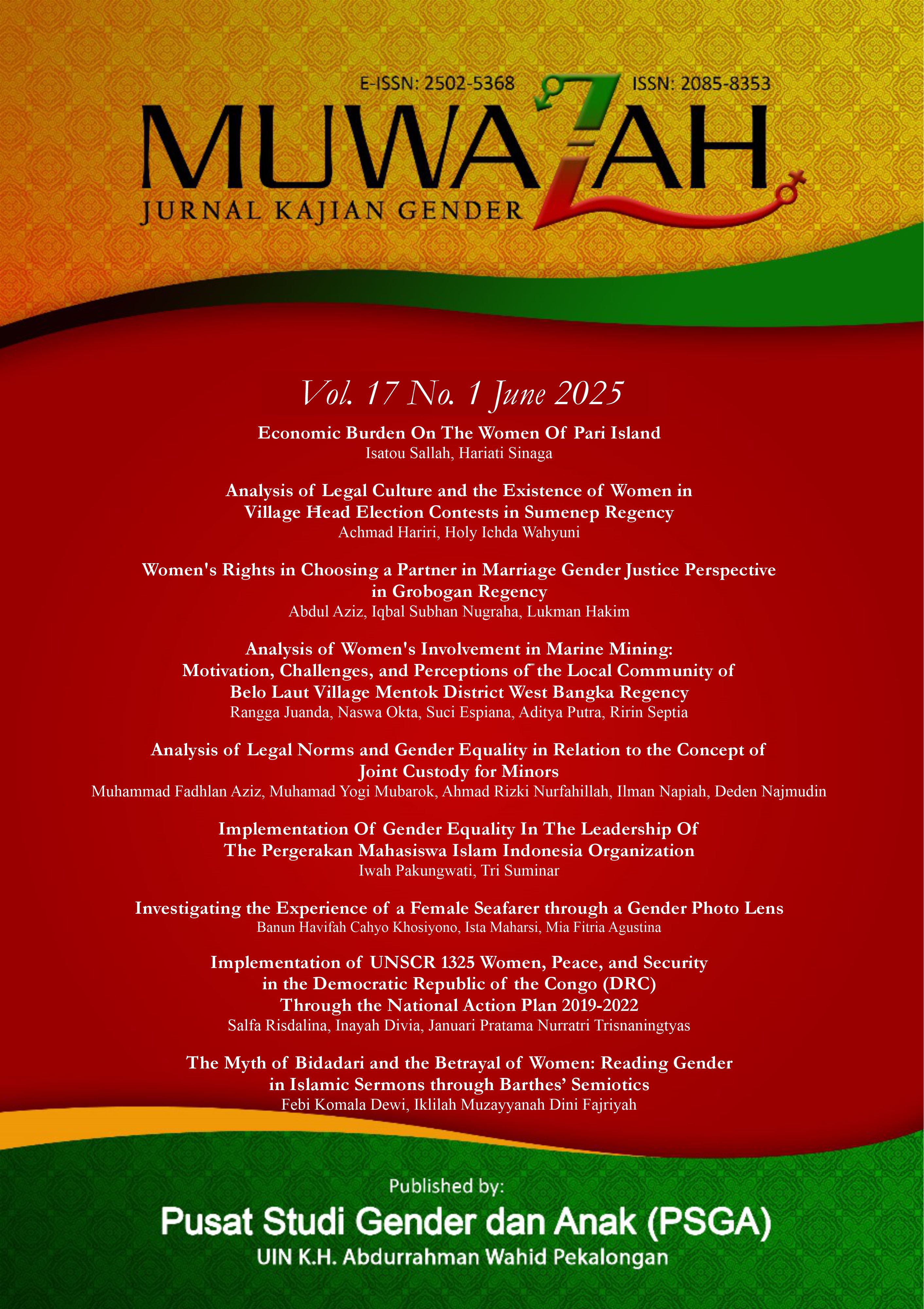
Analysis of Legal Norms and Gender Equality in Relation to the Concept of Joint Custody for Minors
DOI:
https://doi.org/10.28918/muwazah.v17i1.9200Abstract
The application of custody rights in Indonesia generally uses sole custody. As stipulated in the Compilation of Islamic Law in Articles 105 and 156, priority for custody rights is automatically given to the mother. This is considered a problematic issue from a gender equality perspective, as child custody is not always monopolized by one gender but should consider aspects of quality, integrity, morality, and ability to fulfill the best interests of the child. At the same time, several court rulings in Indonesia have now established joint custody rather than sole custody. The purpose of this study is to re-examine the concept of joint custody of minor children as an effort and legitimization of the best interests of the child based on an analysis of legal norms and gender equality. This research is qualitative and uses a descriptive analytical method from library data sources. The results of this research can be concluded that joint custody is the granting of custody or care of the child to both parents alternately after divorce until both are required to take joint responsibility for their child. Although the granting of joint custody appears to deviate from existing provisions, it is not based on the provisions of the KHI but rather on the principle of the best interests of the child and the judge's legal interpretation. Furthermore, within the paradigm of gender equality, the role of men in contemporary society is equal to that of women, including in the care of minor children. This concept could serve as an alternative solution in resolving child custody disputes in Indonesia, simplifying the often complex and problematic process of determining custody rights.
Keywords:
References
Ananda, T., & Rizkianti, W. (2024). Settlement of Child Custody Disputes after Divorce: A Comparison Between Indonesia and the United Kingdom. Juornal USM Law Review, 7(1).
Asmui Syarkowi. (2022). Child Custody Disputes and Gender Equality. Semarang Religious Court. https://badilag.mahkamahagung.go.id/artikel/publikasi/artikel/sengketa-hak-asuh-anak-dan-kesetaraan-gender-oleh-drs-h-asmu-i-m-h-6-10
Asnawi, M. N. (2019). Application of Shared Parenting Model in the Settlement of Child Custody Dispute. Al-Iqtishadiyah: Journal of Sharia Economics and Sharia Economic Law, 5(1).
Bangsa, M. U. P. (n.d.). Convection of Children's Rights. Retrieved November 13, 2024, from https://protc.id/wp-content/uploads/2021/05/KOVENAN-INTERNASIONAL-HAK-ANAK.pdf
Fanani, A. Z. (2017). Child Custody Disputes in Family Law from the Perspective of Gender Justice. Journal Muslim Heritage, 2(1).
Jauhari, M. A. (2021). Conception of Joint Parenting towards the Custody of Minors (Analysis of the Decision of the Gedong Tataan Religious Court No. 0334/PDT.G/2019/PA.GDT). UIN Syarif Hidayatullah Jakarta.
Khair, U. (2020). Implementation of Child Custody Rights after Divorce. Journal of Cendikia Hukum, 5(1).
Kline, M. H. (1998). Joint Cusbody and Shared Parenting. Child and Adolescent Psychiatric Clinics of North America, 7(2).
Maulana, M. I. R., & Safitri, M. I. (2024). Granting Joint Custody in the Settlement of Child Custody Disputes in Indonesia: A Maslahah Mursalah Perspective. Al-Raskh: Journal of Islamic Law, 13(1).
Meliani. (2022). Implementation of Joint Custody of Minors. Fastabiq: Journal of Islamic Studies, 3(1).
Meliani, & Jaya, I. B. (2022). Implementation of Joint Custody of Minors: An Analysis of Legal Norms. Fastabiq: Journal of Islamic Studies, 3(1).
Muhaimin. (2020). Legal Research Methods. Mataram Universty Press.
Mundir. (2013). Qualitative and Quantitative Research Methods. STAIN Jember Press.
Rahim, A. (2015). Gender in Islamic Perspective. Sosioreligius Journal, 1(1).
RI, P. P. (2002). Law of the Republic of Indonesia Number 23 Year 2002 on the Protection of Children (State Gazette of the Republic of Indonesia Year 2002 Number 109).
RI, P. P. (2014). Law Number 35 of 2014 concerning Child Protection (State Gazette of the Republic of Indonesia Year 2014 Number 297).
Rofiah, S. (2015). Building Family Relationship Patterns Based on Gender Equality and Justice. Muwazah: Journal of Gender Studies, 7(2).
Saputra, A., & Mulyana, M. T. (2022). Implementation of Child Custody Rights Based on Court Stipulations with Permanent Legal Force Based on Law Number 35 of 2014 concerning Child Protection. De Juncto Delicti: Journal Of Law, 2(1).
Saraswati, Boputra, & Kusniati. (2024). Fulfillment of Children's Rights in Indonesia Through Parenting Planning, Single Parenting and Joint Parenting. Veritas et Justitia Journal, 7(1).
Saraswati, R. (2021). Fulfillment of Children's Rights in Indonesia through Parenting Planning, Single Parenting and Shared Parenting. Veritas et Justitia Journal, 7(1).
Saraswati, R., Boputra, E., & et al. (2021). Fulfillment of Children's Rights in Indonesia through Planning, Parenting, Single Parenting and Shared Parenting. Veritas et Justitia Journal, 7(1).
Susanto, N. H. (2015). The Challenge of Realizing Gender Equality in a Patriarchal Culture. Muwazah: Journal of Gender Studies, 7(2).
Downloads
Published
License
Copyright (c) 2025 Muwazah

This work is licensed under a Creative Commons Attribution 4.0 International License.