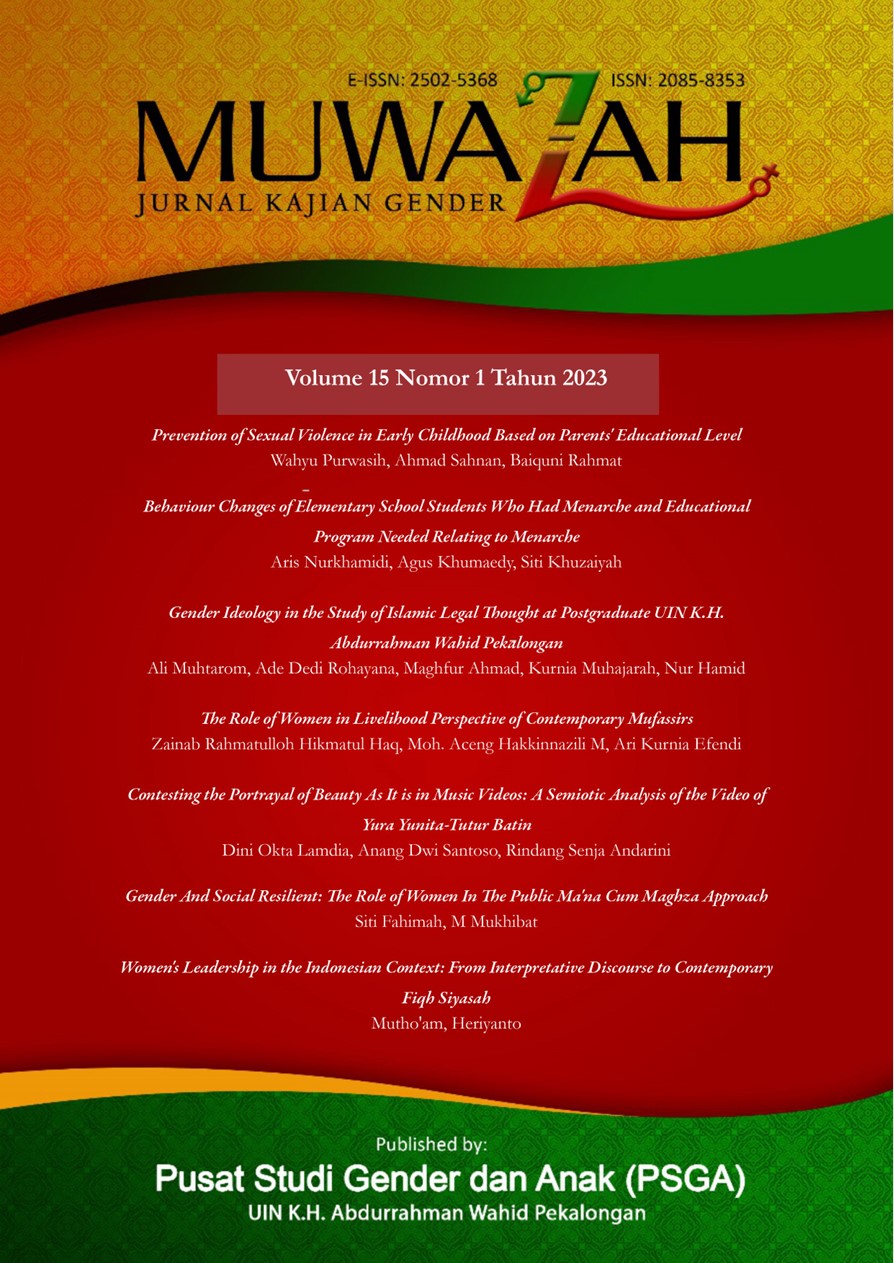
Women's Leadership in the Indonesian Context: From Interpretative Discourse to Contemporary Fiqh Siyasah
DOI:
https://doi.org/10.28918/muwazah.v15i1.8938Abstract
This article aims to explore women's leadership within the Indonesian context, focusing on contemporary discourse on interpretation and fiqh siyasah. This study seeks to understand how the dynamics of thought and the interpretation of religious texts in Indonesia relate to the position of women in the political sphere. The research employs a qualitative approach using text analysis and discourse analysis. Data is collected from various sources, including relevant literature, policy documents, and the experiences of female leaders involved in leadership roles. This methodology is designed to uncover diverse perspectives on women's leadership and how interpretations of tafsir and fiqh siyasah can be applied in a modern context. The findings of the research indicate that although traditional interpretations of Islamic texts often limit women's roles in leadership, contemporary movements and reinterpretations of fiqh siyasah are challenging these norms. The study identifies significant barriers to women's leadership, including socio-cultural attitudes and institutional biases. It concludes that changes in mindset and policy are crucial for fostering an inclusive political environment that recognizes and promotes women's leadership. Thus, the progressive reinterpretation of religious texts and the development of a more inclusive contemporary fiqh siyasah regarding women's leadership is essential to ensure that women's contributions to politics are grounded in a strong legal religious standing
Keywords:
References
Al-Qaradawi, Y. (2016). Fiqh Siyasah: Hukum Islam dalam Politik dan Pemerintahan. Jakarta: Pustaka Al-Kautsar.
Amalia, S., Suyanto, S., & Hendro, E P. (2019, December 4). Tiga Perempuan Pengusaha Batik: Kajian Peran Sosial Ekonomi Perempuan Pengusaha Batik di Kampung Batik Bubakan, Kelurahan Rejomulyo Semarang. Diponegoro University, 3(1), 44-44. https://doi.org/10.14710/endogami.3.1.44-52
Aminah, A. (2021, December 22). Islam dan Negosiasi Gender: Studi Pemikiran Ahmad Syafii Maarif Tentang Hak Perempuan. , 16(2), 294-305. https://doi.org/10.47651/mrf.v16i2.150
Ananda, S A W., Zayyan, W A., & Arifin, I. (2021, November 16). PANDANGAN ISLAM TENTANG WANITA KARIR DAN IBU RUMAH TANGGA DALAM BINGKAI KELUARGA DAN MASYARAKAT. Muhammadiyah University Press, 22(2), 347-356. https://doi.org/10.23917/profetika.v22i2.16700
Anwar, N F. (2023, June 1). Kriteria Pemimpin dalam Al-Qur'an (Analisis Tafsir as Sya’rawi dalam Surah as Saff ayat 2-3 dan Surah Al Baqarah ayat 124 dalam Kitab Tafsir as Sya’rawi). , 3(3), 554-563. https://doi.org/10.58578/anwarul.v3i3.1181
Arfa, F A., & Firmansyah, H. (2020, July 30). Gender Relation Concept: Perspective of Al-Qur’an. Institut Agama Islam Negeri Kendari, 20(01), 11-30. https://doi.org/10.32939/islamika.v20i01.503
Asmarani, R. (2017, July 19). PEREMPUAN DALAM PERSPEKTIF KEBUDAYAAN. , 12(1), 7-7. https://doi.org/10.14710/sabda.v12i1.15249
Asrida, W., Wazni, W., & Dewi, C P. (2013, October 23). Gerakan Politik Perempuan Partai Golkar Kota Pekanbaru Periode 2004 – 2009 Dalam Memperjuangkan Kepentingan Perempuan. , 11(1), 28-28. https://doi.org/10.35967/jipn.v11i1.1611
Boro, V I A., & Kale, A E T. (2020, April 29). Keterwakilan Perempuan di Ranah Lokal: Studi Kasus di Kecamatan Boawae, Nusa Tenggara Timur dalam Pemilu Legislatif 2014. , 11(1), 115-130. https://doi.org/10.14710/politika.11.1.2020.115-130
Botifar, M., & Friantary, H. (2021, January 31). Refleksi Ketidakadilan Gender dalam Novel Perempuan Berkalung Sorban: Persfektif Gender dan Feminisme. , 3(1), 45-45. https://doi.org/10.29300/disastra.v3i1.3559
Cikka, H. (2020, January 14). KESETARAAN HAK DALAM PENDIDIKAN (STUDI PADA SEJARAH PERJUANGAN RAHMAH ELYUNUSIYAH DALAM MEMPERJUANGKAN HAK-HAK WANITA DALAM PENDIDIKAN). , 11(2), 222-252. https://doi.org/10.24239/msw.v11i2.474
Faris, N A., & Abbott, N. (1943, July 1). Aishah: The Beloved of Mohammed. Oxford University Press, 48(4), 761-761. https://doi.org/10.2307/1840498
Fuady, A., & Dewi, K H. (2019, January 1). How Did Women Workers Get Benefit From Revolution 4.0?. https://doi.org/10.2991/icdesa-19.2019.24
Gusmian, I. (2015, December 29). TAFSIR AL-QUR’AN DI INDONESIA: SEJARAH DAN DINAMIKA. , 1(1). https://doi.org/10.32495/nun.v1i1.8
Hadiz, L. (1993, March 1). IDEOLOGI GENDER DI BALIK DEFINISI LEGAL-FORMAL: Analisis Sosioiogis Terhadap Definisi Perkosaan di Dalam Hukum. Badan Penerbit FHUI, 23(1), 43-43. https://doi.org/10.21143/jhp.vol23.no1.643
Hamid, R A. (2022, January 14). Pemaknaan Kembali Konsep Wanita di Era Modern (Studi Atas Gagasan Kaum Feminisme dan Fundamentalis). Universitas Pahlawan Tuanku Tambusai, 4(1), 1157-1169. https://doi.org/10.31004/edukatif.v4i1.2072
Hariyanti, H., Darmawan, C., & Masyitoh, I S. (2018, May 31). Peran partai politik dalam meningkatkan partisipasi politik kader perempuan melalui pendidikan politik. State University of Yogyakarta, 15(1), 74-85. https://doi.org/10.21831/jc.v15i1.17659
Hasanah, S A., & Husnan, L H. (2022, December 19). KESETARAAN DAN KESERASIAN GENDER DALAM AL-QURAN. , 23(2), 195-223. https://doi.org/10.19109/jia.v23i2.15074
Hasanah, U. (2010, December 3). PEREMPUAN DAN HAK ASASI MANUSIA DALAM PERSPEKTIF HUKUM ISLAM. Badan Penerbit FHUI, 40(4), 440-440. https://doi.org/10.21143/jhp.vol40.no4.235
Hasyim, F., & Makruf, S A. (2022, January 31). PEMBERDAYAAN PEREMPUAN MELALUI GERAKAN LITERASI DI ERA DIGITAL. , 2(1), 46-52. https://doi.org/10.51771/jukeshum.v2i1.175
Heriyanti, L., Nailis, S., & Andreyanto, N. (2020, December 28). Membaca Perempuan Di Titik Nol: Perspektif Feminisme Eksistensialis. , 1(2), 31-39. https://doi.org/10.22146/jwk.1027
Idrus, N I. (2014, August 6). Antropologi Feminis: Etnografi, Relasi Gender dan Relativisme Budaya di Indonesia. , 30(3). https://doi.org/10.7454/ai.v30i3.3568
Kasdi, A. (2019, December 26). Reconstruction of Fiqh Nusantara: Developing the Ijtihad Methodology in Formulating Fiqh from Indonesian Perspective. P3M STAIN Kudus, 7(2), 239-239. https://doi.org/10.21043/qijis.v7i2.4797
Kasim, S S., Moita, S., Bahtiar, B., Wang, L., & Masrul, M. (2022, April 22). POTRET KETERWAKILAN POLITIK PEREMPUAN DIPARLEMEN DAN FAKTOR-FAKTOR PENGHAMBATNYA. , 7(2), 78-78. https://doi.org/10.52423/jns.v7i2.24539
Kistanto, N H. (2008, October 1). SISTEM SOSIAL-BUDAYA DI INDONESIA. , 3(2). https://doi.org/10.14710/sabda.v3i2.13221
Larassati, M A. (2020, July 10). PENDEKATAN INKLUSIF DALAM PENDIDIKAN AGAMA ISLAM. , 2(1), 64-67. https://doi.org/10.36761/kagangakomunika.v2i1.628
Lestari, L., Fathani, A T., & Damin, Z A. (2023, June 18). Preparation for Indonesian Election 2024: Women's Participation in Political Contest. , 8(2). https://doi.org/10.31506/jog.v8i2.19045
Miftahuddin, M. (2023, February 12). PERAN MASYARAKAT DALAM PENEGAKAN KEADILAN RESTORATIF DI INDONESIA: PERSPEKTIF SOSIOLOGI HUKUM (The Role of Society in Upholding Restorative Justice in Indonesia: Perspectives of Legal Sociology). , 8(1). https://doi.org/10.56783/jwu.v8i1.7
Muhtadi, A. (2021). Kepemimpinan Perempuan dalam Perspektif Fiqh Siyasah. Jurnal Ilmu Sosial dan Humaniora, 12(2), 85-100.
Mussaif, M M. (2017, May 30). Kesetaraan Gender dalam Sastra Pesantren (Kajian terhadap Kitab Syi’ir Laki Rabi). , 12(2), 80-80. https://doi.org/10.14710/nusa.12.2.80-89
Muthahhari, M. (2018). Tafsir Inklusif: Perempuan dalam Perspektif Islam. Yogyakarta: LKiS.
Natalis, A. (2020, May 26). REFORMASI HUKUM DALAM RANGKA MEWUJUDKAN KEADILAN BAGI PEREMPUAN: TELAAH FEMINIST JURISPRUDENCE. , 2(1), 11-23. https://doi.org/10.14710/crepido.2.1.11-23
Nur, M. (2021, October 15). Justice in Islamic Criminal Law: Study of the Concept and Meaning of Justice in The Law of Qiṣāṣ. , 55(2), 335-335. https://doi.org/10.14421/ajish.v55i2.1011
Nurbaena, W O W. (2016, March 1). Partisipasi Politik Perempuan Kota Baubau Dalam Pemilu Legislatif 2014 (Studi Di Kecamatan Murhum Kota Baubau). , 1(1), 26-34. https://doi.org/10.35326/kybernan.v1i1.162
Nurdin, N. (2022, March 30). Implementing Gender Mainstreaming in Indonesian Local Government: The Case of Tangerang Regency. Brawijaya University, 8(1), 31-56. https://doi.org/10.21776/ub.transformative.2022.008.01.2
Nurmila, N. (2021, June 11). The Spread of Muslim Feminist Ideas in Indonesia: Before and After the Digital Era. Sunan Kalijaga Islamic University, 59(1), 97-126. https://doi.org/10.14421/ajis.2021.591.97-126
Nursangadah, A., Kozain, M Y N., & Afrizal, D. (2021, December 16). kepemimpinan pendidikan islam dalam perspektif gender. , 8(2), 6-13. https://doi.org/10.36987/jes.v8i2.2234
Pinilih, S A G. (2020, May 10). Gender Specificity in Democratic Elections: International Implementability as an Exemplary for Indonesian Political Landscape. Richtmann Publishing, 9(3), 194-194. https://doi.org/10.36941/ajis-2020-0055
Purnomo, M H. (2018, December 1). Persepsi Seks Dua Wanita Beda Budaya: Perbandingan dalam “Pengakuan Pariyem” dan “Malam Yang Keramat”. Diponegoro University, 2(1), 102-102. https://doi.org/10.14710/endogami.2.1.102-110
Rahim, N A B., & Ibrahim, J. (2018, July 1). Maqasid al-Shari'ah as Ethical Theory for Consultants. https://doi.org/10.1109/ict4m.2018.00025
Rahman, H S., & Mas’ud, F. (2022, March 29). PENGARUH KEPEMIMPINAN ISLAM, BUDAYA ORGANISASI ISLAM TERHADAP KINERJA PERAWAT DENGAN MOTIVASI KERJA ISLAM SEBAGAI VARIABEL INTERVENING (STUDI PADA RUMAH SAKIT ISLAM MUHAMMADIYAH KABUPATEN KENDAL). , 8(1), 976-976. https://doi.org/10.29040/jiei.v8i1.4723
Rahmawati, L. (2020). Pendidikan dan Pemahaman Tafsir untuk Pemberdayaan Perempuan. Jurnal Pendidikan Islam, 8(2), 95-110.
Rahmawati, R. (2020). Perempuan dan Tafsir Progresif: Mendorong Partisipasi dalam Kepemimpinan. Jurnal Studi Gender, 10(1), 22-35.
Ratnasari, D. (2019, January 16). GENDER DALAM PERSPEKTIF ALQUR’AN. Univerisitas Negeri Yogyakarta, 18(1), 1-15. https://doi.org/10.21831/hum.v18i1.23125
Riyadi, A., Saerozi, S., & Savitri, F M. (2021, June 24). Women and the Da'wah Movement: Historical Analysis of the Khadijah RA’s Role in the Time of Rasulullah Saw. Sunan Gunung Djati State Islamic University Bandung, 15(1), 43-62. https://doi.org/10.15575/idajhs.v15i1.9346
Robikah, S. (2019, June 30). Pergeseran Paradigma Tafsir Al-Quran: Analisis Terhadap Tafsir Feminis di Indonesia. Universitas Islam Negeri Raden Intan Lampung, 19(1), 105-
Siahaan, F M M. (2009, July 1). Intrapersonal, Interpersonal, and Cultural Factors Supporting Leadership Effectiveness of Women Entrepreneurs fr. University of Indonesia, 13(1), 19-19. https://doi.org/10.7454/mssh.v13i1.200
Sile, A C M., Suwena, I W., & Arjani, N L. (2020, May 28). Relasi Gender dalam Sistem Kekerabatan Matrilineal. Udayana University, 24(2), 177-177. https://doi.org/10.24843/jh.2020.v24.i02.p09
Siregar, A S. (2018, December 31). Para-fiqh: Bridging Thematic Fiqh to Ushūl and Ushūl’s Response to Specialization of Fiqh. STAIN Sultan Sulaiman, 89-118. https://doi.org/10.21093/mj.v17i2.1192
Sitanggang, M N. (2020, August 30). Peran Perempuan dalam Keluarga Petani Pegunungan Tengger. , 3(1), 1-1. https://doi.org/10.24198/umbara.v3i1.25576
Sodik, M. (2012, July 29). KESETARAAN GENDER SEBAGAI PEMENUHAN KONSTITUSI. Pusat Layanan Difabel, 11(2), 167-167. https://doi.org/10.14421/musawa.2012.112.167-180
Susiatiningsih, H., Setiyono, B., Puspapertiwi, S., Saputra, J., & Afrizal, T. (2021, April 15). A Study of Good Governance Innovation of Javanese Leadership in Indonesia. , 17, 342-350. https://doi.org/10.37394/232015.2021.17.34
Suyanto, S. (2019, August 5). Sosok Perempuan dalam Pandangan Bung Karno pada Memoar Sarinah: Sebuah Analisis Wacana Kritis Feminis. , 14(3), 283-283. https://doi.org/10.14710/nusa.14.3.283-292
Wahyudi, V. (2019, April 10). Peran Politik Perempuan dalam Persfektif Gender. , 1(1), 63-83. https://doi.org/10.20414/politea.v1i1.813
White, S., Warburton, E., Pramashavira., Hendrawan, A., & Aspinall, E. (2023, December 22). Voting against Women: Political Patriarchy, Islam, and Representation in Indonesia. Cambridge University Press, 1-31. https://doi.org/10.1017/s1743923x23000648
Winarto, W. (2017, May 1). Term-Term Keadilan dalam Perspektif Al-Qur`an. , 3(01), 1-14. https://doi.org/10.32699/syariati.v3i01.1138
Wulandari, L. (2022). Organisasi Perempuan dan Pemberdayaan dalam Kepemimpinan. Jurnal Pemberdayaan Masyarakat, 5(2), 75-89.
Yudhanti, R., Sulistiyono, A., & Isharyanto. (2018, January 1). Legal Politic of Gender Responsive Election System (A Concept). EDP Sciences, 54, 02010-02010. https://doi.org/10.1051/shsconf/20185402010
Zahro, F. (2018, August 1). PEREMPUAN DALAM TRADISI SPIRITUALITAS ISLAM LOKAL. , 6(01). https://doi.org/10.21274/kontem.2018.6.01.21-36
Downloads
Published
License
Copyright (c) 2023 Muwazah

This work is licensed under a Creative Commons Attribution 4.0 International License.