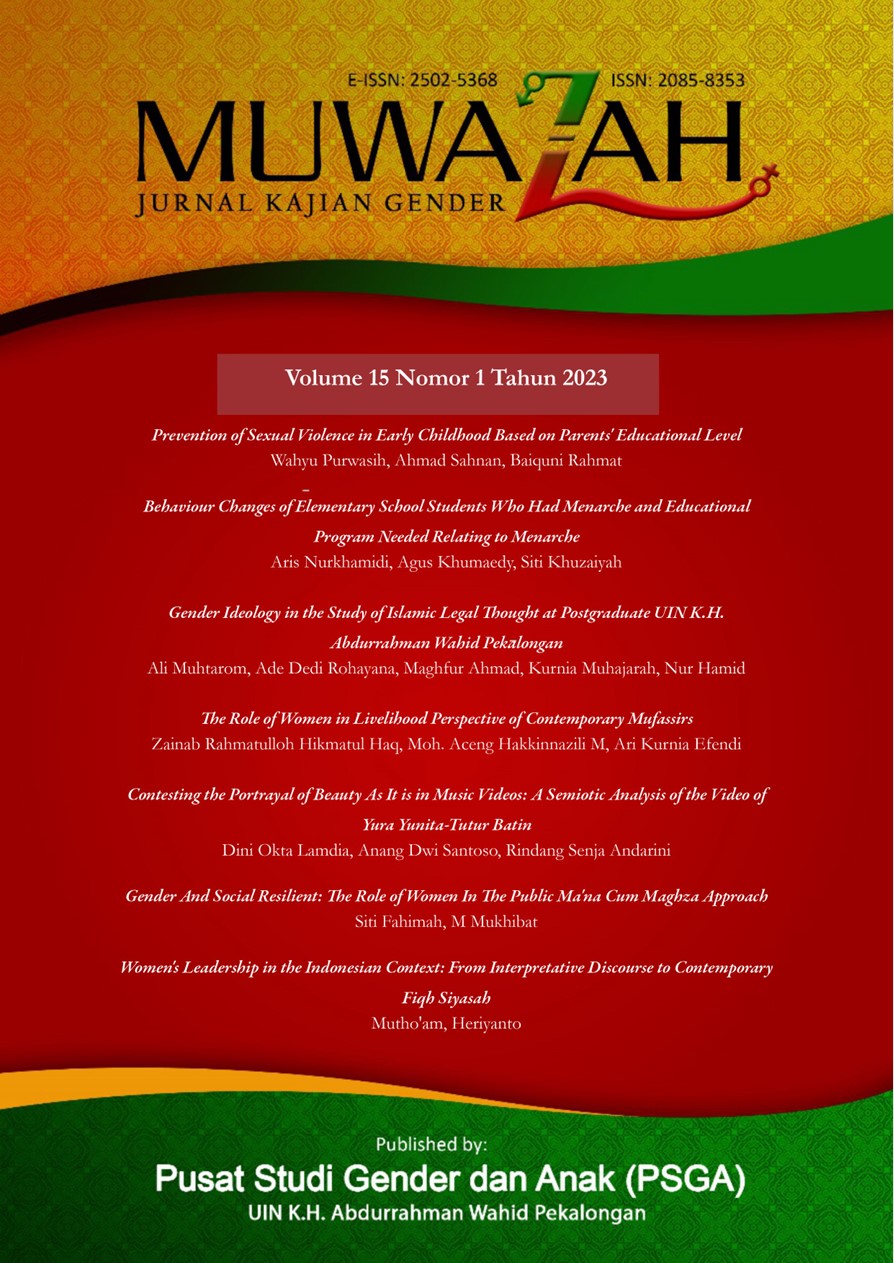
Gender And Social Resilient: The Role of Women In The Public Ma'na Cum Maghza Approach
DOI:
https://doi.org/10.28918/muwazah.v15i1.7256Abstract
This research explores the interpretation of Quran verses that mention women's role in the public sphere using a thematic approach. The study aims to synchronize these verses with resilient verses and their components, as women who dedicate themselves to the public and domestic domains require resilience. The method used is qualitative-descriptive, qualitative-descriptive namely the Analysis of the data obtained (in the form of words, images or behaviour), and not expressed in the form of numbers or statistical figures, but by providing an explanation or description of the situation or conditions studied in the form of a narrative description. It can be emphasized that descriptive qualitative is a research method that utilizes qualitative data and is described in descriptive terms. In this research, thematic interpretation is applied to identify verses related to the topic and classify them. The study reveals that the understanding of the role of women in the public sphere is from the perspective of cum Maghza, meaning that there is no division or role of patents between men and women's duties, and men and women can synergize to carry out their duties. Resilience is achieved by applying the components of resilience, including emotional regulation, desire control, optimism, causality analysis, empathy, self-efficacy, and positive achievement, along with three additional T's: Takhalli, Tahalli, and Tajalli.
Keywords:
References
Abdul Hameed, S. (2012). Al-Quran untuk Hidupmu. Zaman (Qomarudin Serambi Agama).
Adz-Dzakiey, & Hamdani, B. (2005). Prophetic Intelligence, Kecerdasan Kenabian: Menumbuhkan Potensi Hakiki Insani Melalui Pengembangan Kesehatan Ruhani. Islamika.
Andrew, A., Cattan, S., Costa Dias, M., Farquharson, C., Kraftman, L., Krutikova, S., Phimister, A., & Sevilla, A. (2022). The gendered division of paid and domestic work under lockdown. Fiscal Studies, 43(4), 325–340.
Azzahra, F. (2017). Pengaruh Resiliensi Terhadap Distress Psikologis Pada Mahasiswa. Jurnal Ilmiah Psikologi Terapan, 87(1,2), 149–200.
Baharun, H., & Mundiri, A. (2011). Metodologi Studi Islam: Percikan Pemikiran Tokoh Dalam Membumikan Agama. Ar-Ruzz Media.
Charlesworth, T. E., & Banaji, M. R. (2022). Patterns of implicit and explicit stereotypes III: Long-term change in gender stereotypes. Social Psychological and Personality Science, 13(1), 14–26.
Ernawati. (2013). Menyibak Perempuan Kepala Keluarga. MUWÂZÂH, Nomor 2, 5, 154–162.
Fauzi, A. (2016). Transformation Of Values In Developing Leadership Prophetic Islamic Education. In 2nd ICET Theme: Improving The Quality Of Education and Training Through (pp. 1196–1204). Strengthening Networking. Faculty of Education, State University of Malang.
Gustiana, L., Mudjiran, M., & Karneli, Y. (2018). Pergeseran Peran Wanita yang Sudah Menikah dan Implikasinya Dalam Layanan Bimbingan dan Konseling. Islamic Counseling: Jurnal Bimbingan Konseling Islam, 2(2), 153. https://doi.org/10.29240/jbk.v2i2.619
Herliawati, A. (2009). Pemberdayaan Ekonomi Perempuan dan Pengembangan Modal Sosial. Lontar. UI. http://lontar.ui.ac.id
Istibsyaroh. (2004). Hak-hak Perempuan: Relasi Jender Menurut Tafsir al-Sya‟rawi. Teraju.
Maulana, M. F., & Hafidzah, L. (2021). Nguplik: Women's Strategy Leaving the Domestic Sphere. MUWAZAH: Jurnal Kajian Gender, 13(1), 61–80.
Mujib, A. (2007). Kepribadian dalam Psikologi Islam. PT Raja Grafindo Persada.
Murniati Ruslan. (2010). Pemberdayaan Perempuan Dalam Dimensi Pembangunan Berbasis Gender. Musawa, 2(1).
Mustakim, Z. (2021). Gender Equity in Indonesian Higher Education: Exploring the Opportunities of Women's College Graduates as University Leaders. MUWAZAH J. Kaji. Gend, 13(1), 81–98.
Mutmainah. (2021). Metode Muhasabah: Analisis Pendekatan Psikologi Sufistik Perspektif Al –Ghazali (Konsep Pendidikan Ruhaniyah Melalui Tazkiyatun nafs) Mutmainah1. SYAIKHUNA : Jurnal Pendidikan Dan Pranata Islam, 12(1), 47.
Nurna. (2015). Ketidakadilan Gender Dalam Novel Geni Jora Karya Abidah El Khalieqy. Humanika, 3(15), 1–18.
Ratnasari, S., & Suleeman, J. (2017). Perbedaan Regulasi Emosi Perempuan dan Laki-Laki di Perguruan Tinggi. Jurnal Psikologi Sosial, 15(1). https://doi.org/10.7454/jps.2017.4
Reivick, K., & Shatte, A. (2002). The Resilience Factor: Essential skills for overcoming life's inevitable Obstacles. Broadway Books.
Rustika, I. M. (2016). Efikasi Diri: Tinjauan Teori Albert Bandura. Buletin Psikologi, 20(1–2), 18–25. https://doi.org/10.22146/bpsi.11945
Sahiron Syamsuddin. (2020). Pendekatan Ma‘Nā-Cum-Maghzā Atas Al-Qur’an Dan Hadis: Menjawab Problematika Sosial Keagamaan Di Era Kontemporer. In Lembaga Ladang Kata. Lembaga Ladang Kata.
Sari, Y. dan W. (2019). Nilai-Nilai Optimisme Dalam Isti’Adzah Dan Basmalah (Studi Tafsir Ar-Razi). Jurnal Ushuluddin, 18(1).
Sitepu, N. P. (2016). Family, Where the Life Begins And Love Never Ends. Deputi Bidang Perlindungan Anak Kementerian Pember.
Soekanto, S. (2005). Sosiologi Suatu Pengantar. Raja Grafindo Persada.
Wewenkang, D. B. P., & Moordiningsih, M. (2016). Studi Fenomenologi Konteks Budaya Jawa dan Pengaruh Islam: Situasi Psikologis Keluarga dalam Membangun Empati Pada Remaja. Indigenous: Jurnal Ilmiah Psikologi, 1(1), 1. https://doi.org/10.23917/indigenous.v1i1.3129
Downloads
Published
License
Copyright (c) 2023 MUWAZAH : jurnal kajian gender

This work is licensed under a Creative Commons Attribution 4.0 International License.